
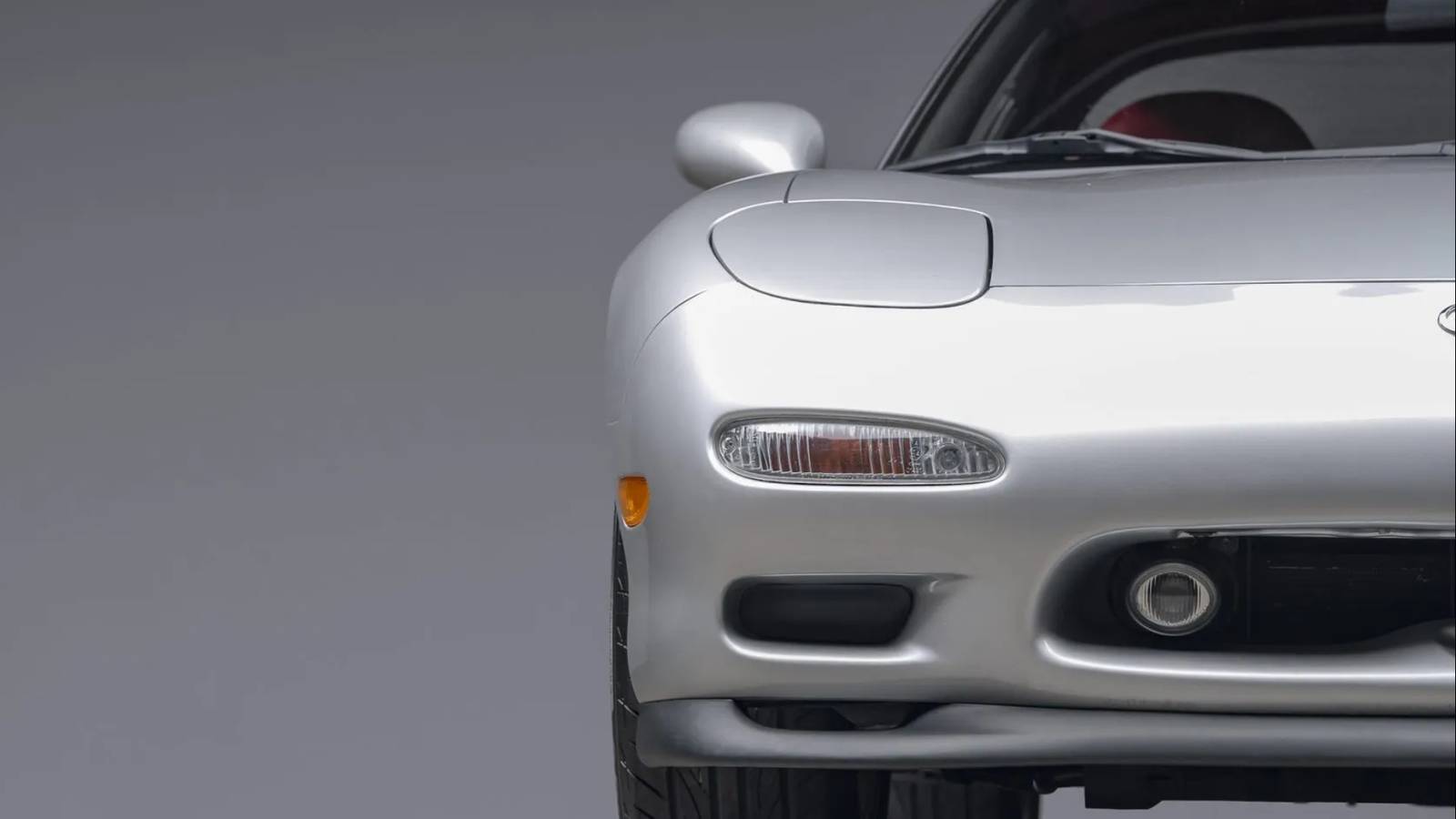
To stand out in a crowd, you have to do something out of the ordinary. Mazda has always been the odd one out among the world’s leading Japanese automakers. Toyota quietly became the largest automaker in the world, Honda wowed us with its engines, and Nissan was always in the mix with consistent sales. Mazda had to find its own angle because the Japanese company knew it could not find success following the same system as everyone else.
Mazda never looked to capitalize on having the most power, selling the most cars, or having the most prestige. Its angle was a bit more difficult to quantify. The Japanese company built its entire modern identity around the idea that the act of driving means something. This concept wasn’t a marketing ploy, but rather, an idea that came about organically from the brand’s engineering philosophy. One car embodied this ideology so completely that its legend has only grown in the thirty years since it disappeared from showrooms.
Japan’s Performance Landscape

By the late 1970s and early 1980s, the Japanese performance car scene began to take off. All the major Japanese automakers at this time were developing the foundations of what would soon become the golden era of JDM culture. Mazda was involved in this battle as well, but to be competitive they needed a smart strategy that emphasized its strengths while working with limited resources.
Bigger Is Better, Even In Japan

Although Japanese automakers may not have been producing big-block V-8 engines at large, the dominant performance philosophy at the time was still bigger is better. Turbocharged inline-six engines were becoming a serious competitive platform, and high-revving naturally aspirated engines were also gaining in popularity. Mazda was focused on neither of the two. Its goal instead was finding an engine architecture that could provide serious performance capability with a small physical footprint. This engine already existed, most automakers had simply given up on it.
The Platform That Scared Major Automakers

Back in the 1960s, automakers such as General Motors and Mercedes all held Wankel licenses with the plan for future production. However, considerations such as fuel economy, emissions regulations, and apex seal wear made the rotary engine seem like a major hurdle to overcome from an engineering perspective. Mazda also understood that challenge, but decided to take it head-on. The compact shape of the rotary engine proved that no comparable conventional piston engine could match its power-to-weight ratio or packaging efficiency. Mazda believed in the rotary or Wankel engine at a time when nobody else did. Some other major automakers understood its potential, but never made the conscious effort to reap its benefits. Mazda’s engineers viewed the aspects of the rotary engine that were considered liabilities as strengths.

The 10 Most Groundbreaking Turbo Systems Of The Past 20 Years
These are the key vehicles that ushered in the latest in turbocharged innovation.
The Engine That Shaped A Legend

By 1965, Mazda produced its first Wankel engine, the 1.0-liter two-rotor 10A. What followed was a decades-long commitment to an engine architecture that no other mass-market manufacturer would touch, and a sports car lineage built entirely around what that engine made possible.
Lightweight By Design

The rotary’s compact dimensions and low center of gravity weren’t just acceptable trade-offs — they were the foundation of an entire vehicle philosophy. The first application in a sports car context produced something weighing around 2,300 pounds with a naturally aspirated twin-rotor engine mounted low and behind the front axle. No comparable piston engine of that displacement could match its power-to-weight ratio or its packaging efficiency. Mazda wasn’t choosing the rotary to be different for its own sake. It was choosing it because, for a manufacturer without the resources to build a heavy, large-displacement sports car, a lightweight rotary-powered coupe was genuinely the right tool.
The second generation refined the concept further, adding turbocharging to address the Wankel’s well-documented torque limitations. The rotary’s potential was being unlocked incrementally, generation by generation.
Engineering Dedication Across Decades
The third evolution of the rotary engine would be the 1.3-liter twin-rotor 13B-REW—featuring the world’s first mass-production sequential twin-turbo system. At this point, the pattern was undeniable: each generation had not merely continued the rotary experiment but elevated it into something more capable, more refined, and more purposeful than before. This was not a car that had arrived by accident. It was the product of three decades of institutional commitment to a technology every other manufacturer had abandoned. This was the Mazda RX-7.

Used High-Value Sports Cars You Can Buy For The Average Price Of A New Luxury Vehicle
For $75,000 or less, these are the few high-value sports cars you can find.
The Mazda RX-7: Built For Emotional Connection

From the beginning, the RX-7 was one of Mazda’s most intriguing, yet mysterious products. It wasn’t just a performance car or a good-looking car that happened to be fast. It was built from the start to be a driver’s car first—built by drivers, for drivers. Spec sheets or performance figures could never tell the full story.
Driving Comes First

During the development of the third and final FD generation of the RX-7, chief engineer Takaharu “Koby” Kobayakawa was one of its most influential figures. Koby was not just another engineer. He was an artist who expressed his emotion through steel and fire. He described the FD’s goal as “emotional fulfillment.” That was not a concept you would normally hear coming from an engineering department, and it is that difference that made the FD special.
The 13B-REW twin-turbocharged two-rotor engine offered 255 hp, which was the lowest horsepower output of the JDM Holy Trinity by a long shot. Torque output was also surprisingly low at only 217 lb-ft, and, on paper, the FD looked like the slowest of the bunch. Yet, once one experienced an FD on a good back road, it was clear that the numbers didn’t do it justice. The FD’s lightweight philosophy made it feel alive in the corners where its rivals struggled to show the same precision and composure. Mazda’s own promotional material expressed that the FD was built to feel like “moving a muscle.” Indeed, with its double-wishbone suspension front and rear, four-piston front brakes, and a perfectly tuned chassis balance, the FD was a handcrafted instrument built exclusively for driving pleasure.
The Cost Of Actually Owning One

One of the saddest details about the FD was that it was only sold in the U.S. for three model years from 1993 to 1995. The total sales within this time frame were 13,879 units, and in the final year, only 500—yes, 500 examples were sold. Compared to the FB or FC RX-7, there is no real comparison. There were over 330,000 FB units and 161,000 FC copies sold during their production runs. That’s why, in today’s market, you can expect to pay over the original $32,500-$33,925 MSRP for a clean example.

The price floor for an unmolested example has only climbed higher with every passing year, and this number will continue to rise as supply diminishes further. An automatic variant also existed, but production numbers are less than 500 units total. Some specific color and trim configurations were only sold in single-digit numbers throughout the entire production run, meaning rarity comes with the territory. Ownership also needs to take into account the particular needs of a rotary engine. Before purchasing any rotary-powered vehicle, a compression test is non-negotiable. Apex seals will become your new best friend, and full engine rebuilds are something you should be prepared for.

What Nobody Tells You About Owning A Modern Turbocharged Engine
Turbochargers promise performance, but at what price? Uncover the trade-offs and challenges of owning a modern boosted engine.
More Than Just Nostalgia

Once certain cars reach a cult-like status among enthusiasts, it’s easy to dismiss them as nothing more than social media clout machines. The reality is that the market for analog driver’s cars has never had a bigger void than it does now, and the RX-7 fills that gap with a uniqueness that no modern car can even attempt to replicate.
A Formula Set In Stone

To most enthusiasts’ disbelief, Toyota brought the Supra back. Nissan also revived the GT-R nameplate for the R35 generation, which lasted 15 years and only ended recently. Honda even revived and modernized the NSX despite its lackluster reception. Mazda, however, never built a successor to the FD.

The closest thing to a successor was the polarizing Mazda RX-8, but that sports car never got a replacement either. Mazda has tried to keep its rotary heritage relevant in the current market, but it has only appeared as a range extender in the Mazda MX-30. This is a cool and interesting modern integration, but it loses all the emotional value that the rotary engine once held. The RX-7 clearly carved its niche, and it has maintained its integrity since. A RWD, rotary-powered, sub-3,000-pound sports coupe built for driving pleasure is a formula that no longer exists in the automotive industry. The resulting market gap has further fueled the RX-7’s appeal well beyond the point of sentimentality.
Why You Should Still Buy One

The FD RX-7 is now a 30-year-old sports car with more quirks than not and a shrinking pool of clean examples. If you think that this is one of those cars you can just casually own, you are looking at the wrong car. Anyone considering an FD must be aware of its unique requirements. Will this be your first rotary engine? Make sure you budget both the time and cost for a pre-purchase inspection with a reputable rotary expert within your area. The FD can be one of the most rewarding cars you could ever buy or one of the worst headaches you could ever imagine.

The aftermarket support for the platform remains strong despite its small owner group. If you want a car that you can go down an endless rabbit hole of tuning and modifying, the FD might be one of the best options you can pick. Just remember—owning an RX-7 isn’t a hobby—it’s a lifestyle. If you accept the cons just as much as you accept the pros, you can unlock a pure driving feeling that few enthusiasts will ever get to experience. Mazda built this sports coupe to prove a point, and thirty years later, its argument has only gotten more valid.
Sources: Mazda, Toyota, Honda, Nissan, General Motors, Mercedes-Benz