
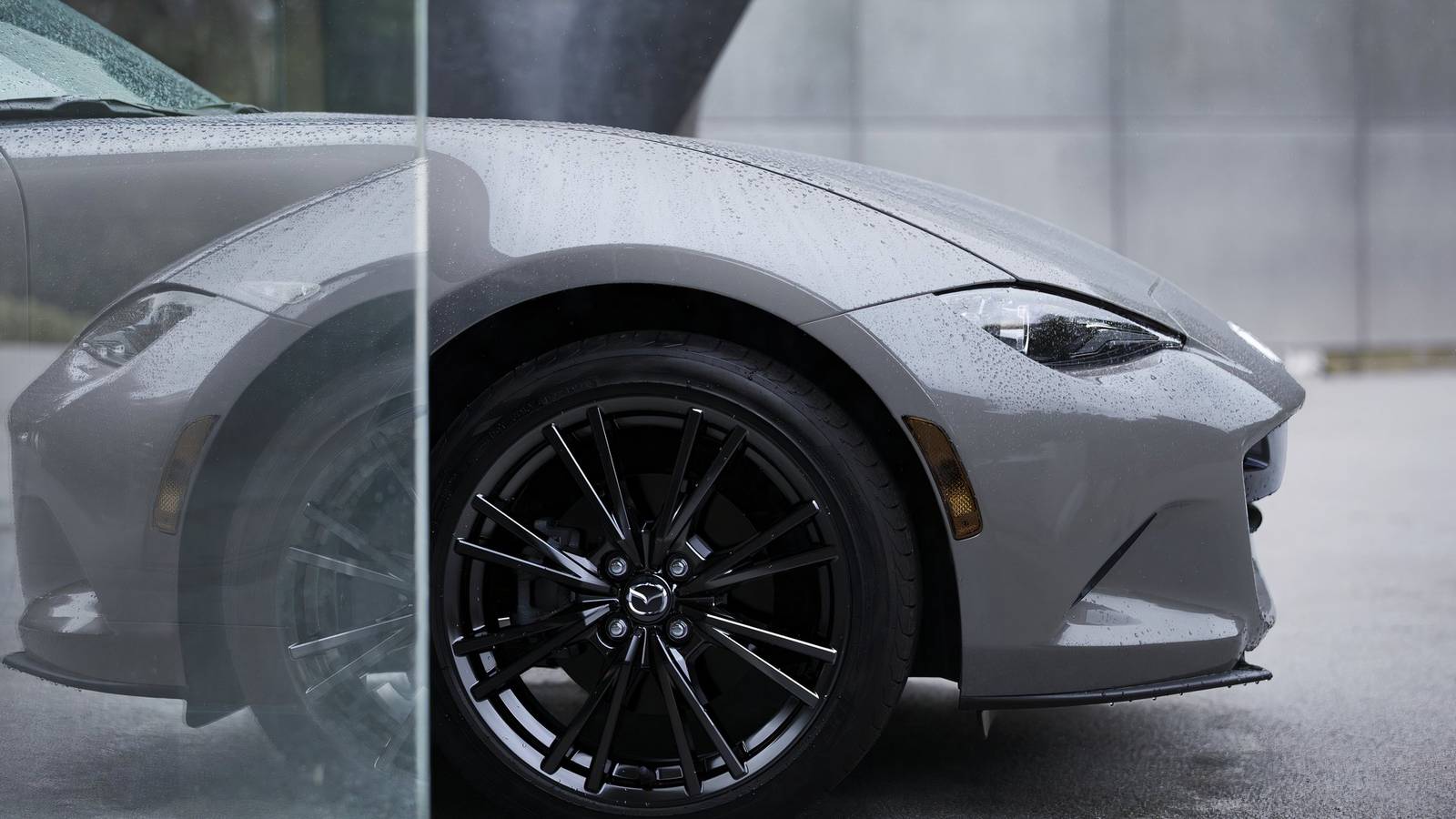
Japanese automakers are known to make reliable cars, and so you pretty much expect that the sports cars they create will also last a long time. Then again, though most Japanese sports cars are reliable, some are more durable than others. I mean, there aren’t a lot of people I know who are willing to own a rotary-powered Japanese sports car.
Today, however, you are left with three choices in the two-door sports car segment. Among these three cars, this is the model you should go for if you want a low-drama Japanese sports car built for the long haul. It’s also one of the most fun cars you’ll ever drive, regardless of price point.
The MX-5 Miata’s Simplicity

The 2026 Mazda MX-5 Miata is one of the most affordable sports cars you can buy today, but it also happens to be one of the simplest and easiest to own in terms of reliability and maintenance.
One Of The Most Reliable Cars

The Mazda MX-5 Miata has long been recognized for its sheer durability, and in 2026, that tradition pretty much carries over. iSeeCars rates the MX-5 Miata an impressive 7.8 out of 10, compared with the Toyota GR86/Scion FR-S/Subaru BRZ’s 7.3 rating. The Nissan Z and its twin-turbo V-6 are too new to be comprehensively evaluated by iSeeCars, which is why they still have no data for this vehicle yet. The MX-5 Miata is so reliable among sports cars that the publication estimates its average lifespan at 16.7 years or 115,270 miles. The probability of reaching 200,000 miles is also good at 3.7 percent.
Making The Most Of What Mazda Got

The Mazda MX-5 isn’t a very sophisticated machine, and that’s exactly why it is so reliable. The engine? It’s heavily based on the 2.0-liter Skyactiv-G four-cylinder that’s been used in countless other Mazdas, albeit tuned slightly for the Miata. As a result, spare parts are abundant, and with its manufacturing pretty much mastered more than 10 years later, the engine is less likely to experience recalls or defects.
2026 Mazda MX-5 Miata Specs
|
Engine |
2.0-liter four-cylinder |
|
Layout |
RWD |
|
Horsepower |
181 hp |
|
Torque |
151 lb-ft |
|
Transmission |
6-speed M/T 6-speed A/T |
|
0-60 mph |
N/A |
|
Top Speed |
N/A |
|
Base MSRP |
$30,430 |
In addition, the 2.0-liter four-cylinder is simple to maintain. It isn’t a complicated engine, and a lot of parts can easily be accessed. The engine bay leaves plenty of room for do-it-yourself (DIY) procedures if you prefer fixing or maintaining the vehicle yourself, while your mechanic wouldn’t be stressed out when trying to fix something in the MX-5. Compare that to a Subaru BRZ/Toyota GR86, for example, whose boxer engine is less friendly for beginners. Good luck changing the spark plugs in the BRZ or GR86, as the boxer engine fits snugly in the engine bay, leaving you with little room to move your hands around.

The Sports Car That Aged Better Than Its Rivals
This aging Japanese roadster still looks young and fresh.
What The MX-5 Miata Offers In 2026

The Mazda MX-5 Miata in its current fourth-generation ND form is already 10 years old, but while this sports car isn’t the most modern by today’s standards, there’s a reason why sales have remained stable.
Timeless Design

The ND MX-5 was first revealed in 2014, and in 2016, it was given the ‘World Car of the Year’ and ‘World Car Design of the Year’. That was also the first time for the ‘World Car Awards’ jury to hand out these two awards simultaneously to a single model. The award, I think, is well-deserved, because even to this day, the ND MX-5 still looks great. Incremental updates were implemented during its 2024 mid-cycle facelift, introducing new LED headlights and taillights, slightly reshaped front and rear bumpers, and new alloy wheels, depending on the variant.

Even the cabin receives incremental changes, such as a slightly redesigned gauge cluster, a new 8.8-inch Mazda Connect infotainment with wireless (on all but the base Sport) Apple CarPlay and Android Auto, and increased use of leather or suede materials across the interior. Also receiving incremental updates is its handling package, wherein the limited-slip differential (LSD) is now an Asymmetric LSD for improved stability and reduced understeer when cornering. Even the Kinematic Posture Control (KPC) system—an evolution of the G-Vectoring Control torque vectoring by braking—introduces incremental handling improvements that help the MX-5 maintain its position as one of the all-time best-handling sports cars.
A Thrilling Drive

But perhaps the main reason why people keep splurging on the MX-5 is just how great this car is to drive. I’ve had the pleasure of reviewing numerous MX-5s, from both automatic and manual versions, and I’m here to tell you that the MX-5 is one of the most fun you’ll have in a car at any price point. The handling is friendly, and that is by design so that the MX-5 isn’t a car that can only be enjoyed within legal speed limits. For instance, the MX-5 Miata deliberately has a degree of controlled body roll, mostly as a way for the vehicle to communicate its body movements to the driver.

Think of it as a horse’s body movements, which allow the rider to adjust how the horse is steered along a trail. This is similarly what the MX-5 Miata provides. Likewise, the steering is also communicative and responsive, and combined with the slick-shifting six-speed manual, the MX-5 Miata is a vehicle that is extremely tactile, which even many sports cars at higher price points couldn’t match. Perhaps its only major cons would be the copious amount of road noise that this small car understandably suffers from, along with the extremely limited practicality.

10 Japanese Sports Cars That Are Still Surprisingly Cheap In 2025
If you want cheaper horsepower and row-your-own gearboxes, Japan dominates—at sane costs, too.
The Future Of The MX-5

With the ND-generation MX-5 soon approaching its 11th year, a lot of fans and owners are wondering what the future of this lightweight sports car looks like. Well, over the past few years, Mazda‘s engineering team has given slight hints at what could be in store for the iconic roadster.
Mild Hybrid Electrification Is Possible

European publication Auto Rai managed to have an interview with the people involved in the “NE” Miata, confirming that a prototype already exists. For now, however, the final powertrain option is not yet settled, but Mazda Europe Design Director Jo Stenuit is confident that the next-generation NE MX-5 will have some form of “electric power assistance”. Yes, he is a fan of internal combustion engines (ICEs), but it’s almost guaranteed that some form of electrification will be introduced for the next-generation MX-5.

For those who don’t want an electric MX-5, there is a sigh of relief because Director of Technology Research and Technical Regulation Compliance Christian Schultze says that an electric version will pose a “serious engineering challenge,” noting that because batteries easily account for half a vehicle’s weight, it will fundamentally change the MX-5’s driving characteristics. Furthermore, the ICE is inherently part of the MX-5’s identity, so taking that away also reduces this car’s emotional appeal.
What About Past Skyactiv-Z Rumors?

Here at TopSpeed, we also caught the news that the next-generation MX-5 was supposed to have a larger 2.5-liter Skyactiv-Z engine. The supposed argument for going for a bigger displacement was to compensate for the reduced power by using the Lambda One combustion method. By making the engine bigger whilst still achieving Lambda One, the next-generation MX-5 will remain emissions compliant in the years to come. However, Schultze cautioned about the idea because the 2.5-liter engine is heavier and thus affects the steering and balance of the MX-5. Nevertheless, because it seems that nothing has been set in stone for the MX-5 yet, the current ND generation is here to stay for a few more years. Schultze says:
Right now, we’re mainly focused on the current MX-5 and how we can best preserve and further develop it. Development of a new generation isn’t finished yet, but it doesn’t need to be. There’s no need to be completely ready at this point. What’s important is that we’re prepared when regulations or market conditions require it. So, we’re working ahead, but without making hasty decisions.
Sources: Mazda, iSeeCars, Auto Rai