
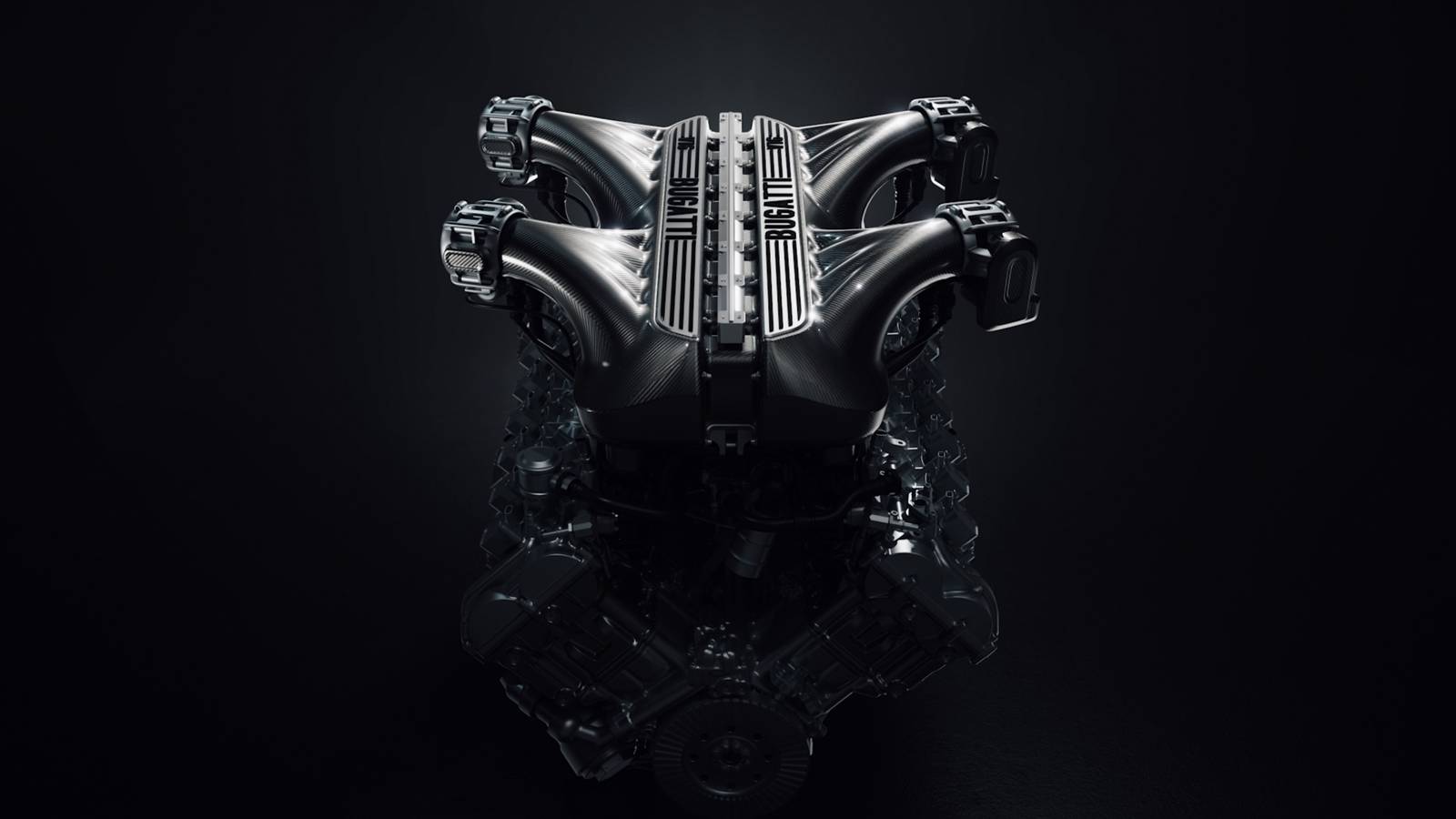
Bugatti has long been synonymous with excess, the kind of engineering brilliance that ignores practical constraints in favor of absolute mechanical dominance. But even by Bugatti standards, the new 8.3-liter naturally aspirated V16 that powers the Bugatti Tourbillon is a landmark achievement. It represents the most ambitious internal combustion engine ever fitted to a European supercar, both in scale and sophistication. Where others have downsized, turbocharged, or gone fully electric, Bugatti has doubled down on displacement, but in a uniquely forward-looking way. The Tourbillon’s V16 doesn’t just chase nostalgia; it sets a new technical precedent, merging old-school engineering with modern hybrid technology to create something truly epochal.
This engine is more than just an engineering curiosity; it’s a statement. Bugatti’s decision to craft a completely new powerplant in an era dominated by electrification speaks volumes about the company’s philosophy under its new Rimac partnership. It’s a defiant celebration of combustion’s enduring appeal, yet it doesn’t shy away from the hybrid future. Instead, it blends both worlds into a singular, seamless vision of performance. The 8.3-liter V16 isn’t merely an engine; it’s an engineering manifesto that redefines what a European supercar can be in the 21st century.

How Bugatti’s New V16 Redefines the Meaning Of Power

|
Engine |
Horsepower |
0-60 MPH |
Top Speed |
|---|---|---|---|
|
8.3-Liter V16 Tri-Motor Hybrid |
1,800+ |
2.0 Seconds |
236–276 MPH |
Bugatti Tourbillon Performance Specs
For decades, “power” in the European supercar world was defined by output figures; the Bugatti Veyron’s 1,001 horsepower shattered expectations, and the Chiron pushed that boundary even further. But with the Tourbillon’s V16, power takes on an entirely new meaning. Instead of relying solely on forced induction, Bugatti has embraced a high-revving, naturally aspirated approach paired with electrification. The result is a combined system output exceeding 1,800 horsepower, where the V16 alone contributes over 1,000 horsepower, and three electric motors fill in the torque gaps to deliver an instantaneous, unrelenting surge of power.
The true genius of the Tourbillon’s powertrain lies in how it delivers that immense energy. Unlike turbocharged systems that deliver their punch in sudden bursts, the V16 offers a progressive build-up of power, the kind of mechanical crescendo that evokes classic grand prix engines.

The electric motors complement this with immediate torque and silent assist, creating an unbroken wall of thrust across the rev range. It’s an entirely different kind of performance, one that combines the emotion of combustion with the precision of electrification. For Bugatti, “power” has evolved from a number on a spec sheet into a symphony of mechanical and electric harmony.
Marking The End Of The Mighty W16 Era

Before the Tourbillon’s V16, Bugatti’s legacy was defined by the mighty 8.0-liter quad-turbocharged W16, a power unit that rewrote automotive history. Introduced with the Veyron in 2005, the W16 was a marvel of packaging and engineering complexity, producing unprecedented power from a compact footprint. It propelled Bugatti into the stratosphere of automotive performance, setting top speed records and redefining what was physically possible for a road car. But as emission regulations tightened and technology evolved, the W16 began to show its age. The end of the Chiron era marked the end of turbocharged excess and the beginning of something more refined, more deliberate, and, paradoxically, more extreme.

The shift to the V16 symbolizes more than just an engine change; it represents the evolution of Bugatti’s philosophy. The W16 was the product of early-2000s engineering bravado; the V16 is a product of modern craftsmanship and environmental consciousness. The new engine, free from turbocharging, emphasizes purity and mechanical beauty. It’s lighter, more responsive, and paired with a cutting-edge hybrid system that ensures Bugatti can meet future emissions standards without compromising its brand DNA.

20 Years Old And Still One Of The Fastest Cars Ever
In 2005, the automotive world witnessed a seismic shift with the debut of the Bugatti Veyron 16.4.
Inside The 8.3-Liter Naturally Aspirated V16

The Tourbillon’s 8.3-liter V16 engine is a technical masterpiece, co-developed with legendary engine builder Cosworth. Stretching nearly a full meter in length, it’s a mechanical sculpture, a long, elegant configuration that instantly recalls racing engines of the 1960s but is built with 21st-century materials and tolerances. Unlike the W16, which was compact and turbocharged, the V16 is a purebred naturally aspirated design. It revs up to a spine-tingling 9,000 rpm, delivering a sound that’s utterly alien in the age of electric silence. With 90 degrees between cylinder banks and titanium internals, the engine weighs far less than its predecessor, despite offering more displacement and higher output.

Every element of the V16 is engineered for precision and drama. The intake and exhaust systems are tuned for both performance and acoustics, creating a sound signature that Bugatti describes as “mechanical music.” Each of the 16 cylinders contributes to a seamless, linear power curve, a rarity in today’s forced-induction world. Despite its monumental size, the engine’s balance and refinement are astonishing, a testament to Cosworth’s engineering prowess. And because it’s naturally aspirated, throttle response is immediate and organic. The result is an engine that feels alive, a rare tactile experience in an increasingly digital age.

Why The Tourbillon Marries Combustion With Electrification

Bugatti’s decision to pair its colossal V16 with hybrid technology might seem contradictory, but it’s exactly what makes the Tourbillon so special. Instead of replacing the engine’s visceral experience, the electric system enhances it. Three electric motors, one on the front axle and two at the rear, provide instant torque and torque vectoring, giving the Tourbillon all-wheel drive and hypercar agility. The electric components add around 800 horsepower, supplementing the combustion engine to create a powertrain that’s both brutal and efficient. The setup allows for limited electric-only driving, a nod to urban compliance, but the system’s real purpose is to amplify performance rather than dilute it.

This hybrid approach also represents a philosophical statement. Bugatti could have followed the industry trend toward full electrification, especially under the Rimac umbrella, but chose instead to preserve the soul of combustion. The hybrid system doesn’t mute the experience; it heightens it, bridging emotion and evolution. The instantaneous torque of the electric motors eliminates lag, while regenerative braking helps recover energy during deceleration. It’s a modern interpretation of the grand touring ethos: ultimate performance, delivered with refinement and responsibility. The Tourbillon’s hybridization is not a compromise; it’s the blueprint for how traditional performance can coexist with a sustainable future.
What The V16 Means For The Future Of European Supercars

Bugatti’s 8.3-liter V16 is more than an engineering achievement; it’s a cultural statement about the future of performance. As Ferrari, Lamborghini, and McLaren move toward smaller hybridized or fully electric powertrains, Bugatti has dared to go in the opposite direction, creating an even larger, more emotive internal combustion engine. This isn’t rebellion for rebellion’s sake; it’s a recognition that the supercar’s soul lies in its connection to the driver. The Tourbillon’s V16 preserves that connection while integrating the best of modern hybrid systems, effectively creating a bridge between eras.

The long-term significance of this engine will likely transcend Bugatti itself. By proving that a naturally aspirated V16 can coexist with cutting-edge hybrid systems, Bugatti has redefined what the term “sustainable performance” can mean. Other brands may follow suit, exploring ways to preserve the sensory engagement of combustion engines in a hybrid framework. As Europe edges closer to a zero-emission mandate, the Tourbillon stands as a reminder that innovation doesn’t always mean abandonment of tradition.
Sources: Bugatti, Climate Action, Reuters