
The average car has a lot more horsepower than it did even ten years ago. As a result, it’s gotten more difficult to distinguish which cars are true performance vehicles versus those that just look the part. Going fast in a straight line is relatively easy, but if you present a performance car with some high-speed decreasing-radius corners, you’ll see what it’s really made of. Those are the types of dynamic road conditions that BMW built its entire brand on.
So how exactly did a sports sedan from a Korean brand that is better known for its econoboxes manage to close the gap to established enthusiast brands like BMW? Most people were skeptical and still are today. We understand that this car never displayed its true intentions from its low-profile exterior, so it was easy to write it off as irrelevant. The reality is that this car had a strong track record from the start—most shoppers just never bothered reading it.
BMW’s Bread And Butter

One of life’s peak automotive experiences is enjoying a good back road behind the wheel of a BMW 3 Series. If you haven’t had this privilege before, we suggest changing that as soon as possible.
What Makes The BMW 3 Series Special

If you have had a go with a BMW 3-Series on a good mountain road, you would know why this sports sedan has been the dominant segment leader for decades. Even though the modern G and F generations are not nearly as communicative as their E predecessors, they are still much better than the next-best option. There is just something about near-perfect 50/50 weight distribution, rear-wheel drive, and strong, confident steering. The experience is rewarding in a tactile way that has often been lost in the modern era of desensitized sports cars. There is no question that BMW’s iconic inline-six engines have played a big part in keeping this appeal alive.
The BMW M340i Benchmark

Then there came the era of the BMW M340i with the now-iconic BMW B58 turbocharged inline-six. 383 horsepower in stock configuration, combined with a quick-shifting ZF eight-speed automatic, this powertrain quickly became known as the strongest option in the segment. Combine that with the popular Adaptive M Suspension, and you could experience “Comfort,” “Sport,” or anything in between at a moment’s notice. This strong overall capability made the BMW M340i the benchmark against which every other sports sedan on the market would be measured. It didn’t compromise on everyday livability for the sake of performance. It perfectly balanced both aspects through what could only be described as engineering genius. Yet, we cannot forget this genius isn’t random—BMW has been refining this exact formula for four decades and counting.

The BMW 3 Series Generations Ranked By Reliability
This is how each of the seven generations of the BMW 3 Series measures up in terms of reliability.
Korea And Germany Are Closer Than You Think

In 2014, Albert Biermann, one of the most important figures of BMW’s M division, left the German company after 31 years of service. During his time there, he oversaw the development of some of the greatest driver’s cars in history. The thing is that he didn’t retire after leaving BMW—he went to Hyundai.

Official Giveaway
🔥 Limited Time
Enter The Weekly Giveaway
Win Car Guy Gear
Sign up to our newsletter to enter. Follow on socials for more entries.
New giveaways every 2 weeks
No purchase necessary. Open to US residents 18+. Full giveaway details on the page.
The Hire That Changed Everything

Biermann’s influence on the direction change of Kia and Hyundai’s performance divisions cannot be overstated. He did not leave his long-term role at BMW to provide small consultations on side projects. He went there to build something new, entirely of his own doing. One of his primary creations was an RWD sports sedan built specifically to challenge the status quo of the company he had served so faithfully for decades.
Biermann’s engineering knowledge was invaluable, but his sports car philosophy, which was crafted at BMW M, was just as imperative. He emphasized that performance cars should be responsive and precise and that chassis feel is just as important as horsepower figures. If you have to break the law to make the driving experience enjoyable, there is something wrong with the car.
A Fresh Take On An Old Idea

Biermann’s arrival announced the start of a new era at Kia. His idea for a sports sedan shared next to nothing with any of its predecessors, other than being a RWD platform. This sports sedan would be built on the Genesis RWD platform and was designed for the ultimate performance experience. A limited-slip differential came standard on RWD GT models, and the steering was precisely tuned to be direct and provide ample feedback.
BMW had been accused of losing its touch with artificial steering weight, so Kia ensured their steering sensation would feel genuinely connected to avoid similar claims. The result was a BMW M–level car developed by a former BMW M engineer, wearing a badge few took seriously.

10 Best BMW M And Mercedes-AMG Cars From Recent Years, Ranked
BMW M models and Mercedes AMG models make up the best of the German brands, and these are the 10 best models from the last few years.
The Kia Stinger GT Is Korea’s Answer To BMW

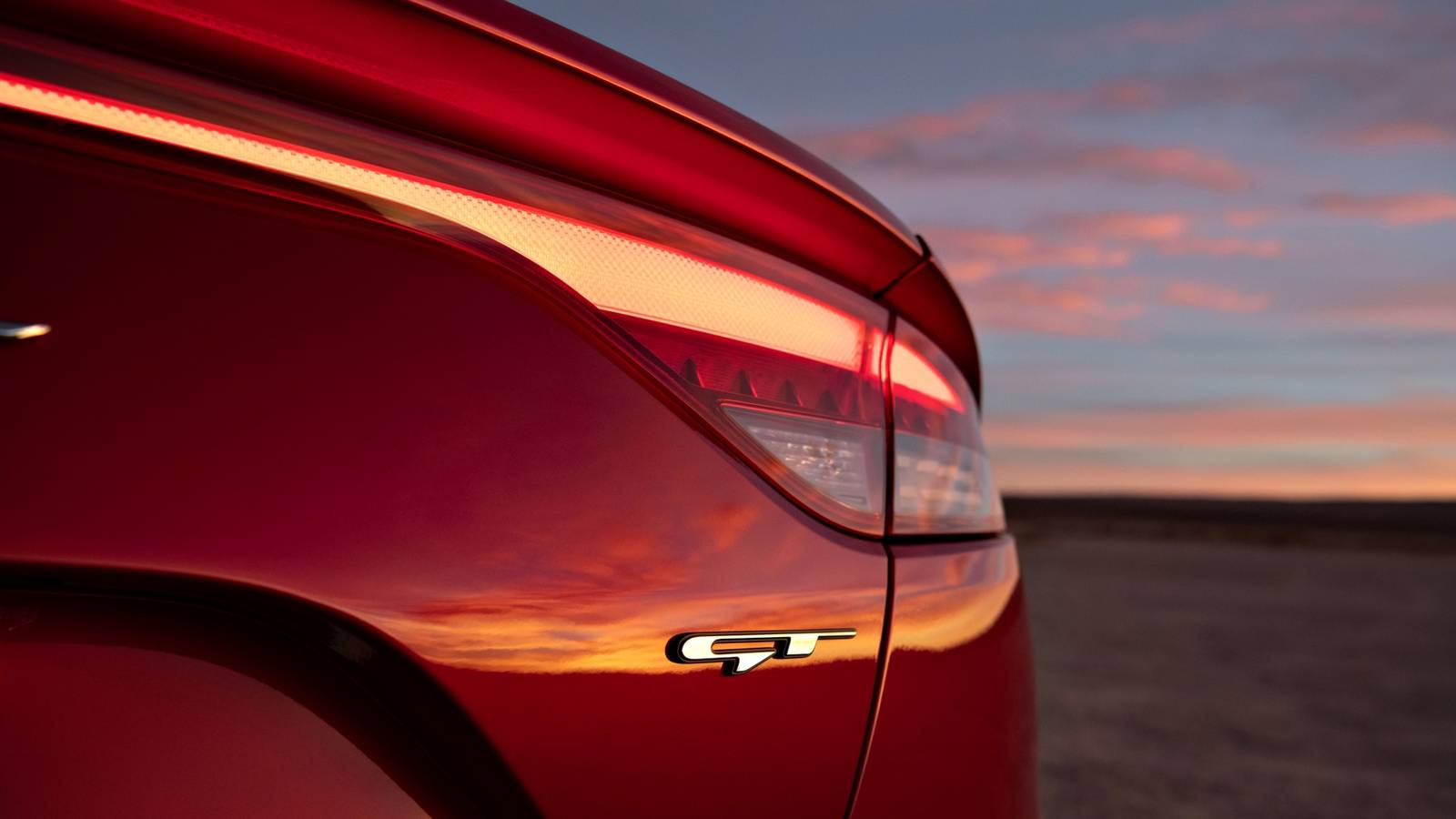
You may have already guessed that the answer is the Kia Stinger GT. Now that you know who designed it and why, the intention and performance of this sports sedan are less surprising and more expected.
Kia’s First RWD Sports Sedan
The Kia Stinger wasn’t just a new car for the Korean automaker. It was their first front-engine, RWD sports sedan ever. The Stinger is built on the Genesis RWD platform and offers standard performance features like a limited-slip differential. The LSD allows the RWD Kia to have the same type of playful rotation around corners you could find on a BMW M340i or BMW M3. Brave enough to turn off traction control? Give it a good flick into a corner and put your foot on the floor, and you’ll see how this Kia can maintain a perfect drift that could rival any German equivalent. Is it magic? No. It’s decades of RWD dynamics knowledge directly implemented into a single vehicle.
How The Stinger Defines Its Capabilities

If there is one detail you will notice right away if you are used to the feeling of a BMW 3 Series, it’s the steering. Just like the BMW M340i, the Kia Stinger utilizes electronic steering, but its directness and road feel are more communicative. On sharp turn-ins and during mid-corner micro-adjustments, this steering feel is genuinely rewarding—more rewarding than what is offered at BMW. Yet, once you understand the pure intention of driving excellence promoted by the design of the Kia Stinger, it all starts to make more sense.
The Kia Stinger GT’s 368-horsepower 3.3-liter twin-turbocharged V-6 is only 14 horsepower less than a BMW M340i and is a fraction of the cost. Kia builds its own transmissions in-house, which means that its proprietary unit is not quite as quick as the segment-leading ZF eight-speed automatic. However, it is far from incompetent. Torque delivery is immediate with maximum torque available from as low as 1,300 RPM. By the time a comparable naturally-aspirated engine is just warming up, the Kia Stinger GT is long gone.

Kia K5 GT Performance And Specs Breakdown
The 2026 Kia K5 GT is proof that affordable sedans don’t have to be boring. This is the full performance and specs guide for the 2026 Kia K5 GT.
The Kia Stinger Is An Absurdly Good Value Proposition

The performance of the Kia Stinger GT is already amazing in itself, but once you consider its price, you begin to realize how competitive it really is.
All The Fun For A Fraction Of The Price

The Kia Stinger GT had a production run from 2018 to the 2023 model year. In its penultimate model year, the top-level RWD GT2 trim topped at about $53,000 — almost $4,200 less than the base model BMW M340i. That’s a significant gap in itself, but once you realize the effect of depreciation, the results are even more shocking. The first model-year Kia Stinger GT depreciated 47 percent over the last three years, meaning that the Kelley Blue Book Fair Purchase Price now sits at only $18,850 for the GT1 trim. With a bit of patience, well-maintained examples with less than 50,000 miles exist on the used market in the sub-$20,000 range. A car with this level of engineering and capability, directly descended from BMW’s M division, costs less than what most people spend on a Toyota Camry. If that’s not a steal, we don’t know what is.
Badge Engineering Is Tricky

Throughout its six-year lifespan, the Kia Stinger was never a true sales success. Sales peaked during its first year with 16,806 copies sold. By 2023, the final model year, sales figures had dwindled to only 5,452 copies the entire year. In total, only 70,845 Kia Stinger models were sold. However, an interesting point is that over 80 percent of all Kia Stinger sales were the twin-turbo V-6-powered GT variants, demonstrating that owners’ primary reason for purchasing the car was performance.
Despite the short lifespan, the car’s abilities were never the issue. Sales struggled due to brand perception. This story of the Kia Stinger is a case study in how deeply impactful brand loyalty can really be. Now, that bias functions in favor of those who don’t believe the hype and are willing to try something different. These Korean RWD sports sedans are now available at a deep discount and offer just about everything you could want out of the BMW 3 Series experience. Most buyers never bother even looking into one. However, take one out for a test drive, and you will see how quickly your opinion could change.
Sources: Kia, Hyundai, BMW, Kelley Blue Book