
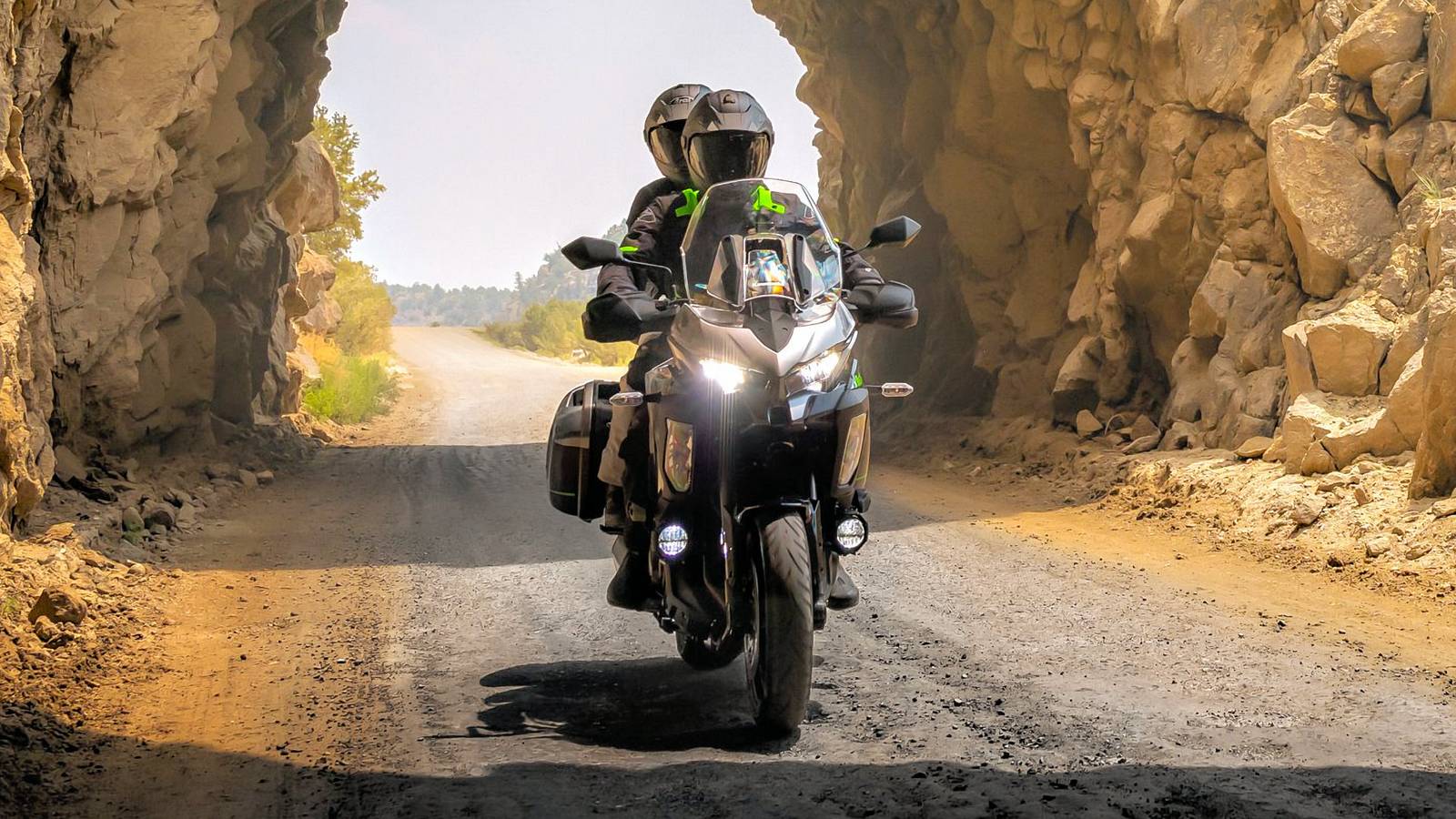
If you’re in the market for trust motorcycles, Kawasaki certainly comes to mind. It has a large assortment of capable bikes with proven durability across a variety of segments. You can find anything from a mini dirt bike or a full-blown track-spec supercharged beast that can do over 250 miles per hour. Add long-haul comfort to the mix, and you’ll have to narrow down things to a handful of touring bikes. Some are sporty, some have ADV credentials, and some are American alternatives. While all of these blend long-haul comfort and durability in a way, one does it better than others.
Kawasaki Has A Few Different Touring Bikes On Sale Today

Kawasaki touring bikes promise a good spread. We have the sport-tourers wearing the Ninja badge. These walk the fine line between tourers and sports bikes, and one of these even has the world’s only production supercharged motorcycle engine today. Then, there is the heavyweight V-twin Vulcan 1700 series. These were made to square up against American big boys (Harley Road Glides and Indian Challengers), but they haven’t had any updates in over a decade.
Somewhere between the two lies the crossover range with the Versys badge. In typical crossover fashion, they look like adventure bikes from afar, yet the focus is on tarmac touring first. There are two bikes under this moniker, and we feel one of them brings the best blend of long-haul comfort with proven durability in 2026.
The Versys 1100 LT SE Has Heaps Of Long-Haul Comfort And Proven Durability

Between the two Versys models, the Versys 1100 has more comfort and durability, according to us. The reasons are pretty simple. This is a recently refreshed motorcycle with a bigger engine for more stress-free riding at freeway speeds. At the same time, it doesn’t shy away from being larger than life in its proportions, which brings massive saddles for both occupants.
There is no shortage of modern-day amenities, either. After all, this is Kawasaki’s current flagship tourer worldwide. It helps that Kawasaki only sells the LT SE variant here. These letters not only bring 28-liter lockable and waterproof saddlebags to the party, but you also get electronic suspension to make your life way easier. This suspension works in tandem with the IMU, fine-tuning the settings in real-time according to real-world riding conditions.

All that premiumness comes at a cost, though. Kawasaki sells the Versys 1100 LT SE at $19,499, which is $750 more than its arch-rival (the Suzuki GSX-S1000GX+). You should also know that this is the MY25 price of the Versys, and we’re yet to get the 2026 model. So there’s a high chance the price will go up by a couple of hundred dollars. That will only widen the gap and hurt its value prospect more.
A 1,099cc Inline-Four Engine Serves As The Powerhouse

Coming to the bike, the Versys 1000 debuted in 2012. Since then, it had Kawasaki’s 1,043cc inline-four engine. After nearly 15 years, the mill has now been replaced by an updated 1,099cc powerhouse. The updates comprise a 3 mm longer stroke, a new piston shape with a higher compression ratio, a new intake funnel length, a new intake port shape, and a new cam profile. Together, these ensure an output of 133 horsepower and 82.5 pound-feet, kicking in at 9,000 RPM and 7,600 RPM, respectively.
The Gearing Is Different, Too

Aside from the mill, Kawasaki says the fifth and sixth gears are longer here to boost touring abilities. That should help with sitting all day long on the highway with less stress on the engine. Accordingly, the service intervals lie at every 7,600 miles (or once a year) with valve checks every alternate year. Oh, and when riding efficiently, the Versys 1100 will return an efficiency of 42 miles per gallon. Seems less, we know, but it’s better than what Suzuki claims for its GX.
Showa EERA Suspension Ensures A Plush Ride, Regardless Of The Terrain

This is where the Versys 1100 truly spoils you. While you enjoy the massive seats and upright riding triangle, the electronic suspension ensures no undulation becomes an issue. This is Showa’s Skyhook EERA (Electronically Equipped Ride Adjustment) technology, comprising 43 mm USD forks and a BFRC monoshock. These work in tandem with Kawasaki Electronically Controlled Suspension technology (KECS). Team Green’s system uses information from the IMU and ECU every 10 milliseconds, even taking into account the natural pitch during deceleration.
Four Base Settings With Manual Adjustment

The result is electronic rebound and compression adjustment on the fly, along with three different preload settings (rider only, rider with luggage, and rider with passenger and luggage). The latter can be further fine-tuned by 10 levels of adjustment. What’s also impressive is the presence of four base settings: Sport, Road, Rain, and Rider mode (Manual). As a result, you get automatic suspension tuning on the go for maximum confidence.
17-inch Wheels And Aluminum Chassis Up The Sportiness

Yes, the Versys looks like an ADV. But the focus is on tarmac riding, as we said before. The 17-inch wheels and 120/180-section tires make that very clear, as do the dual 310 mm front disc brakes and a single 260 mm rear disc with Nissin calipers. All three have Nissin calipers for company and feature dual-channel ABS as standard. All this while, an aluminum chassis serves as the centerpiece. It also helps limit the weight to 571 pounds wet (without saddlebags). Other key dimensions include:
- Seat height: 33.1 inches
- Tank capacity: 5.5 gallons
- Wheelbase: 59.8 inches
- Ground clearance: 5.9 inches
- Suspension travel: 5.9 inches
A Six-Axis IMU Enables A Thoroughly Modern Feature List
Being a premium tourer, it’s only fair you get top-drawer electronics and creature comforts. Two power modes, three modes of traction control, ABS, and a two-way quickshifter are all standard, thanks to a Bosch six-axis IMU setup. As for creature comforts, heated grips, cruise control, cornering lights (mounted on the fairing), and smartphone connectivity (to enable vehicle info, riding log, phone notifications, and turn-by-turn navigation) are present.

In the cockpit, there is a semi-digital instrument cluster. This blends the best of both worlds: an analog tachometer with a large rectangular TFT on its right. You can see a plethora of information with varying brightness levels and two display modes. Kawasaki says, “The first mode was designed with touring in mind; the easy-to-read, calm layout offers a substantial amount of information immediately. Whereas, the second mode was designed with sport riding in mind. Important information is prioritized and presented graphically for easy digestion”.