
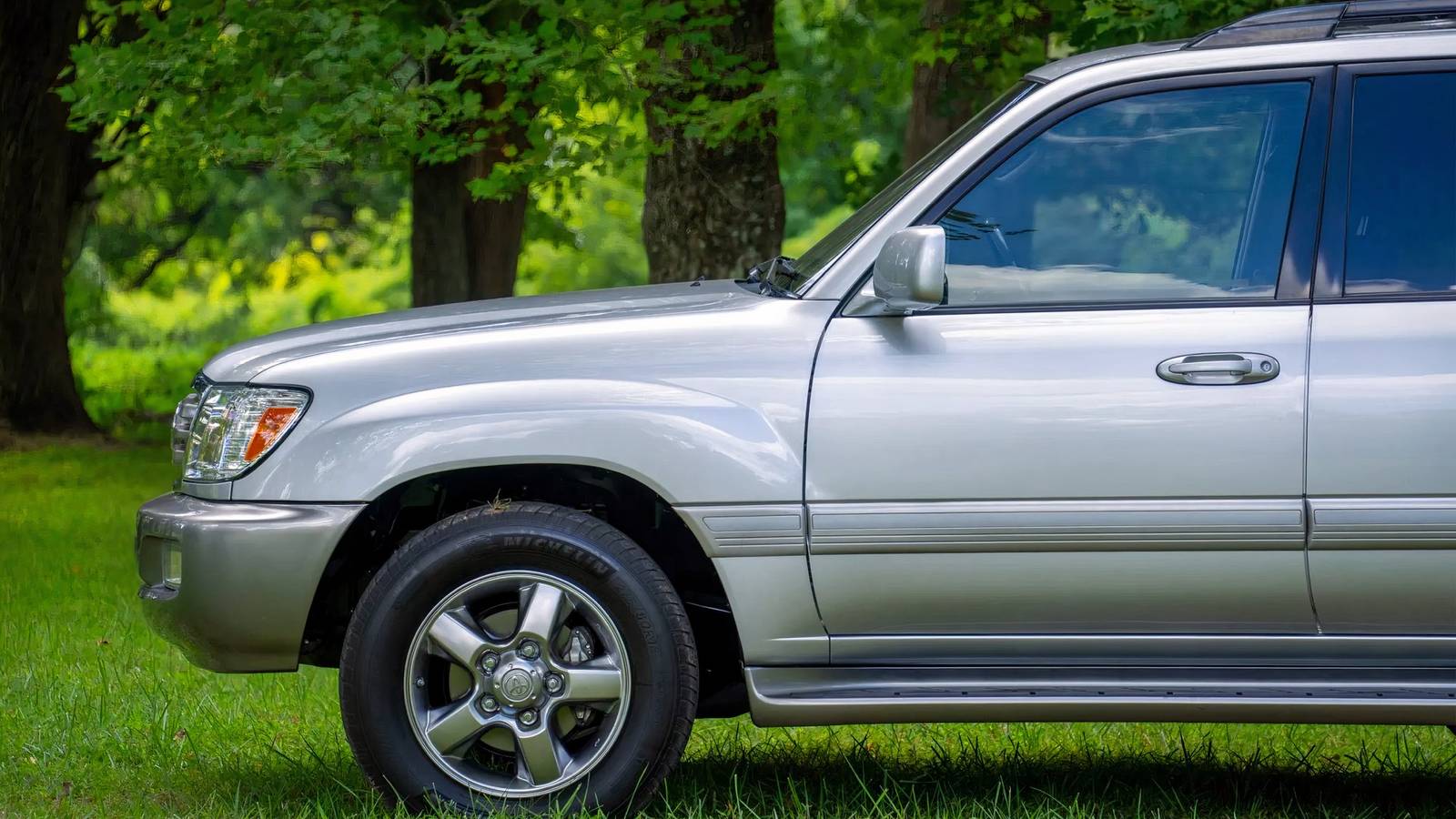
There aren’t many SUVs that have a better reputation for long lives and bulletproof builds than Japanese ones. While it may sound cliché, some Japanese models are near-indestructible in the face of the wilderness, natural disasters, trails, off-road racing, and working on-site. There are, of course, other countries’ exports that can take a beating, but none have yet garnered the solid reputation of Japanese SUVs.
Of the most famously unkillable SUVs, Toyota tends to lead the way, and there is a 2000s Toyota SUV that brought in a new style and interior feel for one of the most bulletproof nameplates ever, while still being a real workhorse. You only need to buy one once—with proper care, these machines can last a lifetime of hard work and play.
2000s SUVs Are Some Of The Toughest Vehicles Ever

The early 2000s are arguably the peak era for SUVs, with a slight touch of modernity in the U.S. Unlike today’s soft-riding crossovers built on car platforms, a lot of SUVs of the decade still had a body-on-frame structure borrowed from pickup trucks. This sturdy foundation, combined with simpler mechanics and fewer nannies, means that these vehicles can shrug off decades of use and abuse that would likely prematurely wear out a more modern vehicle.
From daily commutes, lugging family around, wandering into the boonies, and towing, some of the best SUVs are all you need. This toughness is reflected in how many SUVs from this era are still going today, and there is no shortage of love from both drivers and mechanics for models like the Jeep Cherokee, Chevy Tahoe, Ford Expedition, and Toyota 4Runner of the 2000s. We have seen countless models hit hundreds of thousands of miles without catastrophic issues, but it isn’t accidental; they are a product of more conservative design and a maintenance culture that favors preventative care over software updates.
Why SUVs From The 2000s Were Designed To Last

What stands out for many about the sturdiest 2000s SUVs is that they were designed and engineered around durability, not disposability. Brands built them with strong drivetrains, simpler wiring, and straightforward suspension designs that are not only easier to service than newer SUVs but also less prone to expensive failures. We see a lot of SUVs from the era still utilizing a traditional transfer case, solid rear axles, and independent control arms. They may not always offer the softest ride, but when it comes to off-the-pavement punishment and towing, they are top of the pile.
Under the hood, engines are typically naturally aspirated V8s or inline engines that boast predictable cooling and manageable thermal loads, with no twin-scroll turbos or complex timing issues to get in the way of a good time. Early 2000s SUVs also leaned on fewer electronic assists, so there are fewer control modules and systems to go wrong. While it may not be everyone’s go-to up against what is offered on the modern SUV market, this relative simplicity has translated into longevity (as long as maintenance is kept up).
The Toyota Land Cruiser Has Built A Legendary Reputation

Among the most renowned SUVs for dependability, few have earned a reputation in the U.S. and around the world quite like the Toyota Land Cruiser. It is a cliché option for a reason. While the nameplate goes back to 1954 and its lineage back to 1951, the Land Cruiser models plastered across the showrooms of the late 1990s and 2000s have come to be synonymous with what we describe as “built to last.” This reputation wasn’t forged by marketing gimmicks, though, but in real-world proof: here in the U.S., owners have racked up unbelievable mileage in them, they have trekked across deserts and through jungles, and they have climbed mountains.
It isn’t just about the rugged hardware, though—this comes from a commitment to useful engineering, not short-term trends. While some brands were flirting with increasingly complex suspensions or more lightweight materials, Toyota kept the focus of the 2000s Land Cruiser on reliability and increasingly better mechanics. This kind of design and engineering has certainly paid off today.

10 Off-Road SUVs With Bulletproof Reliability
How reliable are off-road SUVs? These ten are amazingly reliable and will bring you back from your wilderness adventures.
The 100 Series Land Cruiser Perfected The Luxury Off-Roader Formula

The SUV you are only ever going to have to buy once is the 2007 Toyota Land Cruiser 100 Series. The simple reason: it is rock solid and boasts a good amount of comfort and luxury features. You can get dirty in one while still enjoying some of the finer things of a luxury 2000s SUV.
The 2007 model year sits as the final and most refined model year of the 100 Series generation that ran from 1998, so not only do you get the famously rugged build of one of the best generations of Land Cruiser, but also the most up-to-date build before the 200 Series was introduced in 2008.
The 2007 Land Cruiser Balances Comfort, Capability & Durability
By the time the 2007 Land Cruiser hit the road, it had quietly evolved into one of the most well-rounded SUVs in the U.S., benefiting from years of incremental upgrades rather than a single overhaul. Earlier updates in the 100 Series, like the introduction of VVT-i and a more refined five-speed automatic transmission, set the scene for the final model year and gave it a refined feel both on and off-road.
Inside, the 2007 MY gets durable luxury in the shape of leather upholstery with heated, power-adjustable seats, a leather-wrapped steering wheel and shift lever, a center console housing a JBL sound system, and an integrated backup camera. It also got a DVD player and a six-disc in-dash CD changer, but we are tempted to say that the latter has probably been changed out on used models.

Comfortable features such as dual-zone climate control with rear controls, a power-tilt-and-telescoping steering column, multi-information displays, and a rear-seat audio system also give this SUV a touch of class and comfort for when you’re on the pavement. It is not the fanciest SUV of the 2000s, but it does strike a very good balance.
On top of that, you also get a decent amount of space inside. Maximum cargo capacity is 90.8 cubic feet with all rear seats folded down; there is 59.7 cubic feet behind the second row, and there is still a decent amount of space behind the third row of seats, at 20.8 cubic feet. Then there is the generous amount of space for you and your passengers across all three rows (the 100 Series Land Cruiser seats up to eight people).
|
Headroom |
Shoulder Room |
Hip Room |
Legroom |
|
|---|---|---|---|---|
|
First Row |
39.2 Inches |
62.4 Inches |
58.6 Inches |
42.3 Inches |
|
Second Row |
39.1 Inches |
NA |
57.9 Inches |
34.3 Inches |
|
Third Row |
36.4 Inches |
NA |
56.3 Inches |
27.3 Inches |
The 2007 Land Cruiser 100 Series Is One Of The Most Respected SUVs

Currently, there are 210 owner reviews of the 2007 Toyota Land Cruiser on Kelley Blue Book. Of these owners, all 100% of them would recommend buying one. It is not often that we see a 100% owner recommendation rate. Owners have also rated the ’07 Land Cruiser 4.9 out of 5 overall, with solid 4.9 out of 5 ratings across the board: value, quality, reliability, performance, comfort, and styling.
“Smooth and powerful, very reliable, classic style go-anywhere anytime, safe on wet roads, 4-wheel is standard, leather seats are very solid on sketchy roads. Toyota quality throughout.”
– Owner review of their 2007 Toyota Land Cruiser on Kelley Blue Book
iSeeCars also says that the 2007 Land Cruiser has a higher chance of seeing 200,000 miles or more than most other vehicles on the road. While there is no public record of how many 100 Series Land Cruisers have been sold, there have been over 10 million Land Cruiser models of all generations sold worldwide. There are some very good reasons why so many people have bought them, continue to do so, and join Land Cruiser enthusiast clubs to test what they can really do.

How The Toyota Land Cruiser Cemented Its Legacy In Overlanding Culture
As one of the most legendary overlanders in existence, the Toyota Land Cruiser takes some beating – here’s how it has become an overlanding icon.
A Used SUV That Feels Like A Lifetime Investment

In 2007, the starting MSRP of the ’07 Land Cruiser was just north of $56,000. Today, you can buy a 2007 Toyota Land Cruiser 100 Series for between $19,050 and $71,000. There really is that big of a price range. Kelley Blue Book says that the average used price is $19,050, while Classic.com says that the highest auction price for one is $71,000.
Classic.com also says that the average auction price is $33,567, so while Toyota models are renowned for holding their value anyway, the cult appeal of the last model year of the 100 Series seems to be keeping them very expensive. While we can’t speculate, because of what they can do, how long they can last, the enthusiast scene behind them, and because of what they represent, the 100 Series Land Cruiser could hold its value or even become a very sought-after classic one day.
Why The 2007 Land Cruiser Still Commands Strong Demand

The 2007 Land Cruiser represents the final and most refined version of a generation built with a single purpose: durability without compromise. By this point, Toyota had spent years perfecting the platform and strengthening already tough systems. What we get with a used model today is not just an old SUV with a unique style, but a fully matured SUV that is very tried and tested. The maturity of the build is one of the main reasons why off-roaders and trail hunters want one; it is still one of the best out there.
Another reason why it is such a sought-after model is its genuine capability under stress. The ’07 100 Series was engineered to handle heavy loads, sustain off-road beatings, and take on extreme terrain without complaints. Its body-on-frame construction, hefty suspension, strong V8, and full-time four-wheel drive allow it to carry gear and passengers across long distances where a lesser SUV would begin to struggle. It’s not all just theoretical, either; these things have traveled the world where you just can’t take other vehicles.

10 Reliable Luxury SUVs You Won’t Regret Buying
What are some of the most reliable luxury SUVs avaiable? These ten top the list and offer the vareity to provide every driver with good choices.
Legendary Engineering Is Why Owners Keep Them Forever

The main reason why we find so many 2007 Land Cruisers for sale with only one previous owner? They just keep going and going if you look after them well. There is just one engine option for the 2007 100 Series: a 4.7-liter V8, and it is one of Toyota’s most reliable engines.
|
2007 Toyota Land Cruiser 100 Series |
|
|---|---|
|
Engine |
4.7-Liter VVT-i Naturally Aspirated V8 |
|
Horsepower |
265 Horsepower @ 5,400 rpm |
|
Torque |
310 LB-FT @ 3,400 rpm |
There is only one transmission option as well: a five-speed automatic, which feeds power to all four wheels permanently via a transfer case. 0–60 mph times are somewhere around 10 seconds, but that is not the point.
The Proven V-8 And Overbuilt Mechanics Behind Its Longevity And Off-Road Prowess

At the heart of the 2007 Land Cruiser’s strength is the 2UZ-FE V8 under the hood—one of the best engines from the rock-solid UZ engine family. It is a byword for long service life in Toyota trucks and SUVs. It boasts a cast-iron block, forged internals, and conservative tuning to allow it to withstand stress that would knock out a lighter-duty engine. With VVT-i introduced in later versions (like the one in the 2007 Land Cruiser), it balances efficiency and reliability without ruining its strength.
More importantly, for off-roaders and those that tow, the 2UZ-FE V8 offers very strong low-end torque, making it ideal for controlled crawling and hauling. The ’07 Land Cruiser has a maximum towing capacity of 6,500 pounds, so it’s no surprise that, with the permanent four-wheel system and strong engine, it has become such an overlanding hero.

Beyond the engine, the Land Cruiser’s entire mechanical package is designed with the same heavy-duty thinking. It rides on a fully boxed ladder frame that resists twisting over bumps, paired with an independent front suspension and a solid rear axle; an ideal setup for balancing on-road comfort with off-road prowess.
The full-time four-wheel drive system, two-speed transfer case, and locking center differential are built for constant engagement, not just occasional use. Add in high-capacity cooling, durable diffs, and suspension components designed to handle heavy weight, and you’ve got yourself a vehicle that can last for years of overlanding, towing, and trail use without becoming scrap metal.
The Land Cruiser’s Simplicity Helps It Survive Hundreds Of Thousands Of Miles

It is not uncommon to see 100 Series Land Cruisers sailing past 200,000 miles when looked after. Some owners have claimed to put over 400,000 miles on them without anything going seriously wrong, and their simplicity is what keeps the engines going. There is no turbocharging, no overly complicated drivetrain tech, and no reliance on fragile electronics to make the core systems work. It is all proven hardware doing its job without drama, which means fewer things to go wrong as the miles rack up.
“Got this vehicle with 250,000 miles. Drove it countless long roads and weather; hauled many heavy loads thousands of miles. We sold at 420,000 4 years later. Spent money on oil changes every 10,000. Two sets of tires, 1 thermostat, 1 new radiator, 1 new water pump, 1 flywheel sensor, 1 new timing belt. That’s it…… Always runs, starts up first time -30 or +105. Will pull a supertanker out of the Sahara desert! Toyota built this one to perfection.”
– Owner review of their 2007 Toyota Land Cruiser 100 Series on Kelley Blue Book
This makes maintenance more straightforward; major service items are well-known, and most issues are easy to track down before they turn into anything too serious. The 100 Series Land Cruiser is not about fighting to find problems; it’s just about maintaining it. This is why they will just keep going, especially in the hands of owners who have spent a lot of time driving them; they are well-trusted and compliant companions.
Sources: RepairPal, iSeeCars, J.D. Power, Bring A Trailer, Classic.com, and Kelley Blue Book.