
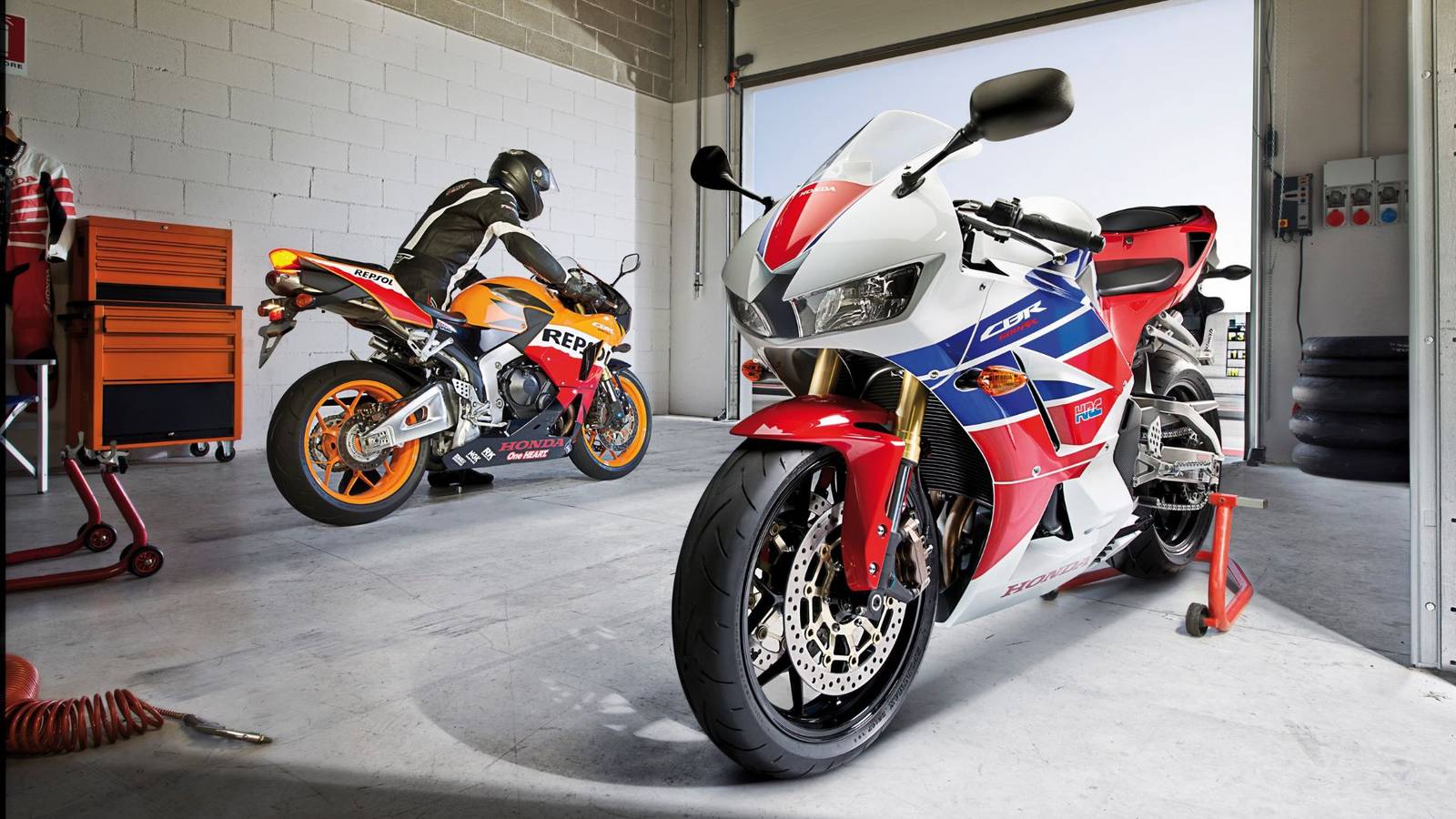
We aren’t looking for durability when we purchase a performance motorcycle. Speed, yes. Revs, yes. Lightweight and cutting-edge? Most definitely. Durability doesn’t really come into the picture when the expectation is that it will probably need repairs from a crash before it will need preventive maintenance. That said, reliability is an aspect that has influenced world titles all through history. We wouldn’t have a number of ‘what ifs’ if a rider or bike had managed to complete a race instead of sending it up the road rubber side up. So yes, durability and reliability do play a bigger role than we usually give them credit for, and it is important. But finding a sportbike that upholds it as one of its pillars can be tricky.
Japanese Sportbikes Pay More Than Just Lip Service To Durability

The Japanese motorcycle manufacturers earned their reputation for reliability and ease of maintenance, and that ethos is reflected across their ranges. Whether a small capacity learner cruiser or a fire-breathing track special, you can be sure that it won’t be a delicate device. This is prevalent across sportbikes from the land of the rising sun. Sometimes they have taken a step backwards to offer better performance in the long run, the way the first crossplane Yamaha YZF-R1 (the 2009 model year) went to the back of the queue when it came to horsepower top trumps in its class. However, there is still one Japanese sportbike that stands head and shoulders above the rest.
The Honda CBR600RR Is The Japanese Motorcycle That Redefined Sportbike Durability

The CBR600RR is Honda’s middleweight offering (one of two, the other being the CBR650R E-Clutch). The latter is an easygoing streetbike with a fairing, but the former is an old-school track monster that has no compromises. The CBR600RR also lent its engine to the Moto2 class of racing motorcycles as a standard power unit from its inception in 2010 until the 2018 season. It is this very engine that continues to be on sale in the US market since 2013, since the recently-launched 2021 model hasn’t yet been launched here. With its longevity and talent to simply keep going with basic preventive maintenance despite regular track day thrashing, it is the Japanese motorcycle that redefined sportbike durability.
A Modern Price For An Old-School Product

The CBR600RR’s $11,499 price is right in line with its peers, but when you add ABS to it, it climbs to $12,499. That can seem a little expensive because the ABS pricing is the exact same pricing as a more modern product like the Yamaha YZF-R9, which has similar output from its three-cylinder engine and an up-to-date electronics suite. However, the Honda’s relatively simpler electronics only make its case as a reliable motorcycle stronger, so you get what you pay for.

10 Cheapest Inline-Four Motorcycles In 2025
These might be the cheapest inline four motorcycles, but they still pack a sold punch!
They Don’t Make Engines Like This Any More

With emissions regs becoming tighter annually, it is difficult for manufacturers to continue with their traditional high-revving inline fours, even in sport bikes. The CBR600RR is a throwback because it is the older generation model that is being sold in the USA. It displaces 599 cc from its ‘screamer’ inline four, with a compression ratio of 12.2:1. It has a really short stroke design, and it generates 118 horsepower at 13,500 RPM and 47 pound-feet at 11,500 RPM. A close-ratio six-speed gearbox puts the power down, and if you let it have its way, you’ll see 160 miles per hour.

There is technology here, but it is decidedly last generation. It has PGM-DSFI, which is Honda’s dual-stage fuel injection system. There are two injectors per cylinder, but under certain conditions (more than 25% throttle, and the engine is above 4,800 RPM), the second injector joins the action. This is also why Honda claims around 40 MPG from this model. However, this has a cable throttle, and the gearbox doesn’t have a quickshifter, even as an accessory.
Old-School Chassis Matches The Engine

There is a twin-spar aluminum chassis for the CBR600RR, with an aluminum swingarm. Showa offers inverted SFF-BP forks and a Unit Pro-link rear shock. There is full adjustment available at both ends, and there is 4.1 inches of travel available at the front and 5.1 inches at the rear. There are 310 mm dual brake discs at the front with Tokico radial four-piston fixed calipers, and a 220 mm disc at the rear with a single-piston Nissin caliper. Light 17-inch cast aluminum alloy wheels and radial tubeless tires that are track-ready are fitted.
This is a compact motorcycle with a rider triangle that is very uncomfortable on the street. The reach to the handlebars is long, the hip is placed high, and the footpegs are rearset. The seat height itself is quite approachable, at 32.4 inches, but the steering lock (or lack thereof) and the weight over the front axle are what make it intimidating to those not used to a bike like this. It has a compact wheelbase as well, at 53.9 inches, and it weighs 419 pounds. The ABS adds on a few, taking it to 434 pounds.

10 Fast And Small Sports Bikes To Kickstart Your 2025 Riding Goals
This list ranges from frugal 25-horsepower urban runabouts to 50+ horsepower track-ready “civilized” monsters
A Basic Feature Set Is All You Get
This is essentially a 2013 design, so your expectations need to be tempered. There is an analog tachnometer, and the LCD has orange backlighting. Thankfully, it has some useful features like a fuel gauge and an electronic steering damper, but there is no mechanical or electronic assistance other than the optional dual-channel ABS on the CBR600RR.
There Are Some Very Durable Japanese Sportbikes Available

We’re not looking at the CBR600RR’s direct competition here; we are taking a good look at any Japanese sportbike that has a reputation for reliability. Starting small, the Yamaha YZF-R3 has been around for a while, and it has been continually refined over the years. Today, it has inverted forks, LED lighting, and smartphone connectivity. The Honda CBR500R and Kawasaki Ninja 650 are more of the same – all three are sportbikes that share underpinnings with a naked, run a 180-degree parallel twin engine, and have earned a reputation for being unbreakable. Both the bigger bikes now offer a TFT screen and traction control that can be switched off.

We’ve already mentioned the Honda CBR650R, which is now standard with the E-Clutch semi-automatic gearbox, which makes it a great all-rounder. Going up the displacement ladder, the Suzuki GSX-R750 hasn’t changed mechanically since 2011. That makes it a great mix of power and reliability, although you do miss out on modern conveniences. If you want a liter bike, the standard Honda CBR1000RR will do fine – it has a ‘mere’ 186 horsepower, and Honda has been evolving it for a while now rather than introducing an all-new model as it did in 2020.
Source: Honda PowerSports