
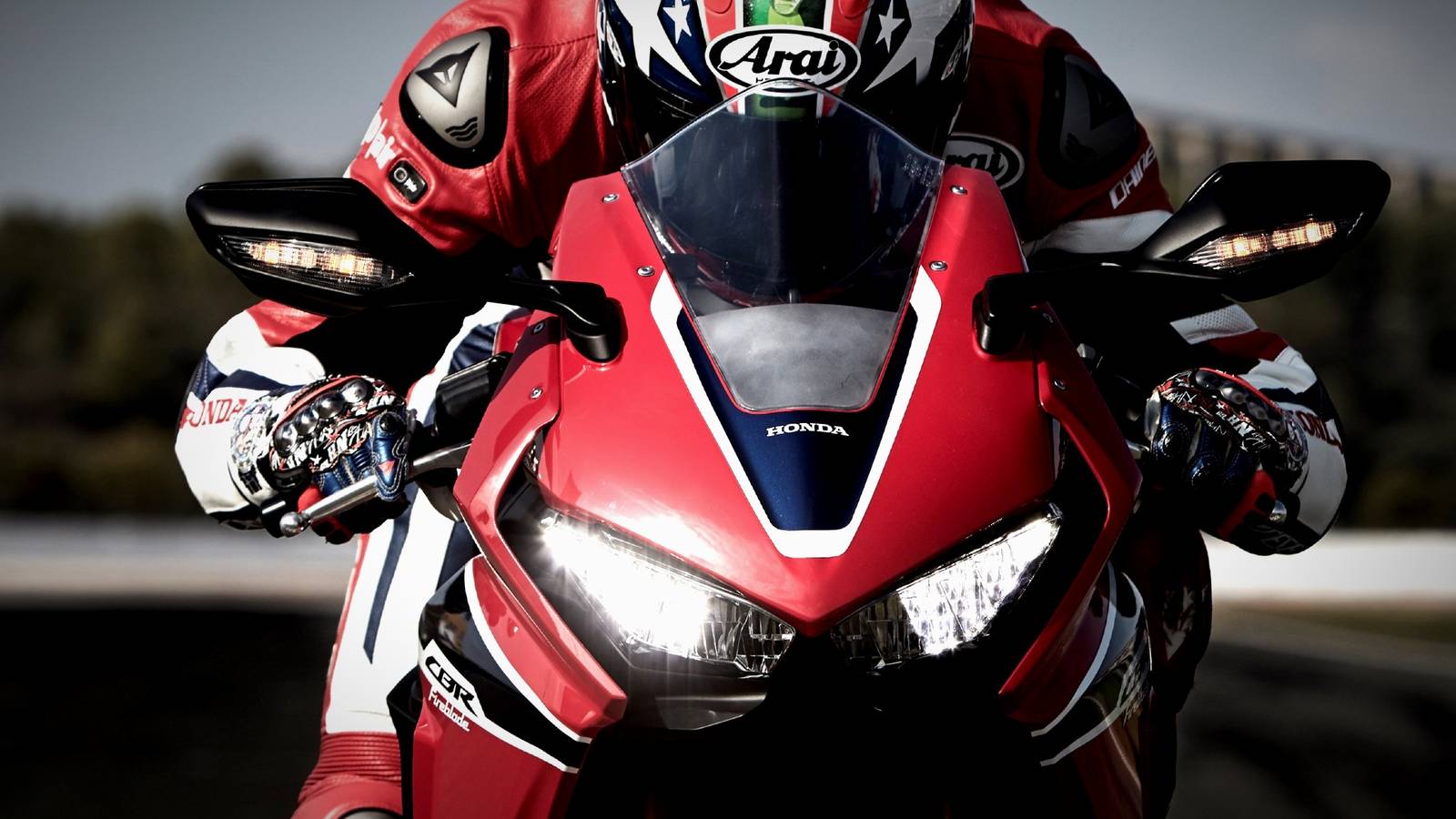
Look at Honda’s lineup, and you’ll realize that the brand rarely makes lightweight motorcycles. All of its bikes are either slightly on the porky side or just around the average weight figure of the class. It makes sense, too, as the brand mostly sticks to making road-friendly bikes rather lightweight bikes that offer cutting-edge performance and lap times.
Thus, in 2026, finding a lightweight Honda that’s lively and powerful is a tough ask. It’s not impossible, though, and upon research, there are a couple of bikes in the 2026 lineup that can meet this brief well. Out of these, a certain forgotten CBR takes the top spot.
The CBR1000RR Is The Honda That Feels Lightweight, Lively, And Surprisingly Powerful

We’re talking about the CBR1000RR that justifies the title quite well. How, you ask? Well, for starters, it tips the scale at just 432 pounds fully fueled. That is around 10 pounds less than its rivals, like the Kawasaki Ninja ZX-10R, Yamaha YZF-R1, and Suzuki GSX-R1000. Not just that, this figure also makes it lighter than middleweight bikes like the Honda CBR650R and Suzuki GSX-8R. Even Honda’s mid-capacity nakeds–CB750 Hornet and CB650R–weigh more than the CBR.
Then, there’s the performance. This might not have the 200 horsepower that’s become the norm nowadays, but you still get well over 180 ponies. It will take you to 62 miles per hour in less than 3.5 seconds, then all the way to 186 miles per hour without running out of breath. When you hit the twisties, its racing-derived underpinnings will sweeten the pot. After all, this is the platform on which Honda’s WSBK racebike was based in 2017.

Finally, a shoutout goes to its competitive MSRP of $16,999. This makes it one of the most accessible liter-class superbikes out there. In fact, it is also cheaper than premium middleweight sports bikes like the MV Agusta F3 R and Ducati Panigale V2. However, you should know that ABS isn’t standard here. The ABS-equipped version sells for a few hundred dollars more ($17,299). Still quite affordable for a superbike if you ask us.

10 Honda Motorcycles With Reputations For Legendary Reliability
These bikes have all done their part to prove the theory that Honda makes the most reliable motorcycles
A Screaming Inline-Four Engine Powers The CBR1000RR

There’s no denying the era of inline-four engines has deteriorated in recent times. V4s have truly taken over, be it in terms of road riding or world championship racing. But there’s no denying pure-bred inline-four engines still hold a special place. If you concur, the CBR1000RR will feel like a pot of gold. It has a screaming sub-1,000cc inline-four engine, with a 76 mm bore, 55.1 mm stroke, and a 13:1 compression ratio.
These help churn out almost 190 horsepower and 82 pound-feet. Both figures kick in under 13,000 RPM, which is earlier than its rivals like the Kawasaki Ninja ZX-10R. Add to that the lower weight here, and you have a properly fast bike, even if it doesn’t touch the holy 200-HP ceiling. A six-speed transmission puts the power down, meanwhile.
Engine Highlights
- 4.4 pounds lighter than the previous version
- 13,000 RPM rev ceiling
- Revised valve lift and cam timing
- Aluminum clutch cover
- Magnesium ignition cover
- Exhaust system is 6.2 pounds lighter than the previous model
The CBR1000RR Has A Race-Proven Chassis

This CBR1000RR might not have received a sizable update in nearly a decade, but the underpinnings are still pretty capable. Its twin-spar frame has an aluminum construction, just like the subframe and swingarm. These are all derived from the WSBK racebike with two key aims: improve handling and reduce weight. So the chassis had 10 percent more flexibility, lower weight, and thinner walls than the previous-gen bike.

The Honda That Feels Sporty, Comfortable, And Easy To Live With
The CB750 Hornet has now elevated itself from a fun motorcycle to an equally practical one as well with the no-cost addition of the E-Clutch system
Showa Suspension Sweetens The Pot

As for suspension, you get Showa 43 mm Big-Piston forks and a Showa BFRC (Balance Free Rear Cushion) shock. Both have full adjustability and latch onto 17-inch cast aluminum wheels. These hoops house 2x 320 mm front disc brakes and a 220 mm rear rotor. While the rotors seem like the usual size, the Tokico caliper system feels a bit inferior to modern-day Brembo setups (speaking from personal experience).
Elsewhere, this is also one of the friendliest superbikes on the market. It has a comfortable riding triangle (by superbike standards), petite dimensions (wheelbase is under 55.5 inches), and an accessible saddle height (32.8 inches). This also feels very slim between the legs, without being too cramped.
The Electronics Are Surprisinly Modern On The CBR1000RR
A motorcycle that’s turning almost 10 years old should feel quite old, right? Well, the CBR1000RR surprisingly doesn’t. You get a five-axis IMU and throttle-by-wire as standard. These allow a nine-level traction control system, rear lift control, wheelie control, and cornering ABS. Engine power modes, engine braking modes, and ride modes are also present.

You access all of these via a crisp TFT. There’s auto-brightness and display modes (Street, Circuit, and Mechanic) in this display, which shows the attention to detail. What seems like a sizable miss, however, is an autoblipper and quickshifter. The latter is available as an optional accessory and costs over $550.
The CBR1000RR Sits Well In The Liter-Class Superbike Segment

Thanks to its age, the CBR1000RR sits at the lower end of the liter-class superbike segment. That means it doesn’t really compete with the modern kids on the block, such as the Ducati Panigale V4, Aprilia RSV4 1100, or the BMW S 1000 RR. The real competition comes from another aging superbike from Japan: the Suzuki GSX-R1000. The Gixxer undercuts the CBR by $500 and has more flashy colors to turn heads. You also get more power, thanks to the MotoGP-derived VVT setup.


How Honda Earned Its Reputation For Bulletproof Engineering
Owning a Honda offers peace of mind because the products are so reliable. How did Honda get here, though?
Another rival in 2026 is the Kawasaki Ninja ZX-10R. It just got a sizable price cut, along with a facelift. That means you get a more modern bike for the same money. Its peak output is the same as the CBR, though, and when you take into account its extra heft, you technically get a lower power-to-weight ratio. Make of that what you will!