
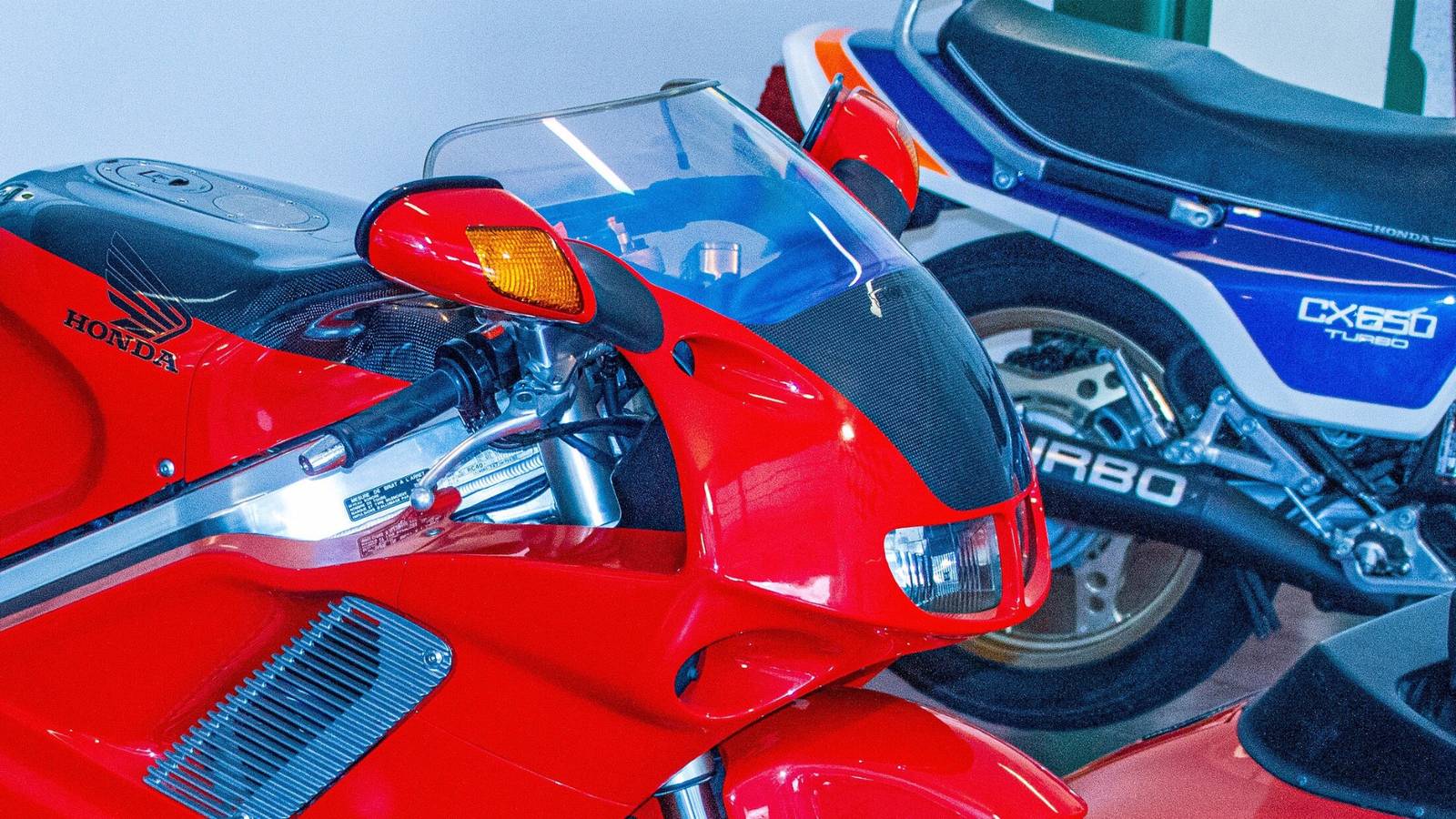
Start naming all the most iconic motorcycles in the world, and Honda’s name will keep popping up. Right from its inception, Honda has produced some incredible motorcycles, many of which have gone on to define or invent segments, like the CB750, the first ever superbike, or the CBR900RR Fireblade, which set the template for modern superbikes. Don’t forget the Super Cub, the bike that literally liberated many countries by making transportation accessible.
Honda is no stranger to producing not just reliable, sensible motorcycles and cars, but also making some of them incredibly important. In this lineup of iconic Hondas, one bike that stands out among the rest is the NR750. It was the result of Honda’s obsession with tech it believed in, and it paved the way for many trends that are now commonplace in modern sports bikes. Here’s the story of the NR750, a bike that was years ahead of its competition.
Honda’s Obsession With Oval Piston Technology That Led To The NR750

To dominate Grand Prix racing, Honda, often considered the technology leader in motorcycling, wanted to create something that was otherwise considered mechanically impossible. It wanted the benefits of a V8 engine within the four-cylinder confines of GP racing regulations, using a V4 engine with oval pistons. Thus, the NR project was born, with a desire to dominate racing with four-stroke engines at a time when two-strokes were all the rage. Honda engineers were even given a blank check to innovate.

This development cycle lasted for over a decade and produced some of the most complex components ever fitted to bikes. The start of it dates back to 1979, when the NR500 Grand Prix racebike was introduced. It was a 499.5cc V4 four-stroke with oval pistons that allowed eight valves per cylinder. Unfortunately, it was too complex to be reliable, and Honda had to abandon it after two unsuccessful years in racing. Instead, Honda was forced to pick two-stroke engines for racing, like the NSR500 V4.


While Honda’s two-strokes did dominate Grand Prix racing, it wasn’t about to give up on the radical oval piston concept just yet. Sure, the initial racing effort was indeed a disaster; so much so that the racing press at the time even dubbed the project ‘Never Ready’ as a play on the NR name. Honda spent the next decade refining the precision machining and metallurgy required to produce reliable oval pistons. By the early 1990s, Honda had succeeded in making a bike that was ready to take on the sports bike segment: the Honda NR750.

10 Vintage Japanese Bikes That Turn Heads Like Supermodels
These ten Japanese bikes will give any enthusiast whiplash when spotted. Here’s why.
1992 Honda NR750: ‘Never Ready’ To Finally Ready

.jpg)
Determined to make the oval piston concept work, Honda had finally achieved something that could be sold to the customers, if not win races. It was the 1992 Honda NR750, priced at $60,000 back then; it was the most expensive motorcycle any Japanese manufacturer had made. It was also mechanically complex and the closest thing you could buy to a Grand Prix bike, which made that steep price tag feel totally worth it. That is, only if you were lucky enough to bag one of the very few hundred units ever made.


Produced between 1992 and 1993, the Honda NR750 remains the only motorcycle for customers to experience Honda’s oval piston engineering. Reviewers at the time praised it for its build quality and attention to detail, with the quasi-V8 engine being a sight to behold. It looked right out of an IndyCar. It also brought many firsts in production motorcycles, like electronic fuel injection and upside-down forks. It was a technical tour de force that may not have set the template, but brought in sports bike trends and features that are still followed to this day.

Dodge Tomahawk Motorcycle: The Radical Concept That Became A Legend Overnight
Powered by a Viper V-10 engine, the Dodge Tomahawk has four wheels and was claimed to be able to do over 400 mph!
The Holy Grail of Oval-Piston Technology
Honda was obsessed with oval-piston technology, and the NR750 is the first and, so far, only motorcycle that lets customers experience this obsession. The 748cc liquid-cooled 90-degree V4 engine was the crown jewel of the bike, with Honda having filed over 200 patents on it. With its oval pistons, it was essentially a V8 engine with cylinders combined, which not only gave it a hellish exhaust note but also a power delivery that’s often compared to jet and rotary wankel engines.
The Goal Was Cylinder Head Flow And Combustion Efficiency

But why did Honda go through such lengths to make oval pistons work? The answer is simple: cylinder head flow and combustion efficiency. The oval shape gave the engine combustion chamber volume of a V8, housing eight valves per cylinder. These valves were actuated with gear-drive DOHC to ensure perfect timing even at 15,000 RPM. The oval pistons were also 30 percent smaller than a pair displacing the same space, which resulted in reduced sleeve-related friction.
Doubling-Down On Top-Spec Components

The complex design of the quasi-V8 engine also required a lot of upmarket components, starting with twin connecting rods made of titanium, which was unheard of for motorcycles back then. Each cylinder used two spark plugs, eight valves, and two EFI throttle bodies. Meanwhile, the exhaust gases were routed out through a complex maze of 8-into-4-into-2-into-1-into-2 exhaust system.
Jet-Like Linear Power Delivery

The V4 powerplant was officially rated at 125 horsepower for the export models. While that may not seem like a lot of ponies today, the way the NR750 delivered power was completely different. Thanks to its ultrashort stroke and valve area, the motor liked to rev all the way to the 15,000 RPM redline. Reviewers at the time noted that power came in right off the bat, in a remarkably smooth manner, with a noticeable output increase at around 7,500 RPM.

10 Powerful Sports Bikes From The 2000s That Are Dirt Cheap Today
By the 00s, the superbike race had reached fever pitch, with fantastic offerings from every major manufacturer
Production Firsts And An Early Adopter Of Cutting-Edge Tech
The Honda NR750 also featured many of the production firsts, or at least adopted much of the tech before it became common in motorcycles. As a result, the NR750 was a rolling showcase of technology and materials that you wouldn’t find on any other motorcycle of that era. For example, the windshield was coated in an iridium film to reduce glare, much like fighter jet canopies. But there was more.
First Japanese Sports Bike With Electronic Fuel Injection

_(52647347730).jpg)
Given how complex the engine was, Honda had to figure out a way to feed a precise air/fuel mixture at all times. So, it was forced to use electronic fuel injection, making it the first Japanese sports bike to feature a fully mapped EFI unit. Honda’s PGM-FI system used twin throttle bodies for each cylinder and ran with a 16-bit ECU, a big deal for that era, which monitored seven sensors to optimize air/fuel delivery to the engine.
USD Forks, Carbon Fiber Fairings, And More

Apart from that, the NR750 was the first production motorcycle to adopt upside-down forks. It used a 45mm Showa fork, promising outstanding feedback and compliance on the road. It also featured a cassette-style transmission, twin four-piston Nissin brake calipers, carbon fiber fairing components, side-mounted radiators, under-seat exhaust, magnesium wheels, and more. Many of these features have now become bare essentials, but when the NR750 came out, they were unheard of.

10 Affordable Used Bikes Under $5,000 That Are Perfect For Track Days
Some of the most incredible sports bikes of yesteryear are getting really affordable today, and they make perfect track weapons
Influence On Modern Sports Bikes, Including The Legendary Ducati 916

The Honda NR750’s oval-piston V4 engine may not have become commonplace today; it was too complex and expensive to produce for production motorcycles. However, NR750 brought in much more that inspired and influenced the sports bikes that followed. It’s hard to think of a superbike today not using fuel injection, upside-down forks, four-pot calipers up front, or lightweight wheels. This alone makes the NR750 one of the most influential motorcycles ever produced.
The Ducati 916 Ripped Off Its Design

The NR750 influenced the sports bike’s design, too. When it was showcased at the EICMA Show 1992, it inspired Massimo Tamburini to toss the first Ducati 916 design and go back to the drawing board. Often considered the most beautiful motorcycle ever made, the Ducati 916 drew many design cues from the NR750, including the cat-eye headlights, under-seat exhaust, and a single-sided swingarm.

Here Are The Most Powerful Naked Bikes From All Popular Brands
With a 0-62 mph time of 3.15 seconds, the most powerful naked bike here is also the quickest of the lot.
300-Odd Units That Are Now Relegated To Museum Duties

The NR750 came out in 1992, being the most expensive and exotic Japanese motorcycle produced back then. Yet after over three decades, the NR750 still seems extreme in comparison to modern superbikes. Name another bike that uses eight rods, two throttle bodies per cylinder, or oval pistons. Even the underpinnings of the bike were so ahead of their time that they became commonplace only in the last decade or so. It was truly advanced for its time.
Can Fetch Six-Digit Figures At Auctions In 2026
Despite its extremely satisfying ride quality, the NR750 couldn’t survive for more than two years. The oval-piston engine was simply too complex and expensive to produce. And so, production came to an end after around 322 units, due to a lack of bookings. This included the 100-horsepower RC41 models, which came with revised camshaft profiles and EFI mapping for the French market. This rarity has made the bike a collector’s dream today, often selling for well over $100,000.
Modern Sports Bikes Owe It To The NR750

The Honda NR750 is a museum piece today, and it deserves to be revered as a time capsule from the golden era of superbikes. It may not be the fastest or the liveliest bike ever made; in fact, reviewers praised it for its almost sports-tourer-esque comfort. It’s still proof that when a manufacturer is obsessed with something, and engineers are given a blank check, the result can sometimes be a bike that becomes a major milestone in automotive history. Modern sports bikes owe it to the NR750 for that.
Source: Honda, HotCars