
Fuel efficiency is a hotter topic than ever, with global events making the price of gas unpredictable and subject to fluctuation. One of the more positive sides of companies downsizing their engines and introducing hybrid options is that engines are generally becoming more efficient. The United States has been lucky in the cost of fuel compared to European countries, but it is certainly becoming more of a consideration than ever to pick a brand-new vehicle that is more economical. The difference of just a few miles per gallon could be the difference between thousands of dollars over the course of a few years, so it’s worth being conscious of.
Perhaps those most affected by this are those who drive full-size pickup trucks. Not only are they thirstier than lighter vehicles, but they are also used as workhorses doing thousands of miles a month sometimes, and frequently with a heavy load attached to them, harming fuel economy even further. Two of the largest manufacturers of large trucks have considered this in recent years, and now two options in particular offer the dominating presence of a full-size truck, but with better economy than most mid-sizers.
The 2026 F-150 Is The New Benchmark For Full-Size Hybrid Efficiency

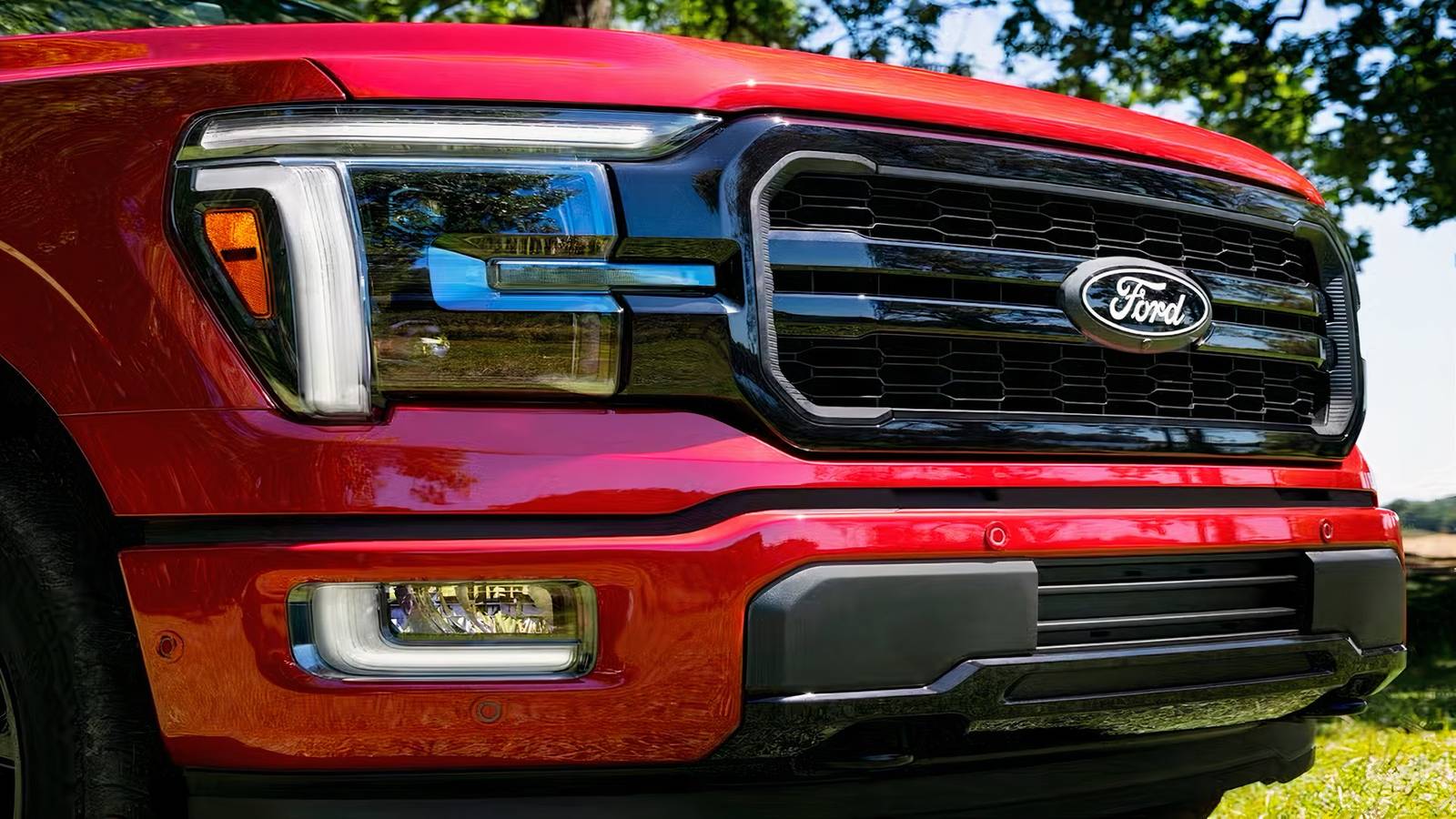
The 2026 Ford F-150 has managed to perform well in efficiency testing, and the singular biggest help in doing so has been offering a hybrid variant. The PowerBoost version of the F-150 pairs the standard 3.5-liter EcoBoost twin-turbocharged V6 with an electric motor. It is not a dedicated plug-in hybrid; the battery is charged by the engine itself and regenerative braking.
2026 Ford F-150 PowerBoost Specs
|
Engine |
3.5-liter twin-turbo V6 hybrid |
|
Horsepower |
420 |
|
Torque |
570 Ib-ft |
|
Transmission |
10-speed automatic |
|
Towing Capacity |
11,200 pounds |
|
Economy |
23 mpg (fueleconomy.gov) |
|
Weight |
5,585 pounds |
This has improved this version of the F-150 in terms of overall efficiency. It’s a system that works by combining gas and electric power seamlessly, and means the added torque from the batteries can propel the F-150 forward without having to use as much engine power and therefore, uses less fuel.


Find 2026 Ford F-150 and more cars for sale on our Marketplace
Economy is important, but for those who are in the market for a full-size truck, it’s a secondary measure compared to the capability of the truck itself. Being a powerful, high-torque engine, the addition of being a hybrid has enhanced the truck in most ways. Whilst not as traditionally muscular as a V8, the electric inclusion has helped the F-150 have instantaneous torque and response, two measures which are helpful when lugging 11,200 pounds around, or tackling steep uphill sections of road.
Even the best turbocharging has some throttle delay, but with the PowerBoost, you’re launched forward. Acceleration is instant and easy. You’re going to burn less gas because you’re just never deep into the throttle.
– Michael Frank for TopSpeed
The 2023 RAM 1500 EcoDiesel Found Its Efficiency Elsewhere

Whilst the RAM after 2023 opted for a gasoline powertrain, their most economically effective option was a version of the RAM 1500 that used a perhaps more traditional method: a trusty diesel. Whilst, on the surface seeming like maybe a quick-fix compared to more sophisticated methods of fuel-saving that would come in later years, there are genuine reasons to use a diesel engine in a big truck, especially when economy is of importance. Diesel contains more usable energy than gasoline on a per-gallon basis and manages to have more pulling power at lower RPMs, just like the F-150 hybrid. While not as significant in city driving, the diesel becomes especially noteworthy in efficiency when doing long highway cruises.
2023 RAM 1500 EcoDiesel Specs
|
Engine |
3.0-liter V6 diesel |
|
Horsepower |
260 |
|
Torque |
480 Ib-ft |
|
Transmission |
8-speed automatic |
|
Towing Capacity |
12,560 pounds |
|
Economy |
24 mpg (fueleconomy.gov) |
|
Weight |
4,800 – 5,400 pounds |
Though this version has since been discontinued, it is still a more economical option than the current gasoline six-cylinder options. RAM is a couple of years behind Ford in the adoption of hybrid trucks, with production starting in early 2026, but it is forecast to have an immense 14,000 pounds of towing capacity and 615 pound-feet of torque.

This 2-Year-Old Hybrid Is The Perfect Balance Of Price, Performance, And Utility
This vehicle is an iteration of America’s most popular vehicle, so it’s a no-brainer that it was given a hybrid powertrain because of its success.
A Comparison To Popular Mid-Sized Trucks

Mid-sized trucks are usually a better all-around choice for most consumers, factoring in price, economy, and how much capability they need. And while full-sized trucks are always going to be more expensive on average, the economy is proving to be closer. Sure, the most efficient and popular mid-sized truck, the Toyota Tacoma, is known for being fairly efficient, even in terms of a mid-sized truck. With the base four-cylinder turbo providing a usable but comparatively measly 228-278 horsepower, it’s no wonder it is able to yield impressive range. However, achieving the same mpg as the F-150 hybrid and RAM EcoDiesel isn’t so impressive when you consider their extra weight, and that their towing capabilities far exceed those of the Tacoma.

Then you have other mid-sized trucks. Take the popular GMC Canyon. On the surface, you’d expect reasonable efficiency results to be possible from the Canyon with its 2.7-liter four-cylinder engine, but according to real-world data on fueleconomy.gov, expect only 20 mpg in a fair mixture of city and highway use. The powertrain in the GMC is useful in its own way, with 300+ horsepower and 7,700 pounds of towing capacity; it is a very capable engine for a four-cylinder. The impact on its fuel usage is clear, though, with the powerful turbo and generous specs requiring more fuel than far larger engines in the F-150 hybrid and RAM EcoDiesel.
A Six-Cylinder Mid-Size Offering

Four-cylinders are becoming more commonplace in the sphere of mid-sized pickup trucks, but six-cylinders, for many, are still the sweet spot. One of the popular applications of a V6 in mid-sized pickups is with the Nissan Frontier. A value-friendly and rugged truck that offers so much for the money, but how about in terms of economy?
2025 Nissan Frontier Specs
|
Engine |
3.8-liter V6 |
|
Horsepower |
310 |
|
Torque |
281 Ib-ft |
|
Transmission |
9-speed automatic |
|
Towing Capacity |
7,150 pounds |
|
Economy |
21 mpg combined (fueleconomy.gov) |
|
Weight |
4,376 – 4,507 pounds |
Everything about the Frontier is excellent when you consider its price, but there is no changing that far more capable six-cylinder full-sized trucks are somehow more efficient, proving the sheer frugality of a properly-engineered hybrid or diesel engine that wasn’t just made for fantastic hauling and torque, but for economy too.
This 2-Year-Old Hybrid Is The Perfect Balance Of Price, Performance, And Utility
This vehicle is an iteration of America’s most popular vehicle, so it’s a no-brainer that it was given a hybrid powertrain because of its success.
The Verdict On The Full-Size Potential Efficiency

Regardless of the size of the truck, there are very few pickups that can outrank the 2026 F-150 hybrid and the 2023 RAM 1500 EcoDiesel in their quest to make a utility-based vehicle efficient. And with Ford’s commitment to hybrid and RAM’s upcoming models, we can expect to see even higher numbers in the future. Given the innovation in this area of engineering, it’s likely we won’t only see higher combined mpg’s for these full-sized trucks, but more heavy-duty work being possible too, with higher torque and towing figures.
Sources: Fuelefficiency.gov, Ford, RAM, Nissan