
We weren’t surprised to hear that the Toyota RAV4 was the best-selling SUV in the U.S. in 2025; it is an institution, it has succeeded where others have failed, and it has been doing so since 1996. Last year, it sold just under 478,000 models, far outselling all of its competition. It is renowned for reliability, it is handy to use, and its nameplate demands a lot of respect.
- Base Trim Engine
-
1.6L Smartstream I4 Hybrid
- Base Trim Transmission
-
6-speed automatic
- Base Trim Drivetrain
-
All-Wheel Drive
- Base Trim Horsepower
-
178 HP @5500 RPM
- Base Trim Torque
-
195 lb.-ft. @ 1500 RPM
- Base Trim Fuel Economy (city/highway/combined)
-
38/38/38 MPG
- Base Trim Battery Type
-
Lithium ion (Li-ion)
- Make
-
Hyundai
- Model
-
Tucson Hybrid
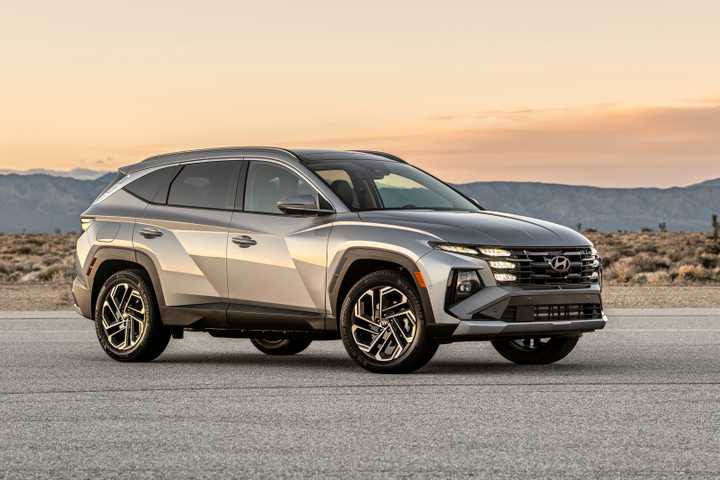
However, there is another Asian-made compact SUV from Hyundai that is rated higher than the new RAV4 for reliability by owners, offers very fuel-efficient driving, and remains affordable, versatile, comfortable, and full of usable technology. This compact hybrid SUV is quietly taking on Toyota at its own game.
How The 2026 Tucson Hybrid Redefines Smart Hybrid Driving

There isn’t much stiffer competition in the U.S. auto market than there is in the SUV market, and the compact SUV segment is heating up to new levels now that drivers have found that a 220-inch-long full-size SUV isn’t needed every day. The Toyota RAV4 may have predictably won the sales war last year, but that doesn’t mean models like the 2026 Hyundai Tucson Hybrid should be overlooked for value, usefulness, reliability, and work ethic.
With a starting price of $32,450 and available in four well-equipped trims, the new Hyundai Tucson Hybrid is designed to be a go-to everyday SUV, and we think that with its fuel-efficient hybrid and plug-in hybrid engine options, roomy interior, affordable trims, dependable design, and versatile build, it is the epitome of smart modern hybrid SUV driving. This 2026 Hyundai Tucson Hybrid is available in the following trims:
- 2026 Hyundai Tucson Blue SE Hybrid. MSRP: $32,450.
- 2026 Hyundai Tucson SEL Hybrid. MSRP: $33,900.
- 2026 Hyundai Tucson SEL Convenience Hybrid. MSRP: $34,900.
- 2026 Hyundai Tucson Limited Hybrid. MSRP: $42,075.
The 2026 Hyundai Tucson Plug-In is only available in two trims, which include:
- 2026 Hyundai Tucson SEL Plug-In Hybrid. MSRP: $40,325.
- 2026 Hyundai Tucson Limited Plug-In Hybrid. MSRP: $48,550.
Breakthrough Fuel Efficiency That Can Save You Money on Gas

There is one engine option for the 2026 Hyundai Tucson Hybrid: a 1.6-liter turbocharged GDI inline-four mated to a hybrid rig that includes a 1.49 kWh battery and a 47.7 kW motor. Total power output is 231 horsepower and 271 pound-feet of torque, and while it won’t ever compete as the most powerful hybrid SUV, it isn’t needed; its purpose is for frugal, everyday driving.
Hyundai says that the most fuel-efficient model of this year’s Tucson Hybrid lineup is the base Blue SE, which can achieve 38 combined mpg (38 mpg on the highway and 38 mpg in the city). All other trims can muster 36 combined mpg (37 mpg on the highway and 36 mpg in the city). According to FuelEconomy.gov, the Tucson Hybrid Blue SE will only cost you an estimated $1,100 for gas, or over five years, $2,000 less than the average modern vehicle.
|
2026 Hyundai Tucson Hybrid Blue SE |
2026 Hyundai Tucson Hybrid SEL/SEL Convenience/Limited |
|
|---|---|---|
|
Gas Tank Range |
521 Miles |
493 Miles |
|
Gas Tank Size |
13.7 Gallons |
13.7 Gallons |
|
Cost To Fill Tank |
$38 |
$38 |
|
Cost To Drive 25 Miles |
$1.85 |
$1.95 |
Then we have the 2026 Hyundai Tucson PHEV lineup. Starting prices are higher than the hybrid range, but you do benefit from a 268-horsepower 1.6-liter turbocharged GDI CVVD inline-four paired with a 72 kW motor and 13.8 kWh battery. FuelEconomy.gov says that you can muster a wholly impressive 77 MPGe from the PHEV Tucson, and maybe more importantly, it will cost you even less for gas and electricity.
|
2026 Hyundai Tucson Plug-In Hybrid |
|
|---|---|
|
Annual Fuel & Electricity Cost |
$1,050 |
|
MPG Rating |
77 MPGe |
|
Gas Tank Range |
420 Miles |
|
All-Electric Range |
32 Miles |
|
Gas Tank Size |
11.1 Gallons |
|
Cost To Fill Tank |
$31 |

10 Hybrid SUVs That Hold Their Value Best
Here are 10 hybrid SUVs that not only save you money in fuel costs, but will pay you back well when you go to sell them.
Hybrid Tucson Usability And Reliability You Can Count On, Year After Year

While Toyota is almost synonymous with reliability, Hyundai is also one of the leading Asian brands for building dependable vehicles. According to the 2026 U.S. Vehicle Dependability Study (VDS), the market average problems per 100 vehicles (PP100) is 204 PP100. Toyota as a whole ranks better than Hyundai (185 PP100 vs. Hyundai’s 198 PP100), but when it comes to the Tucson Hybrid’s reputation for reliability, it is a different story.
iSeeCars rates the Hyundai Tucson 7.9 out of 10; 2026 Tucson Hybrid owner reviews on Kelley Blue Book rate it 4.3 out of 5 for reliability; J.D. Power’s reliability rating for this year’s Tucson Hybrid is 83 out of 100; and RepairPal rates the hybrid Tucson 4 out of 5 for dependability.
“If you’ve driven CR-Vs, RDXs, RAV4s, or similar vehicles in the past, and you want the same (or better) reliability and bang-for-the-buck, as well as incredible fuel-efficiency and great aesthetics, look for a Hyundai Tucson PHEV.”
Owner review of their Hyundai Tucson Hybrid on Kelley Blue Book
CarEdge also gives the Hyundai Tucson a “B-” value rating, saying that it will only cost $2,694 over five years to maintain, which is $902 cheaper than the average similarly-sized SUV. The Tucson Hybrid has only been available in the U.S. market since 2022, but some owners have already claimed to put close to 60,000 miles on their 2022 MYs with routine maintenance and little trouble.
Performance That’s Easy Every Day

A low-stress yet useful-enough hybrid or plug-in hybrid engine under the hood and a rock-solid build make the Tucson Hybrid a useful compact SUV to own every day. However, what really makes it a very useful SUV is the fact that it comes equipped as standard with all-wheel drive and is small enough to comfortably zip around in.
All Hyundai Tucson Hybrid and Tucson PHEV models get HTRAC AWD from the factory, a full-time all-wheel drive system that constantly monitors your throttle inputs, the road surface beneath your wheels, and traction levels, and reacts to slip to shore up your ride.

There are four available drive modes: Eco Mode, which is the standard drive mode for both models; Sport Mode, which gives you a boost in acceleration; and My Drive Mode, which lets you configure drivability yourself. The final mode is Snow Mode, which helps with traction on slippery roads. In other words, there is a drive mode for every on-road driving occasion.
Both the hybrid and plug-in models ride on a 108.5-inch wheelbase and measure in at 182.7 inches in length by 73.4 inches in width, meaning that they are more than useful to use comfortably every day and on smaller roads. Zero to 60 times for both models aren’t what you would call rapid, but at 8.1 seconds for the PHEV and 7.2 seconds for the hybrid, it is more than fast enough to get you up to highway speed. Plus, you get a maximum towing capacity of 2,000 pounds from both models, so weekend lake trips and helping people move house are well within both models’ wheelhouse.
America’s Best Warranty Is Included

Hyundai is currently one of the best brands in terms of new car warranty and markets itself as America’s Best Warranty. Currently, Hyundai’s new vehicle warranty offers 5 years or 60,000 miles of New Vehicle Limited Warranty, which is bumper-to-bumper defect coverage; 10 years or 100,000 miles of Powertrain Limited Warranty, which covers engine and transmission faults; 10 years or 100,000 miles of hybrid and electrical system warranty; 7 years and unlimited miles of anti-perforation warranty; and 5 years of 24-hour roadside assistance.
It is an exceptionally generous new vehicle warranty, and for both the Tucson Hybrid and Tucson Plug-in Hybrid, that means the powertrain and hybrid battery are covered for faults and defects. You still have to maintain your Hyundai, but the new Hyundai vehicle warranty should give you some peace of mind for a long time.

10 Hybrid SUVs For Budget-Friendly Driving
Hybrids are fuel efficient, but how would the size or purchase price of a hybrid SUV influence the cost per mile? Here is a look at some of these.
Why the 2026 Tucson Hybrid Beats Stalwart Toyota Competitors

The 2026 Tucson Hybrid is an exceptionally versatile hybrid SUV, but does it stack up against one of Toyota’s most renowned models and its main rival? How does the Hyundai Tucson Hybrid compare to the Toyota RAV4 Hybrid?
Firstly, iSeeCars rates the Toyota RAV4 Hybrid ever so slightly lower for reliability, at 7.8 out of 10. The difference in rating here is negligible, but the latest J.D. Power reliability rating of 77 out of 100 and the Kelley Blue Book reliability rating of 3.9 out of 5 tell a different story, and is much lower than the Tucson Hybrid’s rating. While the RAV4 may be one of the most revered models in the compact SUV world, this year’s line is deemed by many to be less reliable than the other model years.
Secondly, there is the price. The starting price for the 2026 Toyota RAV4 Hybrid is $31,900, or $550 cheaper than the Tucson Hybrid. The price may only seem like a slight difference at the base level, but as you work your way up the trims, prices do start to climb. The 2026 Toyota RAV4 Hybrid and PHEV lineup includes:
- 2026 Toyota RAV4 Hybrid LE. MSRP: $31,900.
- 2026 Toyota RAV4 Hybrid SE. MSRP: $34,700.
- 2026 Toyota RAV4 Hybrid XLE Premium. MSRP: $36,100.
- 2026 Toyota RAV4 Hybrid Woodland. MSRP: $39,900.
- 2026 Toyota RAV4 Hybrid XSE. MSRP: $41,300.
- 2026 Toyota RAV4 Hybrid Limited. MSRP: $43,300.
We are waiting on Toyota for official pricing for the 2026 Toyota RAV4 Plug-In Hybrid, but the 2025 model year’s pricing includes:
- 2025 Toyota RAV4 SE Plug-In Hybrid. MSRP: $44,815.
- 2025 Toyota RAV4 XSE Plug-In Hybrid. MSRP: $48,685.
There are more trims available for the new RAV4 Hybrid and last year’s RAV4 PHEV, but when it comes to certain aspects of driving, fewer options may be better. Especially as the Tucson Hybrid and Tucson PHEV outperform their RAV4 counterparts in more than one area.
Leading The Compact Hybrid SUV Class In Value And Reliability

While the Tucson Hybrid is estimated to return very impressive fuel economy, there is no beating the 2026 RAV4 Hybrid or 2025 RAV4 PHEV for combined MPG ratings. According to Toyota, the front-wheel drive models of the 2026 RAV4 can achieve up to 44 combined mpg; the all-wheel drive models achieve up to 41 combined mpg, and last year’s RAV4 PHEV can muster an exceptional 94 MPGe.
There is no pricing information for this year yet, but if the 2026 Toyota RAV4 PHEV is as good as last year’s model, it will only cost you an estimated $900 a year for gas and electricity. Is that value for money, though? It may look exceptional on paper, but, using last year’s pricing, the RAV4 PHEV is roughly $4,500 more expensive than the Tucson PHEV, and we can expect slightly higher prices for the 2026 model.
This year’s Tucson Hybrid is also slightly more powerful at the base level; the 2024 RAV4 PHEV is more powerful than the new Tucson PHEV, but again, your wallet has to be fairly wide to get it.
|
2026 Hyundai Tucson Hybrid |
2026 Toyota RAV4 Hybrid |
2026 Hyundai Tucson PHEV |
2025 Toyota RAV4 PHEV |
|
|---|---|---|---|---|
|
MSRP |
$32,450 |
$31,900 |
$40,325 |
$44,815 |
|
Horsepower |
231 Horsepower |
226 Horsepower (FWD)/236 Horsepower (AWD) |
268 Horsepower |
302 Horsepower |
|
Maximum Towing Capacity |
2,000 LBS |
1,750 LBS (FWD)/3,500 LBS (AWD) |
2,000 LBS |
2,500 LBS |
The 2026 Toyota RAV4 Plug-In Hybrid has been confirmed by Toyota to boast a plug-in powertrain good for 324 horsepower, which can get you to 60 mph in 5.4 seconds.
Reasons That Might Make Buyers Choose The Tucson Over Toyota Models

The new Tucson Hybrid is value for money in a compact SUV, and while the Toyota RAV4 is always going to take some beating in popularity, there are lots of reasons to buy a Tucson over the market stalwart. The prices for higher trims are lower than comparable RAV4 trims; everyday driving is easy, and reliability ratings are currently more favorable toward the Tucson Hybrid. However, there are two huge aspects that also make the Tucson Hybrid a wise buy over the RAV4 Hybrid: all-wheel drive and warranty.
Every 2026 Tucson Hybrid and PHEV comes equipped with all-wheel drive; if you buy a new RAV4, you get front-wheel drive as standard, and have to opt for the electronic all-wheel drive system. Toyota’s eAWD system does add some horsepower and shores up wheel spin, but it will cost you another $1,400 on top of the MSRP.

Then there is warranty: Hyundai offers one of the best new vehicle warranties on the market, and while Toyota’s is still generous, it doesn’t stack up against its South Korean counterpart’s.
Hyundai Assurance (the umbrella name for its new vehicle warranty) offers everything we talked about above; Toyota offers 3-year/36,000 miles of bumper-to-bumper coverage, 5-year/60,000 miles of powertrain coverage, 5-year/unlimited mileage corrosion coverage, and 10-year/150,000 miles of hybrid battery coverage. While the hybrid battery warranty may be longer with a new Toyota, the rest of the basic warranty is far behind what Hyundai offers.

10 Cheapest AWD Hybrid SUVs In 2025
These AWD hybrid SUVs all walk a fine line between power, efficiency interior space, and versatility, but all come in with attractive price tags.
Comfort, Tech, And Convenience That Will Last

If you spend a lot of your time on the road, both the 2026 Hyundai Tucson Hybrid and Tucson PHEV are designed to make that time actually comfortable. The base SE Hybrid comes with a 10-way power-adjustable driver seat, 60/40 split rear seats, and dual-zone climate control.
|
Headroom |
Shoulder Room |
Hip Room |
Legroom |
Total Passenger Volume |
|
|---|---|---|---|---|---|
|
Front/Rear |
38.1 Inches–40.1 Inches/38.7 Inches–39.5 Inches |
57.6 Inches/56 Inches |
54.5 Inches/53.9 Inches |
41.4 Inches/39.5 Inches–41.3 Inches |
105.9 Cubic Feet |
Moving up to the SEL trims, you get heated front seats, a power-adjustable passenger seat, and a hands-free smart liftgate, while the Limited trims are verging on affordable luxury. They boast ventilated front seats, heated rear seats, a heated steering wheel, and a panoramic sunroof. For what can be seen as very reasonable prices across the board, the Tucson Hybrid and PHEV have you well covered for comfort.
Modern Interiors And Advanced Tech For Everyday Use
The cabin may not be the fanciest on the market, but both Hyundai Tucson models show off a relatively techy place that does not feel dated. Up front is a 12.3-inch digital cluster and a 12.3-inch touchscreen; the base trim gets wireless Apple CarPlay and Android Auto, and you can upgrade to features like wireless charging, a Bose audio system, and, for PHEV models, EV-specific displays.
Hyundai’s SmartSense safety tech also comes as standard fare. It includes forward collision warnings, lane keeping assist, blind-spot monitoring, and rear cross-traffic alerts. There is a good reason that the NHTSA rates it 5 out of 5 stars for overall safety, with 5-star front and side crash protection and a 4-star rollover resistance rating. With safety being one of the most important aspects of driving a new SUV, the Tucson looks to deliver here as well.
Roomy Cargo And Smart Storage Designed For Active Lifestyles

The standard-fit all-wheel drive system may conjure up images of being useful for some off-roading; unfortunately, it is more suited to keeping control on loose surfaces and in wet parts of the country. However, that doesn’t mean that this affordable and reliable hybrid SUV is not made for those of you with an active lifestyle. It boasts clever storage compartments and a healthy amount of cargo space.
|
Cargo Space Behind First Row |
Cargo Space Behind Second Row |
|
|---|---|---|
|
Cubic Feet |
38.7 Cubic Feet |
74.8 Cubic Feet |
Hyundai hasn’t just designed an open box; the cargo space inside is smart. Tucson models come equipped with the Hyundai Storage Management System, which includes a sliding and adjustable cargo floor that lets you raise the floor for a flat load surface. You also get hidden storage bins, cargo hooks, tie-downs, and a cargo net. Roof rails come equipped on most trims, and the 60/40 split rear seat means you can pass longer items from the trunk into the second-row area.
While the Toyota RAV4 Hybrid may steal the headlines in the reliable and fuel-efficient compact SUV market, the Hyundai Tucson Hybrid is more than well-equipped to take it on at its own game.
Sources: Hyundai, J.D. Power, Kelley Blue Book, RepairPal, CarEdge, FuelEconomy.gov, NHTSA, and iSeeCars.