
Over the last few years, we’ve witnessed the unfortunate and gradual demise of the emotive performance sedan sports car. This is due to factors relating to rising fuel costs and tighter maintenance budgets, resulting in consumers limiting their automotive purchases to cars that are dependable and cheap to run.
Brands have adopted downsized engines and increased electrification. While these measures yield a better balance of speed and efficiency, they aren’t selling as well. Because cars get more advanced, they tend to lose appeal for not having an aggressive and mechanical sound and feel to them.
The Golden Age Of Performance Sedans

The decade between 2000 and 2010 represented a high-water mark for the performance sedan in the U.S., as manufacturers successfully bridged the gap between executive luxury and track-ready engineering. Driven by a burgeoning horsepower war and the refinement of adaptive suspension technologies, the segment flourished because it offered a singular solution for enthusiasts who required the utility of four doors without sacrificing the engagement of a sports car.
This era saw the dominance of icons like the BMW M5, Mercedes-Benz E63 AMG, and the Audi RS6, while domestic competitors like the Cadillac CTS-V proved that American brands could compete on a global stage. However, the segment’s momentum began to stall by the end of the decade due to the pressures of the 2008 financial crisis. This curtailed discretionary spending on high-maintenance performance vehicles, eventually leading to the rapid ascent of the luxury crossover. As SUVs began to offer comparable straight-line speed and superior versatility, the traditional three-box sedan started its transition from a market staple to a specialized niche.
Pontiac’s Glorious Final Days

The final days of Pontiac were marked by a tragic irony. The brand was arguably producing its best enthusiast-oriented vehicles just as its parent company, General Motors, was forced to shut operations down. By 2009, Pontiac’s lineup was a mix of uninspired badge-engineered models like the G3 and G5 and world-class performance machines like the rear-wheel-drive G8 GXP and the Solstice Coupe. Despite the critical acclaim for the G8, which offered BMW-rivaling dynamics at a fraction of the cost, sales across the brand struggled under the weight of the 2008 global financial crisis and years of brand dilution that had eroded its exciting identity.
Ultimately, Pontiac became a casualty of GM’s 2009 Chapter 11 bankruptcy and subsequent government-led restructuring. The U.S. Treasury required GM to lean down to its four core brands, namely Chevrolet, Cadillac, Buick, and GMC, to ensure long-term viability. This forced the shuttering of Pontiac on October 31, 2010, ending an 84-year legacy just as the brand had finally rediscovered its performance roots.

How Pontiac Pioneered The Concept Of The Affordable Muscle Car
There were fast rides before the GTO, but Pontiac made performance affordable, bringing muscle cars to the masses.
Pontiac’s Forgotten Four-Door Legend

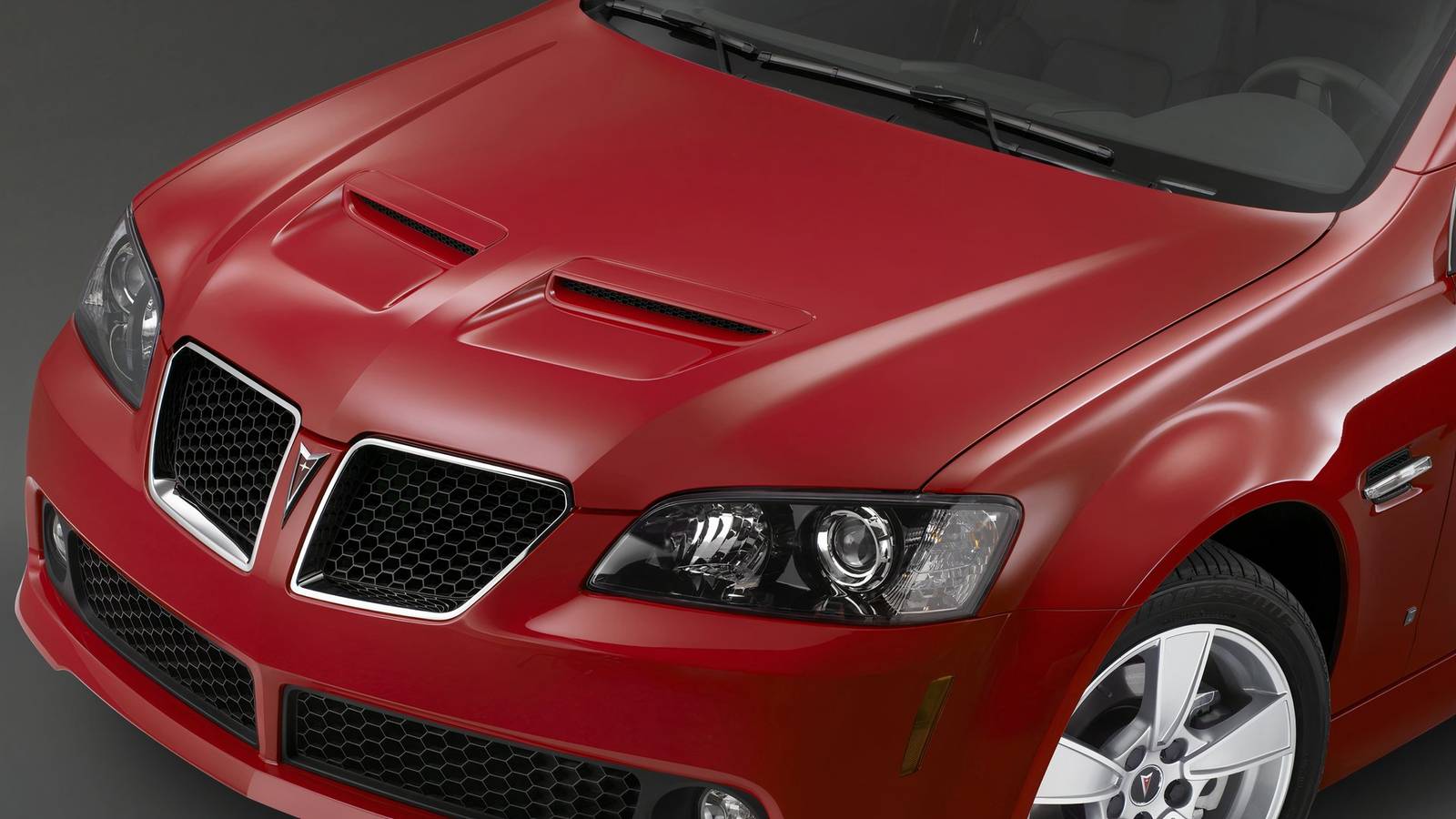
The Pontiac G8 was a full-size rear-wheel-drive sedan based on the GM Zeta platform, which was developed by GM’s Australian subsidiary, Holden, for the VE Commodore. It served as a spiritual successor to both the Bonneville and the Grand Prix, bringing a performance-oriented, import-fighter ethos back to the brand. The model had an exceptionally brief production run, manufactured in Elizabeth, South Australia, from late 2007 through June 2009 for the 2008 and 2009 model years.
During this time, Pontiac offered the sedan in three distinct variations: the entry-level base model, the mid-tier GT, and the top-tier, limited-production GXP. GM had plans to introduce a sports truck and station wagon variant, but these were never able to reach showroom floors due to financial constraints. The G8 was ultimately discontinued not because of a lack of critical acclaim or consumer interest, but as a direct consequence of General Motors’ 2009 bankruptcy and the subsequent decision to dissolve the entire Pontiac brand to meet federal restructuring requirements.
The Best The G8 Had To Offer

The Pontiac G8 GXP served as the performance pinnacle of the G8 lineup, utilizing a naturally aspirated 6.2-liter LS3 V-8. This is a version of the all-aluminum engine that’s also found in the C6 Chevrolet Corvette. This robust architecture produced a balanced 415 horsepower and 415 pound-feet of torque, sent to the rear wheels through your choice of a six-speed automatic or Tremec TR-6060 six-speed manual transmission.
On the road, the GXP delivered world-class acceleration for a full-size sedan, capable of reaching 60 MPH in as little as 4.5 seconds and clearing the standing quarter mile in approximately 13.0 seconds at speeds approaching 110 MPH. While the vehicle was electronically governed to a top speed of 155 MPH, its aerodynamic profile and raw power suggested a drag-limited potential exceeding 175 MPH if left unrestricted.

The Epic Legacy Left Behind By One Of Pontiac’s Greatest Muscle Cars
No other muscle car trim or performance package has had the impact and lasting legacy as the Pontiac Firebird Trans Am.
Corvette-Powered Greatness

The Pontiac G8 GXP’s LS3 V-8 is celebrated for its elegant simplicity, utilizing a deep-skirt, 319-T7 aluminum block with cast-in-iron cylinder liners that balance lightweight construction with immense structural rigidity. Its cam-in-block overhead valve design reduces the engine’s physical footprint and center of gravity compared to bulkier dual-overhead-cam counterparts. The high-flow L92-style cylinder heads feature massive intake ports and hollow-stem valves to facilitate exceptional volumetric efficiency.
For performance, the engine employs a sturdy nodular iron crankshaft, powdered metal connecting rods, and high-silicon hypereutectic aluminum pistons, a combination that handles high-RPM stress with ease. This design is a paragon of reliability because it minimizes moving parts, mitigating the need for complex timing chains or dual-vanos systems. The shared architecture with GM’s small-block lines ensures a massive ecosystem of proven components that can withstand significant power increases without compromising the engine’s internal integrity.
European-Levels Of Handling

The G8 GXP’s chassis features a sophisticated FE3 performance-tuned suspension that elevates the standard G8’s geometry through stiffer valving and recalibrated progressive-rate springs. The layout utilizes a multi-link MacPherson strut system with a direct-acting stabilizer bar in the front and a four-link coil-over-shock independent design in the rear, a configuration specifically engineered to resist body roll during high-lateral-load cornering without sacrificing the compliant ride quality expected of a grand tourer.
To handle the increased power of the LS3, the GXP was significantly upgraded with a heavy-duty Brembo braking system, featuring large 14-inch vented front rotors clamped by four-piston silver-finished aluminum calipers. This is a massive step up from the twin-piston cast units on the base and GT models. Complementing these technical enhancements are a set of model-specific 19-inch polished aluminum wheels wrapped in high-performance summer tires, which provide the necessary clearance for the larger calipers and ensure a wider footprint for superior mechanical grip and steering precision.

Rendering: The Pontiac GTO Judge Reborn
The Pontac GTO Judge is, by far, one of the most legendary muscle cars of all times, and we’ve taken the liberty of bringing it into the modern ages.
The G8’s Well-Kitted Interior

The interior of the 2008 Pontiac G8 GXP was engineered as a driver-centric cockpit that successfully married high-performance ergonomics with executive-level comfort. The cabin was anchored by deeply bolstered sport bucket seats upholstered in premium leather with color-matched microfiber inserts, specifically designed to provide lateral support during high-G cornering while remaining plush enough for long-distance touring.
Standard amenities were comprehensive, including dual-zone automatic climate control, eight-way power-adjustable heated front seats, and a leather-wrapped multifunction steering wheel that allowed the driver to manage the vehicle’s vital functions without taking their eyes off the analog-style instrument cluster. The long wheelbase of the GM Zeta platform ensured that this performance-oriented layout did not compromise utility, offering expansive rear legroom and a substantial trunk with a center pass-through for larger items.

Regarding technology and convenience, the GXP came nearly fully loaded from the factory, with a power sunroof being the primary standalone option for buyers. The centerpiece of the entertainment system was a premium 230-watt, 11-speaker Blaupunkt audio setup that utilized dual subwoofers to deliver high-fidelity sound throughout the cabin.
This system was integrated into a 6.5-inch color display that housed an in-dash 6-disc CD changer with MP3 compatibility and an auxiliary input for external devices. Safety and connectivity were further bolstered by standard OnStar integration, which provided turn-by-turn navigation and emergency services, ensuring that the GXP remained a sophisticated and well-connected daily driver despite its raw mechanical power.
Sources: MotorTrend, Motor Reviewer, and Edmunds