
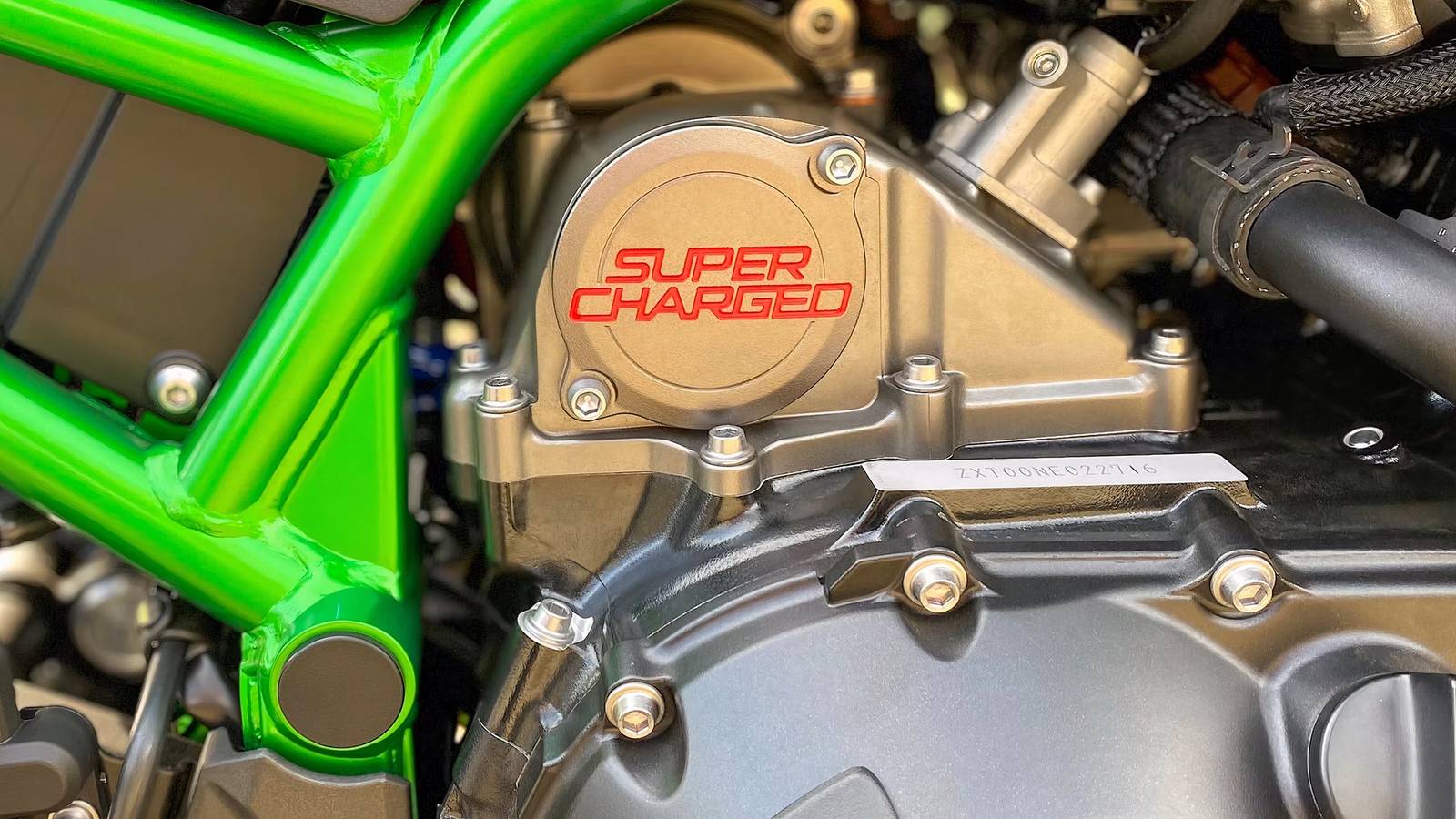
The original Kawasaki 750SS Mach IV H2 was known for its blistering acceleration. So when Kawasaki announced the H2 lineup in 2015, it had everyone on the edge of their seats. Expectations were high, and the H2 models delivered on all fronts. With a whopping 322 horsepower, the H2R promised to offer the ultimate motorcycling experience. This bike was followed by the H2 SX and Z H2, which offered the same supercharged rush in a more road-friendly manner.
What makes these H2 motorcycles so great is the supercharged engine. It’s the fire-breathing heart that makes other motorcycle engines feel outdated. Made by Kawasaki Heavy Industries in a unique collaboration, this supercharged engine features some of the most advanced tech ever used on motorcycles. Let’s dive in to see what’s inside this supercharged engine. Also, strap on, because things are about to get technical.
To give you the most up-to-date and accurate information possible, the data used to compile this article was sourced from authoritative sources, such as Kawasaki Heavy Industries Group. The information in this article primarily pertains to the Kawasaki Ninja H2 engine and may vary by model.

Kawasaki Ninja H2: 10 Years Of The World’s Fastest Superbike
The Ninja H2 remains the only motorcycle of its kind, a decade after its release. r
The Ninja H2R’s Supercharged Engine Is A Marvel Unlike Any Other

The Kawasaki H2R and its road-legal twin, the H2, were designed to offer riders something they’ve never experienced before: ultimate performance. The bikes had to deliver intense acceleration, a high top speed, and supersport-level circuit performance, which required a powerful, compact engine. So, Kawasaki had to develop something from the ground up, and for this project, Kawasaki Heavy Industries Group was involved. You know, the group that produces everything from missiles to submarines and space systems, no big deal.

Using its extensive knowledge and database to create some of the most high-tech machines in the world, the KHI Group, in partnership with Kawasaki motorcycles, developed the supercharged inline-four engine that would go on to power the brand’s flagship sports bikes. This engine, in its most performance-oriented state of tune, is capable of producing a mind-numbing 322 horsepower, sending the bike to 248.548 miles per hour in just 20 seconds.

How has Kawasaki managed to extract so much performance out of this compact engine without sending the pistons to outer space or compromising reliability? The answer lies in the insane engineering that KHI Group has put into the engine. For example, the engine is paired with a mechanical centrifugal supercharger, which is highly efficient and compact. Meanwhile, the engine itself has been toughened to sustain performance, along with improved cooling and intake/exhaust systems. That’s what makes this supercharged engine an engineering marvel, the likes of which have never been seen before on two wheels.
Motorcycles That Use Kawasaki’s Supercharged Engine
|
Models |
Kawasaki Ninja H2R |
Kawasaki Ninja H2 |
Kawasaki Ninja H2 SX SE |
Kawasaki Z H2 |
Bimota Tesi H2 |
Bimota H2 Tera |
|---|---|---|---|---|---|---|
|
Power Output |
322 HP @ 14,000 RPM |
240 HP @ 11,500 RPM |
207 HP @ 10,000 RPM |
197 HP @ 10,500 RPM |
231 HP @ 11,500 RPM |
200 HP @ 11,000 RPM |
|
Torque Output |
121.5 LB-FT @ 12,500 RPM |
104.9 LB-FT @ 11,000 RPM |
101 LB-FT @ 8,500 RPM |
101 LB-FT @ 8,500 RPM |
104.51 LB-FT @ 11,000 RPM |
101 LB-FT @ 8,500 RPM |
|
Compression Ratio |
8.3:1 |
8.3:1 |
11.2:1 |
11.2:1 |
8.5:1 |
11.2:1 |
Extremely Efficient Supercharger Designed For All-Out Performance Across The Rev Range

We’ve seen supercharged motorcycles before, but those examples have been limited to custom Hayabusas and Harley-Davidsons. Such units used to be big and bulky, usually completely compromising the bike’s practicality and reliability. However, Kawasaki’s unit is entirely different; it’s a mechanical centrifugal-type supercharger, designed with tech from KHI’s Gas Turbine and Machinery Company, Aerospace Company, and Corporate Technology Division. Its completely in-house design allows it to be perfectly matched to the Kawasaki’s inline-four powerplant and desired engine character.

The supercharger unit itself is highly efficient in achieving the goals of intense acceleration and maximum power. For instance, the supercharger is mated to a planetary gear train driven by the crankshaft, courtesy Aerospace Company. This gear can spool the impeller shaft to almost 130,000 RPM, pumping close to 200 liters of air per second into the engine. At this rate, the internal air pressure can reach 2.4 atmospheric pressure with a flow rate of 100 meters per second at the inlet.

With so much air passing through and the impeller spooling up exceptionally fast, the supercharger is bound to heat up and lose efficiency. Fortunately, Kawasaki has made the unit extremely efficient, helping prevent overheating in a wide range of conditions. This is unlike most aftermarket superchargers, which only offer this level of efficiency under a limited range of conditions. At the same time, Kawasaki says the unit can also handle a wide range of pressure ratios and flow rates, ideal for road-going motorcycle use. Finally, this efficient design eliminates the need for an intercooler.

The H2R Is The Most Aggressive Kawasaki Ninja You Can Buy
This bullet-on-wheels offers supercharged performance and is the crème de la crème of the Ninja range.
Compact Yet Tough Liter-Class Engine With High-Tech Components

It’s possible to produce such high power figures with conventional naturally-aspirated engines, but that would generally increase the displacement. While that sounds simple enough, it would increase the engine’s dimensions, reducing the bike’s circuit performance. So, the natural choice was to go the supercharger route to keep the engine’s dimensions in check without sacrificing performance. According to Kawasaki, the result is an inline-four engine with dimensions on par with those of conventional liter-class powerplants.

The next goal was to make the engine strong enough to withstand high compression and deliver performance without constantly blowing up. So, the engine is designed to withstand 2x the stress of a naturally aspirated liter-class engine. It can do so thanks to high-tech components, starting with cast pistons. Still, the engine, in its highest state of tune on the H2R, requires a tolerance check every 15 hours followed by a full service after 30 hours. The same isn’t the case with road-going variants of the engine, which have longer service intervals.

The third piece of the engine puzzle is cooling, which can sometimes be a substantial limiting factor for engine output. Here, Kawasaki has beefed up cooling in all ways it could, leading to a highly complex engine design. For instance, the cylinders feature large coolant passageways to keep the combustion chamber cool. Since a single lubrication system provides cooling oil to the engine, transmission, and supercharger, the engine holds 1.32 gallons of oil, which is 35 percent more than a conventional liter-class inline-four engine.
Everything Before And After The Engine Designed To Aid The Supercharged Performance

Kawasaki has ensured that this fire-breathing combination is supported at all times, and that starts with the air intake. A RAM air intake on the left side of the air cowl directs air to the supercharger as straight a line as possible. This intake chamber uses newly developed technology, with the top injectors spraying fuel onto stainless steel nets positioned over the intake funnels to create a more uniform fuel-air mixture. The exhaust ports are designed to pull exhaust air from the combustion chamber efficiently.

On the other end, a dog-ring unit that ensures a smooth, quick-shifting experience. This type of transmission is usually found in MotoGP or Formula 1, and it’s developed with feedback from the Kawasaki Racing Team. What makes this transmission unique is that, unlike a standard transmission, it relies on the dog rings shifting rather than entire gears shifting with shift forks. As a result, the shifts get lighter with better feedback and a much shorter shift time, allowing for a quick acceleration.

The Most Expensive New Kawasaki Motorcycle You Can Buy Today
This Ninja is out of reach for most buyers with its over $50,000 MSRP
Supercharged Performance And Versatility Baked Into The Design And Now In Action

All this information would have you believe that this supercharged inline-four engine is all about performance, but that’s far from the reality. The inline-four engine is already a terrific powerplant that can be tuned to suit various riding needs, from high-revving supersports to gentle sports tourers. The Kawasaki supercharger not only makes it much more powerful but also helps it run more efficiently. According to the company, this supercharger is tuned for wide power delivery suited to various riding conditions, including touring.
Don’t believe us? Just look at the motorcycles that this engine powers. It started with the race-ready H2R and street-legal H2 hyperbikes, but has now found its way into other motorcycles. You can get the same engine in a sports tourer package with the H2 SX or in a naked bike with the Z H2, albeit with milder states of tune and different components. If green isn’t your favorite color, and you have deeper pockets, you can even go for Bimota motorcycles, which include the Tesi H2 Tera, a crossover beast with 200 horsepower.
In general, all the motorcycles powered by this supercharged engine sit at the upper end of the motorcycling spectrum, flush with cutting-edge tech and components. But it’s this powerplant that makes these bikes so special. For all we know, this supercharged engine might save internal combustion engines, too. It can allow manufacturers to offer high performance while keeping engine displacement low, thereby complying with ever-tightening emission norms. While no one can know for sure where motorcycles will go from here, this supercharged engine offers some hope. It also inspires enthusiasts to save more money to experience the ultimate motorcycling experience.