
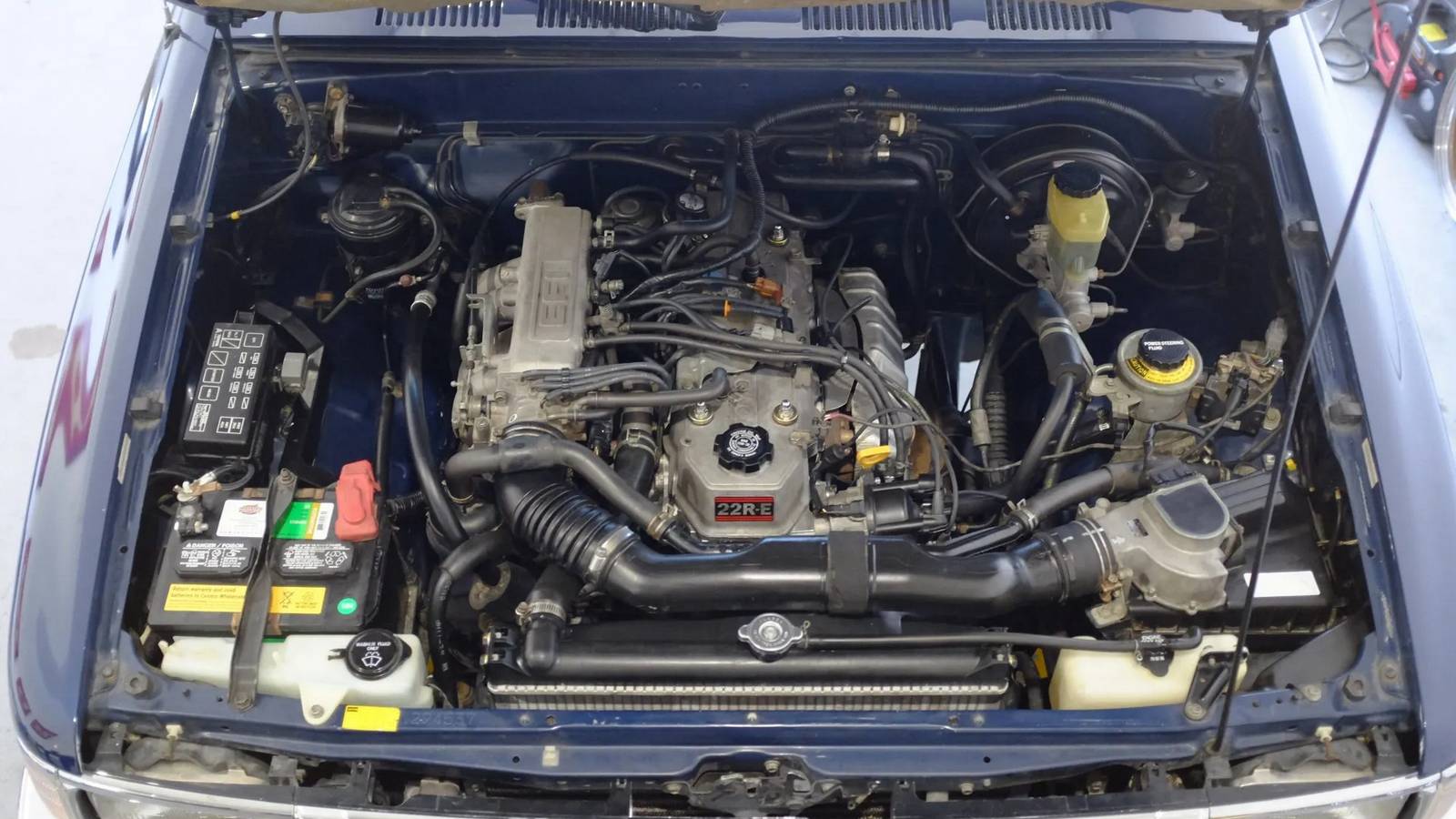
Find someone who has built an engine or two, and they will always tell you the same thing: Toyota’s reputation wasn’t built in a marketing department. It was proven through trial by fire. The stories of Toyota’s legendary reliability are so fantastic nowadays that it has gotten to the point where it’s essentially modern mythology. We all know about the indestructible nature of the Hilux pickup and its off-road prowess, while the Toyota 4Runner regularly made it to 300,000 miles without an engine rebuild, like it’s nothing. For decades, the very lifeblood of the American Southwest was none other than this iron-block inline-four: the 22R.
If you answered that the 22R inline-four was the engine that helped Toyota dominate America, it would be a smart answer. This simple and sweet engine cemented that Toyota knew how to build a durable powertrain that could withstand the test of time, before the brand ever gained the reputation for reliability as one of its selling points. It proved that Japanese engineering was more than one step ahead of anything Detroit had to offer when Detroit still wasn’t taking Japanese vehicles seriously. But that’s the wrong answer.
The Engine That Started The Legend

TheToyota22R started production in 1982, and variants were in production until about 1995. 16 years of continuous production tells you a lot about how solid this inline-four engine was.
The DNA Of The 22R

The 22R displaced a healthy 2.4 liters from an iron block, began as a carbureted unit, then later gained fuel injection as the 22R-E. Was it fast? No. Did it get good fuel economy? Not at all. Was it refined and quiet at idle? Absolutely not. Its redeeming quality? It was indestructible.
The 22R-E would go on to power the Pickup, 4Runner, and the T100 — trucks that became legends in commercial applications or on off-road expeditions. You could drive these trucks to and from work, then go off-road on the weekend and do it all over again the next week without problems. The 22R-E will get you there, and even if you didn’t treat it well, it will still be happily running 10 years later. The 22R-E ate up miles like it had a point to prove, and these engines covered hundreds of thousands of miles on a consistent basis despite daily abuse.
The Scope Of The 22R Was Its Limitation

The reliability of the 22R engine family was undeniable, but its limitation was scope. The 22R was always a truck engine — a workhorse built for durability but not versatility. It never found its way into commuter sedans. It never became the engine of choice for minivans, crossovers, sports cars, or luxury cars. Those market segments are the ones that generate the type of volume necessary to truly dominate the American market — and the 22R was never present in any of them. Toyota won the hearts of truck owners across America with the 22R, but the car-driving metropolitan public would need something else entirely to win over urban car buyers.

The Buy-It-for-Life Brand That Wins Over Customers Year After Year
Learn what this Japanese brand offers that produces its die-hard supporters.
The Engine That Is Overlooked

In 1993, the 22R inline-four engine family was past its prime, and Toyota was expanding its engine infrastructure. One engine that is often overlooked despite laying the foundation for future greatness is the MZ V-6 engine family, specifically the 3.0-liter 1MZ-FE first found in the 1994 Toyota Camry.
The Strength Of The MZ V-6

The Toyota MZ V-6 was Toyota’s second V-6 engine family, with the first being the VZ engine family introduced in the 1988 Toyota Camry. The MZ V-6 would power a wide variety of Toyota models, including the Camry, Avalon, and Sienna. The V-6 engine would also eventually power the Lexus ES 300 and Lexus RX 300, one of the first engines shared between both brands. Though not Toyota’s first V-6, it was the first that regular Americans encountered in meaningful numbers. The best part about it was that it was smooth like butter, reliable, and had enjoyable dynamics. No matter whether the application was a family sedan or a minivan, the MZ V-6 felt at home.
The MZ’s Impact And Limitations

Variants of the MZ V-6 engine family were in production for 21 years. The 3.3-liter 3MZ-FE variant was the sole powerplant of the world’s first luxury hybrid vehicle, the Lexus RX 400h. The MZ V-6 helped Toyota crack the mid-sized sedan segment and gave Lexus a clear edge by effectively establishing the luxury crossover market that is still red-hot among shoppers today. If this article were published in 2006, the MZ V-6 might be the right answer. Its only problem is that the MZ V-6 didn’t age as well as some of its other counterparts from a technical perspective. Toyota needed an engine that could carry every segment in its growing vehicle lineup, and the MZ V-6 wasn’t capable of handling that challenge. The Japanese company was about to make its most ambitious push in the American market, so the success of this idea needed to be certain. The MZ V-6 engine family was the proof of concept, and what came next was the execution.

This Toyota Hybrid Regularly Hits 300,000 Miles With Almost No Repairs
Toyota’s focus on efficient, smooth, and durable hybrid systems contributes to their reputation for lasting over 300,000 miles with minimal repairs.
The Engine That Actually Flipped The Switch

In 2005, Toyota quietly introduced the 2GR-FE V-6 with the debut of the new Toyota Avalon. On paper, it looked like a strong evolution of its predecessor. In reality, it achieved a goal Toyota had not yet managed: a single engine architecture functioning neatly across nearly the entirety of its vehicle lineup.
The Automotive Swiss Army Knife

The 2GR-FE was a 3.5-liter DOHC V-6 with dual VVT-i and 268 horsepower in its base configuration. The 2GR-FE utilized a timing chain design as opposed to the timing belt found in its predecessors, a significant upgrade that paid dividends towards its reliability. Of course, the 2GR-FE served as the heart of the bestselling car of the 2000s: the Toyota Camry. Then, Toyota put it into the Highlander and made it into one of the most influential mid-sized crossovers of its generation. After, they threw it in the Sienna, and it instantly became the most dependable minivan on the market.
There was almost no Toyota product left untouched by the 2GR-FE. From the Tacoma to the Venza, its impact was felt. It even became the defining engine of Lexus’ lineup, featured in the RX, IS, ES, and GS models, designated by the 350 numbering. Toyota knew that anything the 2GR-FE touched would turn to gold, so they even gave TRD free rein and let them build a racing variant for endurance competition. This is how Toyota dominated the American market. It didn’t build one good vehicle, one use case, or target one major demographic. It targeted every use case imaginable with dozens of vehicles, all with the same core engine. The 2GR-FE proved itself to be the definitive one-size-fits-all V-6 engine. Detroit had no response to match the sheer versatility and strength of the 2GR-FE. By the time they realized how much they were losing, all they could do was sit back and look in disbelief at how far they had fallen behind.
Built To Near Perfection

What is it about the 2GR-FE that makes it so flexible and capable of handling a variety of challenges? It all came down to its core engineering philosophy that emphasized longevity. The aluminum block was lightweight and ensured that weight wasn’t a penalty where it mattered, especially in products like the Camry. Dual VVT-i was a new improvement that its MZ predecessor lacked, giving Toyota the flexibility to adjust the engine’s behavior according to its application. That’s why the 2GR-FE felt natural in both a Toyota Tundra and a Lexus ES.

Although its foundation never changed, the 2GR-FE did see incremental iterations and improvements year after year. Eventually, there would be direct-injected versions, turbocharged variants, and hybrid-paired options that have kept this V-6 engine relevant decades later. One of the key developments, the 2GR-FKS, is a revised version with both port and direct injection, which solved the carbon buildup issues that were prevalent among direct injection-only engines. Most other automakers avoided addressing the problem entirely, whereas Toyota had designed a solution before people even asked for it. If there has ever been a definitive engine that represents Toyota as a brand, it is the 2GR engine family.

Uncover the details about the longest-lasting car engines of the past two decades.
Why The 2GR V-6 Still Matters

45 years ago, Toyota gave us a taste of the 22R for the first time. Nowadays, this engine lives on in project cars and off-roaders and remains as durable as it was back in its heyday. This Toyota inline-four’s reputation is mythological in 2026, but it was the decades of consistency that cemented its legend. In the end, this power unit was amazing, but its scope was narrow, as it only truly shone like a workhorse truck engine. It represented survival, not refinement.
The 2GR V-6 Is Still Here

Somehow, someway, you can still get a 2GR V-6 in a brand-new Toyota product today. That sentence has remained true since 2005 because some engines are just too good to replace. Currently, the 2GR V-6 is no longer available in any current Toyota models, but it is still available as the sole engine option in the 2026 Lexus IS sedan as well as the 2026 Lexus TX 550h+ Luxury AWD. The 2GR V-6 has managed a longevity that most engines could never even imagine was possible. Toyota’s dominance of the American market didn’t come from any singular event or vehicle. Instead, the Japanese company relied on trusting what they know: building the most competitive and most capable powertrain that could function across all segments. The timing was perfect, but the execution was even better. The 22R won our hearts off-road, but the 2GR-FE won Toyota the entire nation.
Sources: Toyota, Lexus