
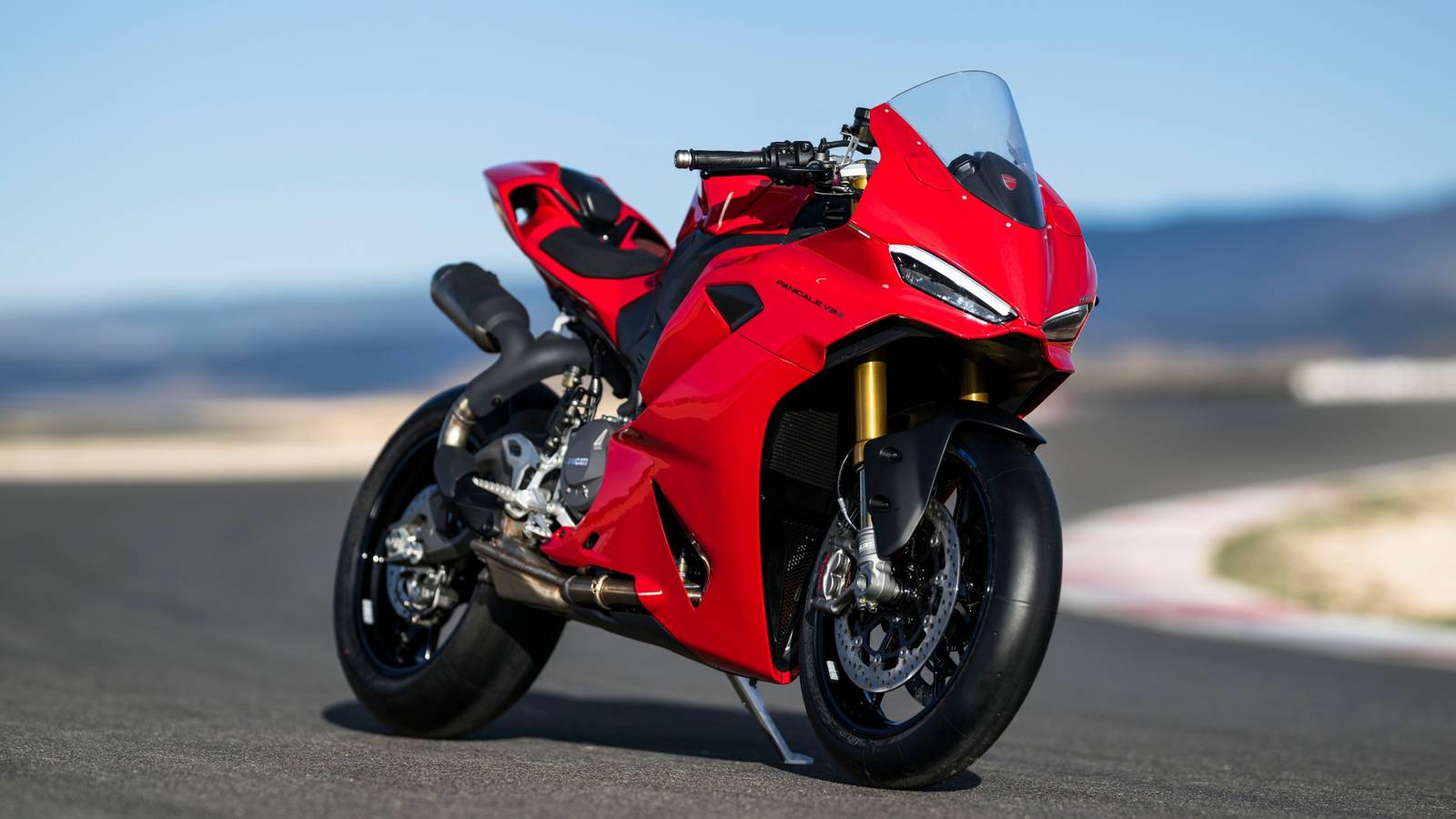
Ducatis have always a reputation for being prima donnas. They also sacrifice everything at the altar of speed: practicality, reliability, and pretty much anything logical. They still sell, because the highs that they manage with this no-compromise approach far outweigh the lows of the dreaded Desmodromic valve clearance check and adjustment.
In recent years, however, Ducati has made a conscious effort to change this perception with real change in its products. The biggest one is ditching the holy desmo setup. Likewise, the new bikes chase light weight rather than more power for better performance. That’s not to say that they have lost the essence of what makes them Ducatis; they’ve merely shed a lot of their negatives. And there is no better example than the Ducati that feels exotic, usable, and less intimidating than you’d expect.
The Panigale V2 Is The Ducati That Feels Exotic, Usable, And Less Intimidating Than You’d Expect

Ducati sport bikes are the purest distillation of what Ducati stands for, but for its middleweight Panigale, Ducati has pivoted and decided to make it more accessible to a wider audience. The Panigale V4 is still pure Ducati, but the V2 is now more like a sport bike that can commute. At the same time, the way it looks and feels is special. It ends up feeling both exotic as well as usable, because it is less intimidating than you’d expect.
Ducati Panigale V2 Price: $16,995

The new Panigale V2 still has premium pricing, but it sits somewhere between the middleweight sport bikes and the liter-class ones. The pricing is still premium, and if you load it with accessories or opt for the Panigale V2 S, you’ll easily slip into liter sport bike territory, but a case can be made that the base price of under $17,000 is almost reasonable for a Ducati sport bike!
Ducati Panigale V2 Engine

Look at the spec sheet, and it seems like Ducati decided to take a step back with the new Panigale V2. The old Panigale was a power-hungry monster that didn’t care for daily life. Whereas, the new one eschews Desmodromic valves for regular valve springs, it has lower displacement and peak power. The only nod to modernity (on the spec sheet, at least) is the introduction of variable valve timing for the intake valves.

The new V2 retains the 90-degree V-twin format, but displaces 890 cc, and generates 120 horsepower at 10,750 RPM and 69 pound-feet at 8,250 RPM. It still retains its short-stroke character and has a high compression ratio of 13.1:1. All of this might make it sound like a high-revving engine, but the truth is that 70 percent of peak torque is already available by 3,000 RPM.
A by-wire throttle and six-axis IMU are standard, so you do get ride modes, cornering traction control, wheelie control, and engine brake control. Meanwhile, the six-speed gearbox has a hydraulically assisted assist and slipper clutch, and a two-way quickshifter is standard. Despite all the apparent drawbacks, the new Panigale V2 isn’t significantly slower than the Panigale V2 it replaces!

10 Affordable Alternatives To The Ducati Panigale V2 In 2025
Who knew you could get a handful of liter-class superbikes that cost less than the Panigale V2 S in 2025?
Ducati Panigale V2 Chassis

The Panigale V2 carries on the monocoque design that is also used on the Panigale V4. It uses aluminum, and gives ‘engine as a stressed member’ a whole new meaning. The monocoque is bolted onto the cylinder head, while the rear subframe attaches to the rear cylinder head. There is a hollow aluminum two-sided swingarm, and a Lithium-ion battery that saves weight. As for suspension, you get 43 mm Marzocchi fully adjustable inverted forks paired with a fully adjustable Kayaba single shock at the rear. Travel stands at 4.7 inches at the front and 5.9 inches at the rear.
The brakes are serious: twin 320 mm semi-floating discs at the front with Brembo M50 monobloc calipers that are radially mounted, fixed, and with four pistons each. At the rear, a 245 mm disc has a two-piston fixed caliper. Cornering ABS is standard and has three levels of adjustability. 17-inch Y-spoke alloy wheels are shod with Pirelli Diablo Rosso tires for maximum grip on tarmac.
Ducati Panigale V2 Dimensions

This remains a relatively compact bike, but not uncomfortably so. The seat height is a relatively tall 33 inches, and the wheelbase is 57.7 inches. Its tank holds a very reasonable 4 gallons, but the big step forward has been in terms of weight. The Panigale V2 weighs 395 pounds wet, with no fuel.
That comes from weight-saving in different places. For instance, this is the lightest V-twin engine Ducati has ever produced (20 pounds lighter than the Superquadro engine it replaces). Add to that the frame’s 8.8 pounds, and this new Panigale V2 has managed to shed 33 pounds over the older model.
Ducati Panigale V2 Features

The Panigale V2’s forte is speed and versatility. The feature set is geared towards those two things, not really toward flashy-looking things as such. It does have the basics covered: there is a 5-inch TFT screen that displays everything you could possibly need to customize all the parameters of the electronics. However, Ducati persists in making Bluetooth and navigation optional extras, so you will have to spend $372 on the Bluetooth module, and a total of $688 for the GPS module and turn-by-turn software. That’s another $1,000 added to the Panigale V2’s price. We’d also want to add tire pressure monitoring, which is another $561.

If you want to convert it to a track machine, there are a lot of bits and bobs that you can add, including a lap timer, tire warmers, an Ohlins steering damper, adjustable aluminum footpegs, sporty handlebars, a larger windscreen and racing fairing, covers for the holes left by the mirror mounts and number plate mounts, various carbonfiber bits… the list is endless. Suffice it to say that you can convert the Panigale V2 to an old-school Ducati sport bike (somewhat) with the right accessories.

10 Powerful Motorcycles Coming In 2026
The smallest offering here boasts the most powerful single-cylinder engine on sale today
Ducati Panigale V2 Competition

The Panigale V2’s true rival is the Yamaha YZF-R9. It has similar power, targets a similar audience, and at $12,499 is significantly cheaper, especially since you don’t have to put in extra money for Bluetooth and navigation. However, it doesn’t meet the ‘exotic’ criteria. The Aprilia RS660 Factory certainly meets that, but it belongs in a class below, both on price ($13,999) and performance.
One could consider a liter sport bike like the Honda CBR1000RR ABS ($17,299). The Fireblade is the most docile of all the liter bikes, but it is only exotic because so few sell these days. And an old school liter bike can be plenty intimidating if you reach the higher reaches of the rev range.

If we’re looking for exotic, usable, and less intimidating than you’d expect, allow us to propose a left-field choice: the Aprilia Tuono V4 1100. At $16,399, it is priced right within the ballpark of the Panigale V2. It also has options that will allow you to customize it to your preferences, whether as a daily bike or a trackday tool. Its mill is torquey, yet has awesome power on tap. Being a sport naked, it is definitely usable and has a less intimidating riding position. Oh, and it is just as Italian and as exotic as the Panigale V2.
Ducati Panigale V2 Vs Aprilia Tuono V4 1100
|
Model |
Ducati Panigale V2 |
Aprilia Tuono V4 1100 |
|
Price |
$16,995 |
$16,399 |
|
Engine |
90° V-twin |
65° V4 |
|
Displacement |
890 cc |
1,099 cc |
|
Power |
120 HP @ 10,750 RPM |
180 HP @ 11,800 RPM |
|
Torque |
69 LB-FT @ 8,250 RPM |
89.2 LB-FT @ 9,650 RPM |
|
Curb Weight |
395 pounds (wet) |
465 pounds (wet) |
Source: Ducati USA