
The world’s first mass-market production hybrid electric vehicles (HEVs) but the first mass-market hybrid that would reach North America would be the Honda Insight in 1999, which was classified as a 2000 model-year vehicle. Both are small cars which saw HEVs as an experimental drivetrain at the time. Eventually, both Honda and Toyota scaled up their hybrid systems, fitting them to an increasing number of models, both bigger and smaller than the last.
However, whereas all of today’s hybrids come with an automatic, did you know that Honda used to offer a manual hybrid? The Insight was fitted with either a five-speed manual or a CVT, and its production run lasted from 1999 to 2006. It won’t be until 2010 that Honda will reintroduce a manual hybrid that combines the forward-thinking innovation of the Insight, but also the sporting character of the CR-X, one of the quirkiest and most fun two-door front-wheel drive (FWD) cars to come out in the late ’80s.

The Affordable Honda Hybrid That’s Perfect For A First-Time Buyer
First time buyers are often stretched for money, but looking for a car that is a good investment. Honda hybrids are affordable and offer great value.
The CR-Z is CR-ZY

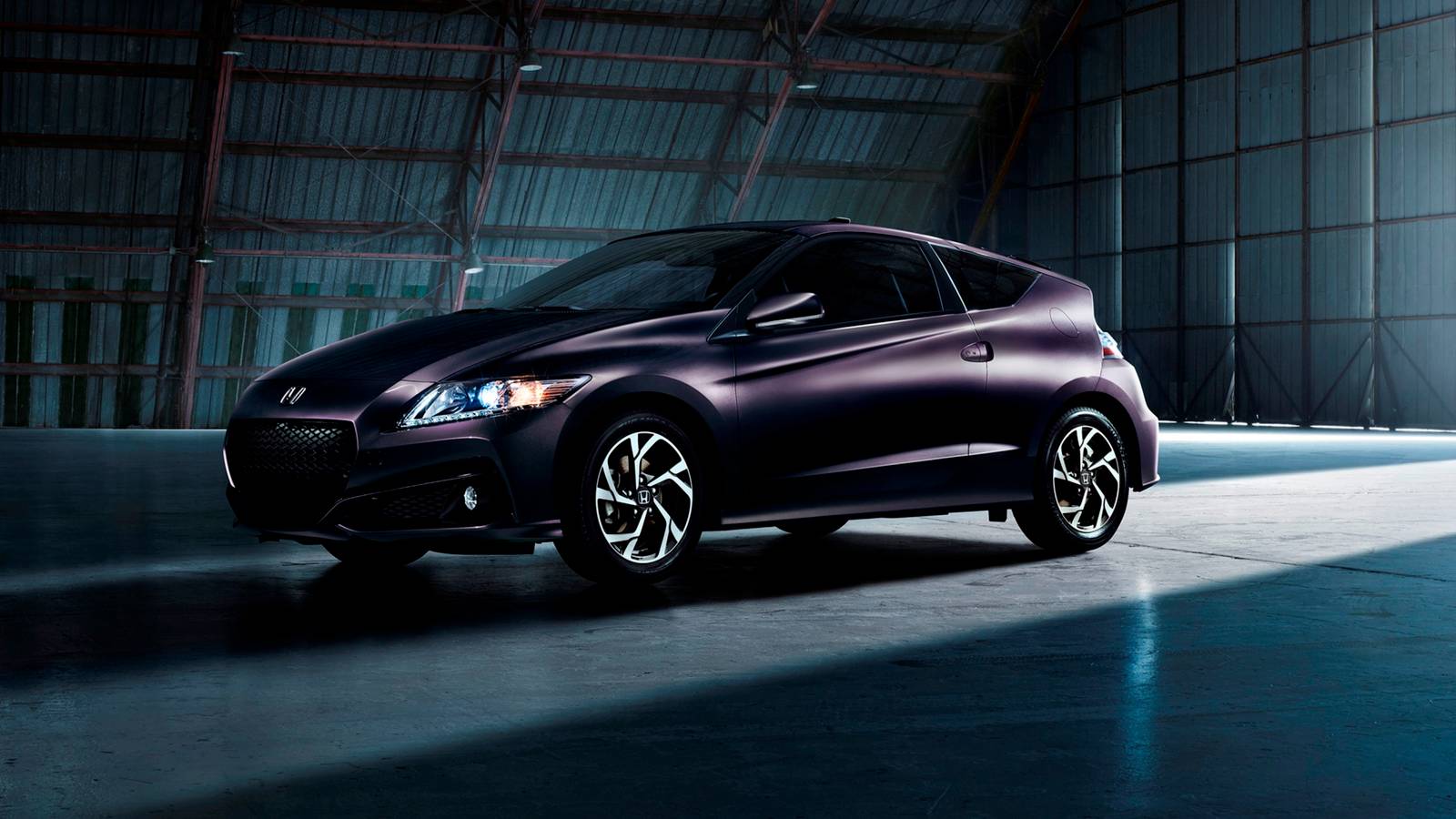
I’m sorry, I just had to get that out of my system. But yes, the manual hybrid or HEV in question here is the 2011-2016 Honda CR-Z–the spiritual successor to both the Insight and the CR-X. Unlike the Insight, the CR-Z became a core product of the Honda range, rather than just another alternative powertrain experiment.
How Honda Added A Manual To A Hybrid

With today’s hybrids being purely an automatic affair, especially with the complication of managing two powertrain sources, how was Honda able to utilize a six-speed manual? Well, you have to first understand how the Honda Integrated Motor Assist (IMA) system works. Right off the bat, Honda’s IMA is a pure parallel hybrid system, which means that the electric motor is sandwiched between the engine and the transmission. The other manual hybrid to get the IMA system apart from the 2000-2006 Insight and the 2011-2016 CR-Z was the 2003 Honda Civic Hybrid, which, when fitted with the five-speed manual, was the most efficient five-passenger sedan at the time.

The IMA system’s electric motor, however, isn’t strong enough to propel the car in pure electric mode. This is unlike Toyota’s series-parallel or power-split Hybrid Synergy Drive (HSD) system, which can run in pure electric mode for short distances. The best that the IMA’s electric motor could do in the CR-Z’s implementation is for it to rapidly start the engine when letting go of the brakes at a stoplight. The improved fuel efficiency and low emissions came from the augmentation of the electric motor. This allowed Honda to use a smaller engine–in this case, a 1.5-liter four-cylinder. At the CR-Z’s peak when a powertrain update was introduced for the 2013 model year, its system output was 130 horsepower and 140 pound-feet of torque–nearly the same as its 1.8-liter four-cylinder i-VTEC engine at the time.
Honda CR-Z Specs
|
2011-2012 |
2013-2016 |
|
|
Engine |
1.5-liter four-cylinder parallel hybrid system |
1.5-liter four-cylinder parallel hybrid system |
|
Horsepower |
121 hp |
130 hp |
|
Torque |
128 lb-ft |
140 lb-ft |
|
Transmission |
5-speed M/T, CVT |
5-speed M/T, CVT |
|
Drivetrain |
FWD |
FWD |
|
Fuel Economy (Combined) |
34 MPG (M/T) 37 MPG (CVT) |
34 MPG (M/T) 37 MPG (CVT) |
It Was A Mild Hybrid At Best

That’s one way you can think about the Honda IMA system. Compared to Toyota’s HSD full-hybrid system, IMA is more like a mild hybrid–albeit a stronger one since the electric motor integrated within the driveshaft contributes to the power output. Since it can’t run in pure electric mode anyway, there’s no engine handover to deal with in the manual transmission’s design. This is the biggest reason why manual hybrids don’t exist today. At best, only a manual mild hybrid or, in the CR-Z’s case, a manual parallel hybrid that can’t run in pure electric mode.
This is pretty much how the first-generation Honda Insight also worked. Yes, it was one of the first HEVs to reach mass production, but like the CR-Z, it was a mild hybrid at best. It helped the Insight achieve low emissions and improved efficiency, being rated by the California Air Resources Board (CARB) as an Ultra Low Emissions Vehicle (ULEV) for the manual version and Super Ultra Low Emissions Vehicle (SULEV) for the CVT. The CR-Z achieved a similar status, being rated as an Advanced Technology Partial Zero Emissions Vehicle (AT-PZEV) by CARB when the sporty manual hybrid went on sale in 2010.

The Cheapest Honda Hybrid With More Than 500 Miles Of Range Today
The cheapest Honda hybrid with more than 500 miles of range also happens to be the 2025 North American Car of the Year.
Everything Else That A CR-Z Offered

The Honda CR-Z demonstrated how electrification to a certain degree can be used for performance improvement applications. The CR-Z was able to have the power output of a 1.8-liter i-VTEC engine when it got a facelift, despite using a smaller and thus, more efficient and less-polluting 1.5-liter i-VTEC engine. But apart from its novel hybrid (or mild-hybrid) IMA system, the CR-Z also had a few standout traits going for it.
Striking Looks Inside And Out
I think we can mostly agree that 2005-2012 was Honda’s peak era in terms of design. It began with cars like the eighth-generation Civic (famously called by its generation code “FD”) having a sleek and radical “monoform” design that debuted to universal acclaim in 2005, and that was complemented by a highly futuristic interior design with blue-lit dot-matrix LCDs and gauges. That level of futurism and advanced design transcended into the CR-Z, and because it was a modern interpretation of the Insight and CR-X, oh boy did this three-row small sporty car make a bold statement in 2010.
The same goes for its interior, whose blue-lit gauges and displays, along with its driver-centered cockpit, were screaming “Star Trek” vibes all over. I seriously hope that the era of striking design from Honda comes back, because even today, in 2025, the CR-Z looks right at home. Nevertheless, that interior, while stylish and striking, wasn’t spacious. But that probably isn’t surprising, since it’s a two-door fastback anyway that’s mostly meant for young lads who just got out of college or a family man treating the CR-Z as a second car.
Sporty Driving Dynamics To Boot

The Honda CR-Z shared a similar architecture with the Honda Fit and the Insight, which means that right off the bat, you’ve got a small car that feels nimble and sporty. The CR-Z back in 2015 was one of my first press cars, and so I actually had fond memories of it. In particular, the CR-Z’s steering felt so sharp that it made this small car feel really like an extension of you, especially when nipping through gaps in traffic. Furthermore, the CR-Z’s five-speed manual, in typical Honda fashion, is precise and well-weighted, making it a joy to use.
Likewise, that 1.5-liter IMA hybrid system, while not very powerful, was just right for the car. Before the 2013 powertrain update, the CR-Z’s output was a modest 121 horsepower and 128 pound-feet versus the 130 horses and 140 pound-feet it received in 2013. Whatever the case, both powertrain versions made the CR-Z feel spritely due to the electric motors providing boost to the engine, and the manual just helped the CR-Z feel even more engaging to drive.

10 Hybrids That Balance Fuel Economy With Good Performance
Hybrids are exceptional options in almost all catagories, but sometimes we need to balance fuel efficiency with performance.
Here’s What Led To Its Downfall

The Honda CR-Z may seem like a cutting-edge sporty vehicle. After all, marrying a hybrid with a manual transmission sounded like an ingenious way to boost performance and fuel economy. The problem is, that high expectations are often a double-edged sword. What sounded like a great idea on paper wasn’t necessarily translated into an excellent vehicle.
It Wasn’t THAT Fuel Efficient

Customers who are drawn to hybrids at the time are driven by one singular motivation–fuel economy. Sure, while the CR-Z achieved AT-PZEV status with CARB, its fuel efficiency wasn’t great–for a hybrid. The EPA rated the CR-Z to do a combined 37 MPG for the CVT, while the manual did even less at 34 MPG combined. That was merely at the same level as the 2012 Honda Civic HF (the most efficient gas-powered Civic at the time), which did a combined 33 MPG. The 2012 Civic Hybrid, on the other hand, was rated at 45 MPG, and that would also be the last time that the IMA system would be used in any new Honda moving forward.
Oh, and to add insult to injury, did you know that the EPA rated the 1988 Honda CR-X HF to have a combined fuel economy of 44 MPG? The CR-X isn’t even a hybrid, but it was smaller, lighter, and thus, also felt more nimble than the CR-Z, and that leads us to this vehicle’s next major hurdle.
And, It Also Wasn’t THAT Sporty

Okay, so the CR-Z really did feel sporty and fun to drive, but when you start to compare it to what it was similarly priced with when it was on sale, then you’ll see its next challenge. The CR-Z’s base price is only a few thousand less than the sportier and faster Civic Si, which had a more powerful and great-sounding 2.0-liter K20 i-VTEC four-cylinder–one of the last few Honda engines to have the true camshaft-profile-changing VTEC. Finally, when spec’d to its fully-loaded EX with Navigation trim, the CR-Z was also priced at around $23,000, which is only a smidge less than the $24,000 asking price of the Scion FR-S, the former name of the first-generation Toyota 86.
And, that’s when the CR-Z started to fall into a gray, no man’s land, where it wasn’t efficient enough for a hybrid, nor was it fast or fun enough to compete with cars like Honda’s own Civic Si or even the rear-wheel drive (RWD) Scion FR-S. Oh, and let’s not forget that the Mazda MX–5 Miata in NC form also existed at the same price as a range-topping CR-Z EX with Navigation. In 2015, Honda revealed a 2016 model year facelift for the CR-Z, but it still wasn’t enough for buyers to be attracted to this small sporty hybrid, and a year later, the CR-Z would officially be killed in the United States. Cumulative sales of the CR-Z stood at just 35,040 examples, which makes this sporty two-door a rarity in today’s roads.