
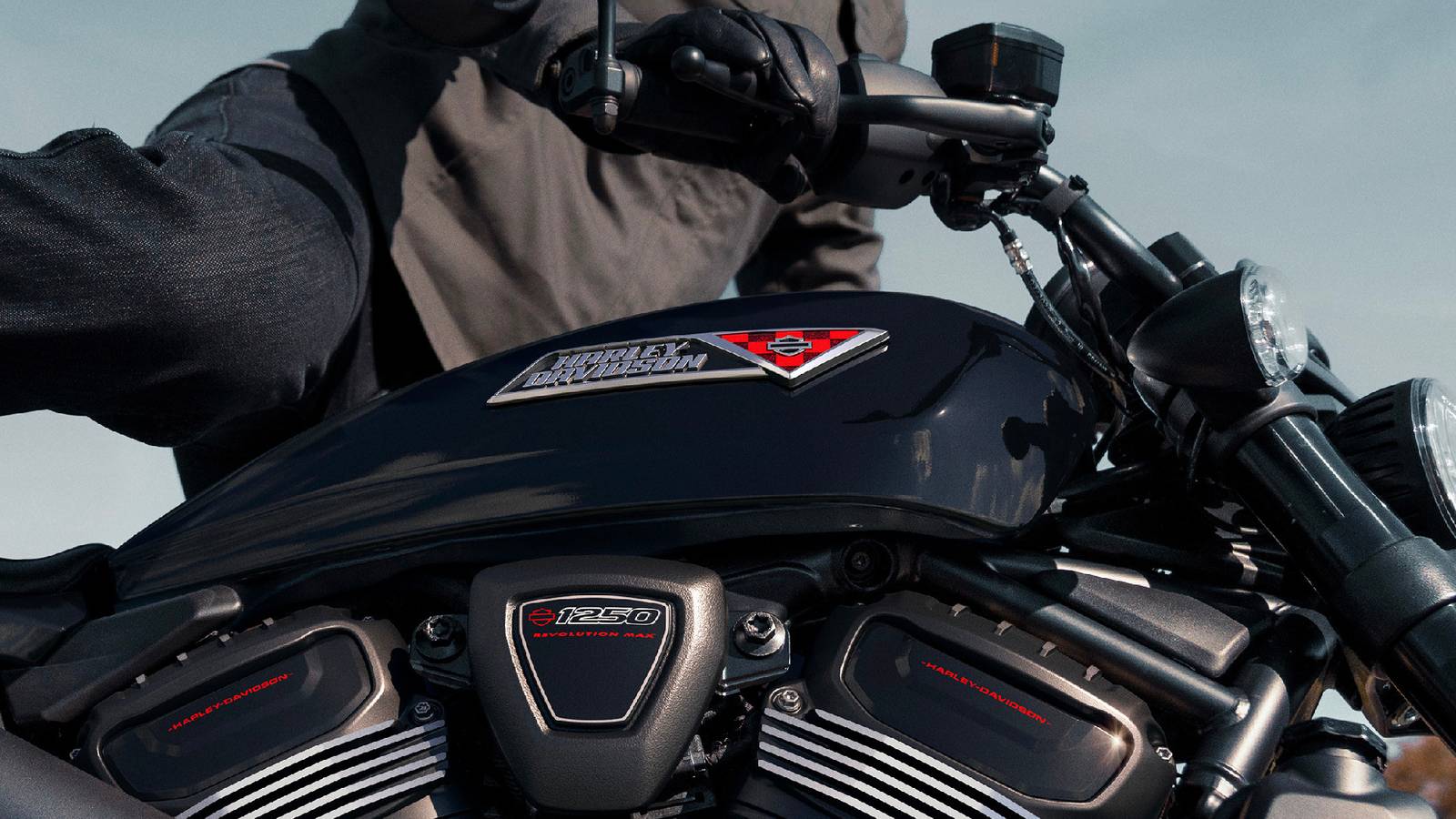
Harley-Davidson and Indian Motorcycle are the founding pillars of the cruiser segment. The general formula for a cruiser bike includes a big V-twin, a low-slung, stretched-out design, and very comfortable ergonomics. Sportiness is not a priority here, and hence cruiser motorcycles are rarely associated with sporty dynamics, aggressive ergonomics, or grin-worthy performance. However, thanks to the ever-increasing popularity of this segment, cruiser bikes are a lot more vibrant today. A surprising testament to that comes from an iconic Harley-Davidson nameplate.

The Cheapest Harley-Davidson That Still Feels Like A Harley
This chromed-out cruiser is the most affordable Harley-Davidson with the Milwaukee-Eight 117 engine at $14,999.
Cruiser Bikes And Sportiness Seldom Go Together

The priority for cruisers lies in comfort, style, and character. Comfort is provided by well-padded (sometimes extra-padded) seats, a wide, tall handlebar, and forward-set footpegs. Styling is a no-compromise element on a cruiser bike and is characterized by classic-vibing body panels (in metal) and lots of chrome across the bodywork.

Finally, character is usually via a huge engine (most commonly a V-twin) that emphasizes low-RPM torque over high-revving power. Its characteristic long rake angle also makes cruiser bikes harder to maneuver. The low-slung design gives cruisers low ground clearance, making it tough to handle sharp, high-speed corners. All of these features surely contribute to a cruiser bike’s presence and charm.
A Few Cruisers Break The Norm

Changes in the industry and market trends have sprouted a new wave of cruiser bikes that stray away from the norm. A prime example is the CFMoto 450CL-C, which shares its engine and a few chassis components with the track-ready CFMoto 450SS. This helps the 450CL-C fuse nimble riding dynamics and a high-revving mill with neo-retro design and fairly relaxed ergonomics.

Another exciting example is the all-American Buell Super Cruiser. This badass-looking cruiser bike has a muscular old-school chopper charm that neatly hides a superbike-derived engine and chassis combo. Most of the underpinnings on the Super Cruiser are shared with the Buell Hammerhead 1190, including the lightweight alloy wheels and even some suspension hardware.

A shoutout also goes to the Triumph Rocket 3 Storm GT. It is powered by the biggest production motorcycle engine ever, which is a longitudinal inline three-cylinder mill with a displacement of 2,458 cc. You get 179.5 horsepower and a scarcely believable 165 pound-feet of torque on tap. As sporty as this sounds, there is one Harley that promises surprisingly more sportiness while still retaining the OG V-twin experience.
The Harley-Davidson Sportster S Is Surprisingly Sporty
Price: $15,999

We’re talking about the flagship liquid-cooled H-D cruiser: the Sportster S. The Sportster S’s sporty appeal stems from a combination of a compact form factor, a high-revving V-twin engine, ride-enhancing electronics, and an impactful street presence. All of these features are enclosed in a minimal, weight-saving design. Its design is primarily inspired by a blend of Harley’s racing heritage (including the XR750 flat tracker) and the stripped-down look of a classic bobber.

Its chassis is also designed for performance, with increased rigidity. All of its features are a drastic shift from what a traditional Harley-Davidson is associated with, especially a “Sportster”. All of this for under $16,000 makes the Harley Sportster S one of the most value-packed power cruisers today.
From Raw And Simple To Refined And Sophisticated
A Crowd Favorite Since 1957

From its inception, the Sportster has been a rebel. The 1950s XL Sportster was the first of its kind, giving Harley-Davidson fans a smaller, nimbler alternative to the larger, heavier FL bikes. Ironically, the lightweight, barebones form factor, coupled with a torquey big-twin, made the Sportster a crowd favorite. Various sub-models, such as the XLH Sportster tourer, the XLC Sportster off-roader, and the XLRTT special edition, made the Sportster much more desirable to a wider fan base.

A major shift occurred in 1986, when Harley replaced the Ironheads with the Evolution lineup of V-twins on the Sportsters. The most notable of this lot are the 1990s XL1200C and XL1200S. The 2000s saw a major chassis redesign, bringing in rubber mounts, an enclosed battery, and a new oil tank. In 2007, Harley introduced fuel injection to the Sportster family. The updates after that were mostly related to electronics.

Then in 2021, the Sportster got its boldest upgrade yet. Harley reintroduced the iconic nameplate with the all-new Sportster S. This was a whole new breed, packing the latest and greatest performance and technology features courtesy of the Revolution Max liquid-cooled V-twin. Some of the coolest Sportster models that Harley has treated us with over the decades include the Forty-Eight, the Seventy-Two, the Iron 883, and, of course, the bold-new Sportster S.
The Sportster S Is The Most Powerful Harley Cruiser In 2026

The Revolution Max V-twin powers the 2026 Harley-Davidson Sportster S. It is a modern mill with liquid-cooling, hydraulic self-adjusting lifters, and VVT intake and exhaust valves (four per cylinder). With a bore x stroke of 4.134 x 2.846 inches, its short-stroke design helps this sporty Harley rev notably higher.
You Get Over 120 Ponies

The Sportster S produces 121 horsepower at 7,500 RPM and 93 pound-feet of torque at 6,000 RPM. Power is sent to the rear wheel via a six-speed gearbox and a belt final drive. This mill is both torquey and high-revving, unlike a traditional Harley.
The Modern Underpinnings Keep The Weight Low
Curb Weight: 502 pounds
The Sportster S utilizes an alloy-steel trellis frame, coupled to an alloy-steel swingarm. The choice of a trellis frame helps reduce overall weight, as the engine is used as a stressed member. That results in a curb weight of 503 pounds. As for suspension, you get fully-adjustable 43 mm inverted front forks with 3.6 inches of travel. The rear gets a fully-adjustable linkage-mounted piggyback monoshock with 3.2 inches of travel.

Braking duties are taken care of by radially-mounted monoblock 4-piston calipers up front and a floating single-piston caliper at the rear. Grip duties are courtesy of grippy Dunlop Harley-Davidson Series GT503 tubeless tires; 160-section up front and 180-section at the rear. These are wrapped around lightweight cast aluminum 17-inch front and 16-inch rear wheels.
Aggressive Ergonomics, But No Space For A Second

The muscular-looking Sportster S is compact for its class, with a wheelbase of 59.8 inches, overall length of 89.4 inches, and width of 33.1 inches. It has a low ground clearance of 3.5 inches. This notably lowers the seat height to 30.1 inches, making the Sportster S relatively accessible. While Harley deploys a cruiser-esque rider triangle with forward-set footpegs and a wide handlebar, the rider sits with a slight forward lean to complement the Sportster’s sporty character.
Topped With Advanced Electronics

Harley-Davidson has loaded the Sportster S with top-spec technology features. It comes with a 4-inch TFT screen, Bluetooth, and navigation as standard. A six-axis IMU helps weave together all of its safety features, including ABS, Electronic Linked Braking, traction control, Drag-torque Slip Control System, Vehicle Hold Control, and Wheel Lift Mitigation. The Sportster S is also equipped with standard cornering-enhanced versions of many of its safety features. Elevating the riding experience are features like an assist-and-slipper clutch, a by-wire throttle, and various ride modes, including custom user-defined modes.
Source: Harley-Davidson