
Honda is the largest two-wheeler manufacturer in the world, and it has become that on the back of sales of small, uncomplicated runabouts in developing markets. These products eschew all but the most necessary tech but retain the legendary reliability that we expect from Team Red. At the other end of the spectrum, Honda also sells the world’s most powerful naturally aspirated inline-four engine. It also joined the arms race in the late ’90s/early 2000s, developing engines with truly large displacements that culminated with the VTX1800 but has stepped back a little since then.
However, there is one model that prides itself on being larger than life, and it has one of the great engines of the two-wheeled world. It has a bunch of tech that even a few cars would be proud to have while fighting a lone fight for Japan when it comes to its segment. That model, of course, is the massively popular Gold Wing tourer, which has sold so well, especially in the United States, that it is celebrating its 50th anniversary this year.

Here’s How Much A 5-Year-Old Honda Gold Wing Costs Today
The current Gold Wing offers unrivalled luxury, and a 5-year-old example offers pretty good value
The Biggest Honda Engine In 2025 Belongs To The Gold Wing
Capacity: 1,833 cc

Honda decided to take on the Americans at their own game, and the result was the Gold Wing. It started life powered by a flat four-cylinder mill, but in its fourth generation, the increased displacement warranted an extra two cylinders, for a grand total of six. That’s right – the Gold Wing and premium Porsches both run similar engine layouts (not to mention gearboxes!).
Another fun way to look at the Gold Wing engine is that Honda has never made an engine with more than six cylinders for either cars or bikes. Shoutout to Honda Marine for making a V8, though! Back on two wheels, today in its latest avatar, the Gold Wing’s displacement has gone up to 1,833 cc, while the horizontally opposed six-cylinder layout remains. That makes it the biggest Honda motorcycle you can buy today. Capacity AND size-wise. More on that later.
Standout Features Of Honda’s Flat-Six Engine On The Gold Wing
Bringing Six-y Back

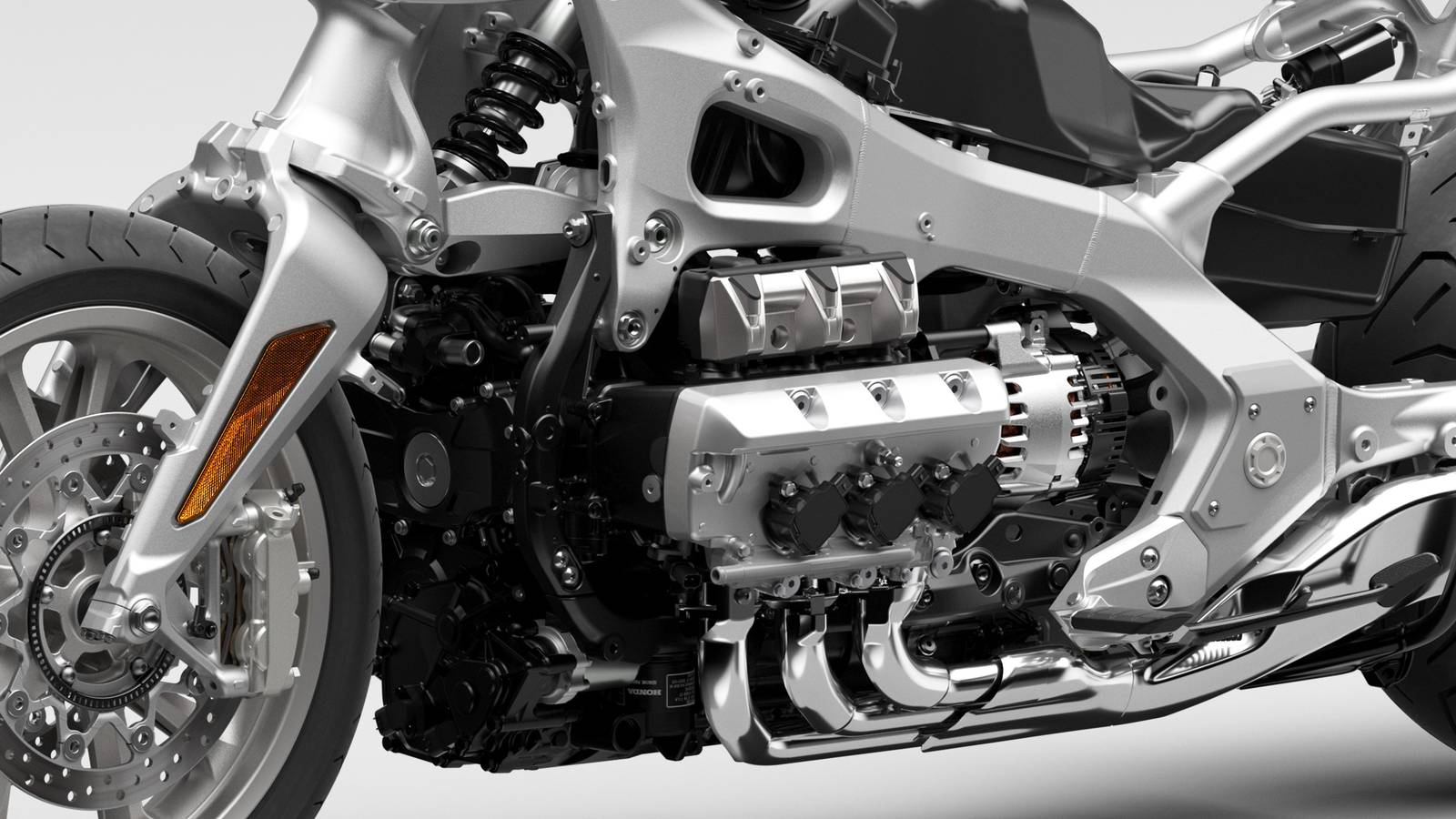
Let’s start with the basics: this is a liquid-cooled engine, and it has recently gained a four-valve-per-head configuration, a big difference from the previous-generation engine that displaced just 1 cc less. That means better airflow, translating to higher efficiency and lower emissions. It also runs Honda’s Unicam SOHC setup for its 24 valves, which reduces the head size – an important consideration that reduces the Gold Wing’s overall width at the bottom.
This means a greater lean angle can be achieved, and a narrow-bottomed motorcycle becomes accessible to a wider audience as well since you don’t need giraffe legs to get around that width. There isn’t any other high-tech wizardry going on here. No fancy VTEC system or forced induction is required for Euro 5 compliance from this engine. Moving on, notice that Honda calls it a horizontally opposed six and not a boxer engine.
That means each cylinder is on a different crank pin, meaning the power pulses can be tuned to the manufacturer’s convenience. Honda has chosen to keep an even firing order for a butter-smooth power and torque delivery. The goal here isn’t to maximize traction and shoot out of a corner like a cannonball, so there is no need for a big-bang firing order. Just a smooth but strong shove in your back.

A 180-degree configuration is usually longitudinal – BMW uses this format as well – and the cylinder heads stick out to make cooling an easier task than traditional transverse inline or V-shaped configurations. Porsche will also be quick to tell you that a horizontally opposed six-cylinder engine is shorter than an equivalent inline six, which means the Gold Wing engine is light and short for what it is. Of course, BMW has its own six-cylinder solution with the K 1600 GTL, but that’s a story for another day.
As befits a modern engine, the throttle is by-wire, and Honda has given it four modes: Tour, Sport, Economy, and Rain. Not only is the throttle response changed in each mode, but the combined braking system also changes with each mode. Lastly, Honda doesn’t use a conventional starter motor with the Gold Wing engine, instead, it opts for an integrated starter generator that doubles as a starter motor and alternator.

Honda Gold Wing: 50 Years Of The Touring Legend
The Gold Wing redefined the luxury touring segment and continues to be a benchmark
Honda Gold Wing Engine Specifications

|
Models That It Powers |
Gold Wing, Gold Wing Tour |
|
Engine Type |
Horizontally opposed six-cylinder, liquid-cooled, 4 valves per cylinder, Unicam SOHC |
|
Displacement |
1,833 cc |
|
Bore |
73 mm |
|
Stroke |
73 mm |
|
Compression Ratio |
10.5:1 |
|
Power |
124.7 HP @ 5,500 RPM |
|
Torque |
125.3 LB-FT @ 4,500 RPM |
|
Transmission |
6 speed manual/7 speed DCT |
|
Final Drive |
Shaft drive |
|
Top Speed |
NA |
|
Claimed Fuel Economy |
NA |
The Gold Wing Engine Is Part Of A Great Driveline
ISG Or DCT, It Has All The Best Acronyms

Honda has put the transmission under the engine, which helps reduce its length even more. It also lowers the center of gravity. The dual-clutch transmission is the only one of its kind in the world, with its seven forward speeds. It shifts differently based on what engine mode is selected and offers manual mode as well. There’s also a ‘crawl’ feature that makes parking lot maneuvers really easy, both forward and backward. The Gold Wing with the six-speed manual uses the integrated starter motor for this ‘crawl’ feature.
We wonder, in the future, if Honda wants to extract better economy and/or performance from this engine, could it put the ISG to good use as a small electric motor to assist the engine? It isn’t out of the realm of reality, especially when you hear about some of the things that it might get in the future! The Gold Wing is chock full of innovations not just to its engine, but also to its chassis and suspension, all of which put together make it one of the best tourers out there – and 100 percent the best automatic tourer on the market today.

The Touring Bike That Challenges The Honda Gold Wing For Less Money
If you want more value than a Gold Wing, look to the BMW K 1600 B. You might just be surprised!
The Honda Gold Wing Has No Shortage Of Competition
It Takes On Both Europe As Well As America

The Gold Wing’s engine has competition that is really varied when it comes to powerplants. We start with the most low-tech one of them all: the Indian Roadmaster Elite’s Thunderstroke 116 that is fully air-cooled and is good for 92 horsepower and 116 pound-feet. A step up the ladder is the BMW R 18 Transcontinental’s air/oil-cooled boxer twin, which generates 91 horsepower and 116 pound-feet of torque from 1,802 cc. Another step up is the Harley-Davidson CVO Road Glide, whose Milwaukee-Eight 121 VVT V-twin has water-cooled heads but air-cooled cylinders, and generates 115 horsepower and 139 pound-feet of torque.

Indian’s PowerPlus V-twin with 1,768 cc and fully liquid cooling offers 122 horsepower and 126 pound-feet in the Challenger Elite. Another similar engine is the Kawasaki Vulcan Voyager’s 1,700 cc V-twin with liquid cooling, but its 82 horsepower and 107 pound-feet have it lacking in the present company. Finally, the only other series production motorcycle with a six-cylinder engine on sale today is the BMW K 1600 series. The K 1600 GTL generates a monstrous 160 horsepower and 132.7 pound-feet from its 1,649 cc inline six-cylinder engine.