
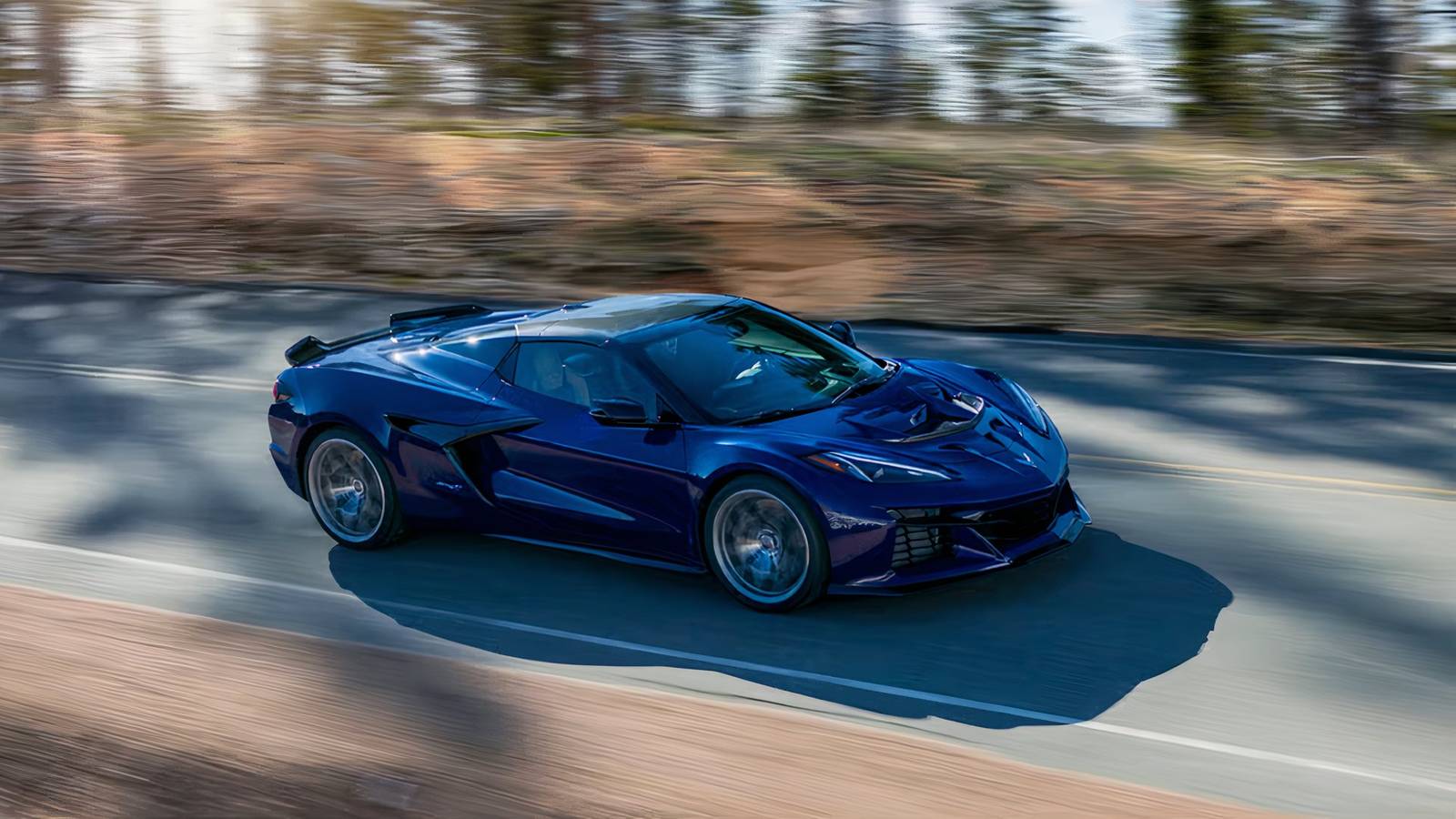
Let’s say you have about $250,000 to spend on a supercar. Once we start discussing vehicles with this kind of exotic price point, logic and pragmatism often fly completely out the window. The reality is nobody buys a Lamborghini or Ferrari because it’s a smart financial decision. You buy it because it looks cool or sounds cool, and that’s usually as far as due diligence goes in this situation.
If there has ever been a pragmatic performance car that puts extravagant Italian exotics to shame, it is the 2026 Chevrolet Corvette ZR1. For decades, the ZR1 has defined itself as the ultimate American performance vehicle. The Corvette ZR1 offers a clear price-to-performance advantage compared to its European rivals, but it doesn’t sell as well as the flashier Lamborghini Huracán. However, once we take a deeper look at the ultimate Corvette, you’ll forget about your ambitions of foreign prancing horses and instead find yourself dreaming about having this American legend in your garage one day.
The 2026 ZR1 Is So Fast It Should Be Illegal

Ever wondered what it feels like to cruise effortlessly at 200 MPH? Few vehicles ever made are more capable of achieving this feat than the 2026 Chevrolet Corvette ZR1. Since the C3 generation of the Chevrolet Corvette in the 1970s, the ZR1 designation on a Corvette has indicated that it is one of the hottest and fastest cars available. With a 233 MPH top speed, the current C8 generation ZR1 is no different and stands at the pinnacle of Chevy’s performance division. Yet, what makes the top dog Corvette so fast? Let’s dissect a few of its key features.
The C8 ZR1 Is Unlike Any ZR1 Before It

The C8 generation Corvette was a radical shift in design compared to its predecessors, most notably the layout change from front-engine to mid-engine. Then, in the high-performance C8 Z06, we were introduced to the first flat-plane crank V-8 engine available on a Corvette. The C8 ZR1 further upped the ante by adding twin-turbos to this new flat-plane crank engine, with the result being 1,064 horsepower on tap and the most powerful engine ever put in a production Corvette. The C8 ZR1 produces 309 horsepower more than its 755-horsepower C7 ZR1 predecessor, the largest generational jump in power output of any ZR1 model, ever.
The C8 ZR1’s Unique Engine Has A Distinct Character

The horsepower output of the new 5.5-liter twin-turbo LT7 engine is amazing in its own right, but this engine’s torque curve is what makes it magnificent. Typically, modern turbocharged vehicles produce a significant amount of torque at low revs and gradually decrease as the revs increase closer to the redline. However, the LT7 V-8 does not have this type of character, but rather, one that feels much more like a naturally aspirated or supercharged engine. The C8 ZR1’s peak torque of 828 pound-feet comes in at a lofty 6,000 RPM, while this flat-plane crank engine will sing all the way to 8,000 RPM. This distinct character is the result of utilizing 67mm monoscroll turbochargers as opposed to smaller twin-scroll turbochargers found on most twin-turbo applications. You’d think there would be turbo lag as a result, but compact integrated exhaust manifolds mean that full spool can be achieved near instantly. The LT7 V-8 makes peak torque across an amazing 3,500 RPM range, and the performance of this engine alone is something that needs to be felt to be understood.

The Best Turbocharged Engines, Ranked Based On Horsepower And Reliability
With turbocharged engines representing the new normal, let’s explore some of the most reliable examples of the modern era, ranked by horsepower.
The 2026 ZR1 Is Faster Than Its More Expensive Rivals

So what other cars directly compete with the Chevrolet Corvette ZR1 in its price range? None of them, and that’s not just us being nice, it’s the plain truth. The C8 ZR1 provides hypercar-level performance for less than the average cost of a supercar. Let’s compare the C8 ZR1 with its most common rivals and demonstrate how the American hero crushes all of them when it comes to performance per dollar (base price divided by horsepower).
The C8 ZR1 Easily Defeats The Ferrari 296 GTB And Lamborghini Huracán

The Ferrari 296 GTB is one of the brand’s current heavy-hitters and produces an impressive 819 horsepower via its hybrid twin-turbocharged V-6 engine. Compared to the C8 ZR1, the 296 GTB offers similar performance capabilities with an amazing 2.4-second zero-to-60 MPH time and a sub-nine-second quarter-mile time. However, a 2025 Ferrari 296 GTB starts at $347,000 and can be easily optioned out to the half-million dollar mark. The 2026 Chevrolet Corvette ZR1 offers a price-to-performance ratio of $173.87 per horsepower, while the 2026 Ferrari 296 GTB offers a price-to-performance ratio of $423.63 per horsepower. That means you are getting almost 2.5 times the performance for the money with the Corvette, and it doesn’t take a genius to understand which of the two provides better value.

Another common rival for the C8 ZR1 is the RWD-only Lamborghini Huracán Tecnica. Despite the pleasing roar of the brand’s iconic V-10 engine, the 2024 Huracan Tecnica only produces about 640 horsepower and achieves a zero-to-60 MPH time of 3.2 seconds. That Italian experience will set you back about $250,000 before any options, giving the Huracan Tecnica a price-to-performance ratio of $390.41 per horsepower. Does the Lamborghini sound better? It’s debatable. What isn’t debatable is that the C8 ZR1 offers over twice the performance for the money when compared to its Lamborghini rival, and the numbers don’t lie.
The C8 ZR1 Makes Quick Work Of The McLaren 750S And Porsche 911 Turbo S

If you have more British inclinations, you may also be considering a McLaren 750S among worthy competitors to beat the C8 Corvette ZR1. The 2026 McLaren 750S offers 750 horsepower from its 4.0-liter twin-turbo V-8 engine and achieves a 2.8-second zero-to-60 MPH time and a 206 MPH top speed. At a base cost of about $329,500 for the coupe variant, the McLaren 750s offers a price-to-performance ratio of $440 per horsepower. That gives it the worst relative price-to-performance ratio of the C8 ZR1’s primary competition, as the Corvette offers over 2.5 times the performance for its cost.

The best relative deal compared to what the C8 ZR1 offers in raw performance is the Porsche 911 Turbo S. The 2026 Porsche 911 Turbo S produces 701 horsepower via a 3.6-liter twin-turbocharged flat-six and achieves a 2.4-second zero-to-60 MPH time with the optional Sport Chrono Package. The privilege of owning one without a single option starts at $270,300, which gives the Turbo S a price-to-performance ratio of $385 per horsepower. That is a lot better than the other three alternatives, but still nowhere near the value that the C8 ZR1 provides. That’s before considering that the Porsche 911 Turbo S is AWD, and even then, the Corvette still wins the head-to-head battle. It is clear that the Chevrolet Corvette ZR1 is truly in its own lane as far as raw performance per dollar, and this American hero is mostly in competition with itself.

The 5-Year-Old Sports Car Worth Buying In 2025 Is The Chevrolet Corvette C8
With nearly 500 horsepower and a $50,000 price tag, a five-year-old C8 ‘Vette has the best performance-to-price ratio on the market.
Choosing Between The ZR1 And ZR1X

The 2026 Chevrolet Corvette ZR1 offers absurd levels of raw performance, and, realistically, the C8 ZR1 is way too much car for the street in any application. You need saint-like restraint to not break the law every time you turn it on. Yet, what if we told you there was still a production Corvette with more power that was even faster? That is the 2026 Chevrolet Corvette ZR1X, the AWD hybrid-powered variant of the ZR1 that boasts 1,250 combined horsepower and a sub-two-second zero-to-60 MPH time. What are the differences between these two extreme Corvettes, and is the difference in price worth it? Let’s break it down.
Not For Purists, But For Performance

An AWD hybrid Corvette is certainly not for everybody, and neither is the C8 ZR1X’s $209,700 starting price. We can assure you that even at that price point, the $167.76 per horsepower price-to-performance ratio that the C8 ZR1X offers far exceeds that of its exotic rivals. Indeed, by this standard, the ZR1X narrowly beats out the ZR1’s $173.87 per horsepower price-to-performance ratio. Yet, is this performance difference tangible in real-world situations? Not as much as you might think.

The electric front drive unit of the C8 ZR1X adds another 186 horsepower and 145 pound-feet of torque on top of the 1,064 horsepower being produced by the LT7 V-8 engine. This hybrid unit allows for responsive AWD capability that improves the ZR1X’s acceleration and cornering ability. However, if you directly compare the Nürburgring lap times of the two models, the C8 ZR1X is only about a second and a half faster. That means you are paying about $25,000 more for that extra second and a half of speed, and the ZR1X is also heavier than its non-hybrid counterpart. Is that difference worth it? It depends on how you plan to actually use the car.
How Use Case Will Affect Decision-Making

Although the C8 Corvette ZR1X may be faster, more powerful, and provide better grip, you may feel less inclined to regularly drive it at a racetrack when compared to the standard ZR1. Why? Well, it’s rather simple. The raw RWD nature of the ZR1 is more fun and more engaging than the ZR1X’s more composed, yet calculated demeanor. However, you only really get to feel the difference when you push the car near the limit, a feat that is impossible on the street. Thus, if the car is going to spend more time on the track than on the street, we’d pick the ZR1 first. If it’s more of a dual-purpose hypercar that gets regular street miles, the ZR1X becomes a bit more attractive as an option.

The fact is, any RWD car with 1,000 horsepower or more is downright dangerous on the street. Throw some inclement weather in the mix, and you are effectively driving a death trap. The ZR1X’s AWD system makes putting the power down on the street a lot more viable, and you will feel less hesitant to bring it out even in less-than-ideal traction conditions. The reality is, either vehicle is completely illogical and downright absurd as a street car. However, Chevy didn’t build a 1,000+ horsepower street Corvette because it makes sense. If we really care about logic, a base model C8 Stingray provides more than enough juice for any street application and will make 99 percent of prospective owners giddy with joy. We hope this helps guide someone down the line to make the right purchasing decision for their future Corvette. Either way, if you don’t think about it too much, you can’t really go wrong!
Sources: Chevrolet, Lamborghini, Ferrari, McLaren, Porsche