
The age-old debate between American and European performance cars has evolved since the early days of fire-breathing muscle cars and technically advanced sports cars. As of 2026, the push towards efficiency and electrification has completely changed the competitive landscape. Historically, Americans favored raw, straight-line muscle and strong performance-per-dollar value. The Europeans prioritized clinical precision and high-revving refinement with an aura of exclusive luxury, making them much more expensive propositions.
In today’s market, however, these lines have blurred. High-end American offerings now frequently beat their European rivals on the track thanks to better weight balance and chassis tuning. European manufacturers are increasingly producing high torque from hybrid and electric systems to mimic that classic American raw power. Globally, this plays out as a regional tug-of-war where European brands leverage deep-rooted heritage to maintain a status-driven stronghold in luxury-focused or slower-growth markets, while American performance brands aggressively undercut them on price to capture a younger, tech-forward demographic.
The State Of Europe’s Sports Car Industry

As of early 2026, the European sports car market is navigating a complex recovery. Reports published across the continent highlight a sales growth of 2.4 percent during a time when the industry pivots toward a high-performance electrified future. Traditional icons remain the most popular choices, with the Porsche 911 continuing to set delivery records and the Mazda Miata MX-5 holding its ground as the preferred accessible roadster. More niche options like the Alpine A110 and Toyota GR86 maintain strong appeal among dedicated lightweight performance car supporters.
The typical target audience across the continent remains an affluent demographic of driving enthusiasts who view these vehicles as both status symbols and tools for leisure, though a growing segment of younger, eco-conscious buyers is driving a 53 percent increase in adoption of electrified performance models. This European passion for engineering comes at a steep premium compared to the U.S. This is due to a combination of high value-added tax, regional luxury duties, and stricter emission compliance penalties. Sports cars in Europe are often 30 to 50 percent more expensive than their American counterparts, with some entry-level models starting at nearly $40,000 and high-end staples frequently exceeding $112,000 at current exchange rates.
The Chevrolet Corvette’s Historic Reputation

The Chevrolet Corvette has evolved from its 1953 debut as a fiberglass-bodied response to European roadsters into a dominant mid-engine supercar that redefined American performance by offering exotic-level capabilities at a fraction of its competitors’ prices. This impact is rooted in its role as GM’s halo car that democratized speed, famously transitioning from a front-engine layout to a world-class mid-engine configuration with the eighth generation to finally rival the elite performance metrics of European marques.
It remains a highly desirable option in 2026 due to this exceptional value proposition. The ZR1X represents the peak of the model’s lengthy heritage, introducing track-dominating power and advanced technology that no other manufacturer can match at an equally competitive MSRP. While historically the Corvette was primarily a domestic-market specialty due to left-hand-drive constraints and a focus on North American sales volume, the brand has recently expanded its reach with right-hand-drive production for markets like the UK, Australia, and Japan.

2026 Corvette Lineup Explained: Full Specs And Prices
The 2026 Chevrolet Corvette E-Ray combines a 490-horsepower V8 and electric motor for 655 hp and all-wheel drive, boosting traction and acceleration.
The Z06’s European Dominance

The production of the 2026 Chevrolet Corvette Z06 for right-hand drive markets, including the UK, represents a historic milestone as the first time this high-performance flagship is being built to suit these environments directly on the main assembly line in Bowling Green, Kentucky. Unlike previous generations that required expensive and invasive third-party mirror-image remanufacturing from firms like Clive Sutton or Autogroup International, this factory-integrated approach ensures that the 670-horsepower, flat-plane crank LT6 engine and its complex mid-engine architecture maintain original OEM-grade safety and electronic integrity.
Distributed through a specialized network including retailers like Lumen Automotive and Arnold Clark, the RHD Z06 is priced significantly higher than its American counterpart, starting around $240,000, which is double what Americans pay for a new one. Despite this premium, it remains a monumental step for the brand by finally offering a factory-supported, supercar-slaying icon that can compete on equal footing with European exotics on their own narrow, right-hand-steer roads.
Chevy’s First Right-Hand Drive Corvette

The factory right-hand drive Corvette has achieved remarkable niche success in its new regions, with Japan notably recording 300 sales within just 60 hours of its launch. This result sees it surpassing the previous annual total for left-hand drive imports by three times the annual total. In Australia and the UK, the model has seen consistent, albeit supply-constrained, demand. 2025 production figures indicate that right-hand drive variants now account for roughly 1.7 percent of total global output, or about 436 units annually, with Australian allocations typically capped at 200 units per year to maintain exclusivity.
Despite its budget supercar reputation in the U.S., the right-hand drive Corvette faces a much tougher competitive landscape abroad due to heavy taxation and luxury duties. This significantly higher price point places it in direct competition with established European rivals like the Porsche 911 GT3 and Mercedes-AMG GT, where it no longer wins on price alone but instead relies on its unique naturally aspirated V-8 character and mid-engine exotic appeal to lure buyers away from the traditional European marques.

The C8 Corvette Just Set A Record That Porsche Can’t Touch
Chevrolet has been setting insane records with its ZR1 and ZR1X models, leaving Porsche in the dust on track and in a straight line.
GM’s Ultimate LT6 V-8 Powertrain

The star of the 2026 Chevrolet Corvette Z06’s experience is GM’s hand-assembled 5.5-liter LT6 V-8 engine, featuring dual-overhead-cams with a flat-plane crankshaft. This is currently the most powerful naturally aspirated V-8 in production. Thanks to its high-revving nature, the LT6 produces 670 horsepower at 8,400 RPM and 460 pound-feet of torque at 6,300 RPM with an 8,600-RPM redline.
Power is managed through an eight-speed dual-clutch transmission that enables a 0 to 60 MPH acceleration time of 2.6 seconds and a quarter-mile sprint in 10.6 seconds at 131 MPH. While its top speed is officially cited at 195 MPH, this figure can vary slightly depending on aerodynamic configurations, such as the high-downforce Z07 Performance Package, which prioritizes cornering grip and track stability over maximum velocity.
Reinventing The Flat-Plane Crank

The brilliance of the LT6’s design lies in its clean-sheet approach that prioritizes lightweight, race-grade materials and superior air management. The forged steel flat-plane crankshaft is 33 percent lighter than a traditional cross-plane unit, significantly reducing rotating inertia and allowing the engine to snap through its rev range with immediate throttle response. This is complemented by an oversquare architecture, consisting of a large 104.25 mm bore and a shorter 80 mm stroke. This design physically limits piston speed to ensure durability at high frequencies.
To handle these extreme speeds, engineers utilized forged titanium connecting rods and titanium intake valves, which are 21 percent lighter than previous high-performance variants, while the exhaust valves are sodium-filled to better dissipate the intense heat generated near the redline. The engine also features a unique Gemini dual-overhead-cam valvetrain with finger followers coated in diamond-like carbon for reduced friction, and a complex active intake manifold that uses internal valves to exploit Helmholtz resonance. This tuning allows the engine to achieve over 100 percent volumetric efficiency above 3,500 RPM, essentially supercharging the combustion chambers with air pressure waves without the need for a physical blower, resulting in the most powerful naturally aspirated V-8 ever put into a production car.

America’s Poor Man’s Hypercar Just Destroyed One Worth 15 Times As Much
The drag race result that’s sending shockwaves through the automotive world.
A Suspension To Match The Speed

The 2026 Chevrolet Corvette Z06 features a significantly wider and more aggressive chassis than the base Stingray, with a track widened by 3.6 inches to accommodate massive Michelin Pilot Sport 4S ZP tires. This compound provides a substantial increase in mechanical grip. The suspension configuration consists of a standard Magnetic Ride Control 4.0 calibration that has been specifically tuned for high-frequency road inputs and high-G cornering.
It utilizes stiffer springs and specialized bushings to manage the increased lateral loads. Stopping power is provided by a high-performance Brembo braking system featuring six-piston front and four-piston rear monoblock calipers. These clamp down on massive 14.6-inch front and 15.0-inch rear rotors that offer significantly more surface area for heat dissipation than the standard model’s equipment.
These mechanical upgrades are further enhanced by a unique electronic limited-slip differential and a performance traction management system that allows drivers to fine-tune the car’s stability and damping characteristics across five distinct track modes, effectively transforming the platform from a comfortable grand tourer into a dedicated track machine.
The Z07 Pack Takes Things To The Extreme

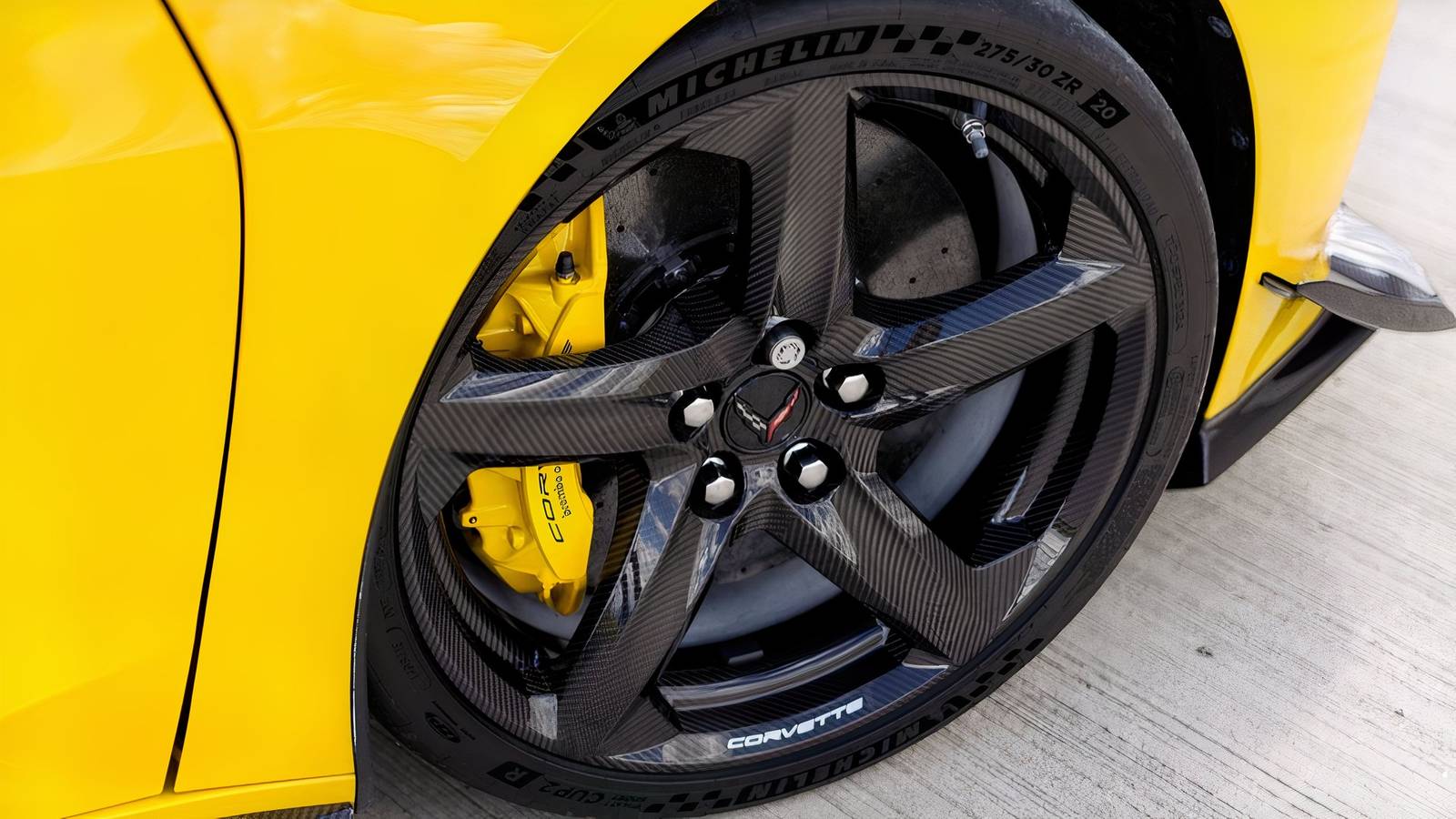
The Z07 Performance Package transforms the 2026 Chevrolet Corvette Z06 into a high-downforce track specialist, most notably through its specialized FE7 suspension calibration and the addition of Brembo carbon-ceramic brakes. These massive rotors measure 15.7 inches in the front and 15.4 inches in the rear, and provide better thermal capacity for repeated shedding.
This package is also the only way to get access to the Michelin Pilot Sport Cup 2R ZP tires. Visually and functionally, the Z07 requires the Carbon Fiber Aero Package, which adds a frame-mounted high wing, a larger front splitter, and front dive planes to produce up to 734 pounds of downforce at 186 MPH. Compared to the base Z06, these changes significantly prioritize track endurance and high-speed stability over road comfort, as the stiffer spring rates and aggressive rubber make for a more communicative but noticeably firmer ride on public highways.
Sources: Motor Reviewer, Edmunds, and Clive Sutton