This more powerful 2.0-litre TSI Terramar is comfortably the most convincing version of the car we have yet tested. The characteristics of the EA888 are as they ever were, with accessible, consistent torque delivery being prioritised over much in the way of ‘shape’ in the power curve, but it is done to impressive effect.
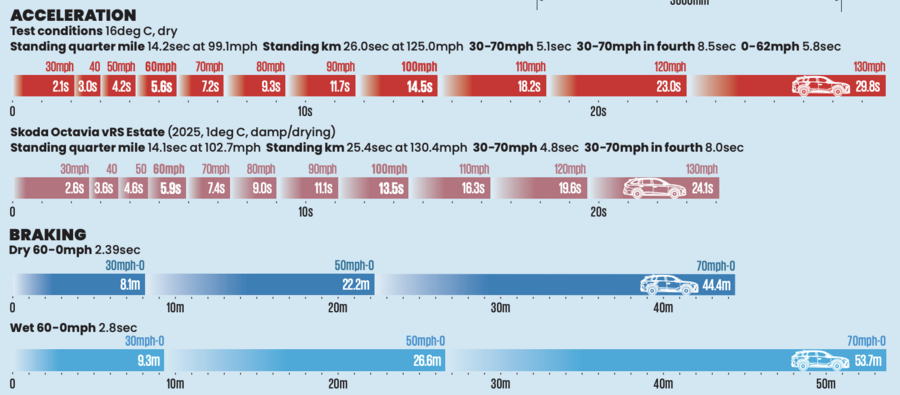
With 261bhp, and helped by a launch control function, the Terramar surged to 60mph in 5.6sec and 62mph in 5.8sec, beating the manufacturer’s 5.9sec claim. Had Cupra been generous enough to fit the Terramar with the 329bhp version of the powertrain found in the Formentor, we would expect those figures to be a second or so quicker, but even so, this is not a sluggish car, particularly by class standards, and it has prodigiously easy drivability. With four-wheel drive and good rubber, straightline traction is also never an issue, even in the damp.
The Terramar’s performance is aided by a capable dual-clutch automatic gearbox that goes about its business without fanfare. This extends to the shift paddles, which are somewhat uneventful to pull in light of the flamboyance of Cupra’s approach to cabin design elsewhere.
But perhaps that’s not worth crying over, because although you can initiate a manual mode, the car’s brain never seems to give you full control, and will always upshift at the 6500rpm redline besides.
Given the strait-laced effectiveness of the engine itself, perhaps the most memorable element of the Terramar’s performance is the synthetic engine and exhaust notes piped into the cabin. This feels more forgivable in a slightly frivolous, pseudo-sporty crossover than it does in a serious performance car like, say, a BMW M5, and the Terramar’s made-up sonic output is, in truth, among the rortiest and silliest around.
Yet pushing the mode-select button that hangs off the steering wheel and engaging Cupra mode (available only on VZ models) does up the fun factor and lends some engagement to the car’s lightly boosty throttle response and uniform delivery.
Ultimately, although the hottest Terramar is down on spec-sheet power compared with rivals from BMW, Mercedes-AMG and Mini, on the road it feels plenty quick enough and decently good fun.
At the other end of the Terramar spectrum sits the 1.5-litre e-Hybrid that makes 201bhp and 258lb ft for a fairly uneventful 0-62mph time of 8.3sec. There’s a briskness to it in both full EV and hybrid mode, and the electric motor adds a modicum of additional zip for nipping into gaps in traffic and overtaking on a motorway, but it’s by no means quick.
If you’re after more grunt then you can have the hybrid with 268bhp, but it’s dearer and less efficient when the battery is empty, which means you might as well opt for the pure petrol 2.0-litre TSI.
The plug-in hybrid has a number of drive modes and some shifter paddles behind the steering wheel allowing you to swap cogs, but the gearbox isn’t the most refined. Most of the time the car ignores them and overrides your inputs: that might be to shut off the engine when you’re braking into a corner, or to loudly fire the engine up when you think you’re accelerating gently. There’s also a tendency for the automatic transmission to hang on to a gear for too long, which means the engine gets pretty vocal when you step on the accelerotr more abruptly.
The hybrid powertrain works more seamlessly when you’re cruising along the motorway; in this setting it’s hushed, refined and there’s only a small amount of wind roar filtering into the cabin. Running exclusively in electric mode brings more smoothness, too, particularly at lower speeds around town. You can adjust the regenerative braking, and in its highest setting, it draws you in nicely, despite a slightly mushy feel to the brake pedal.