
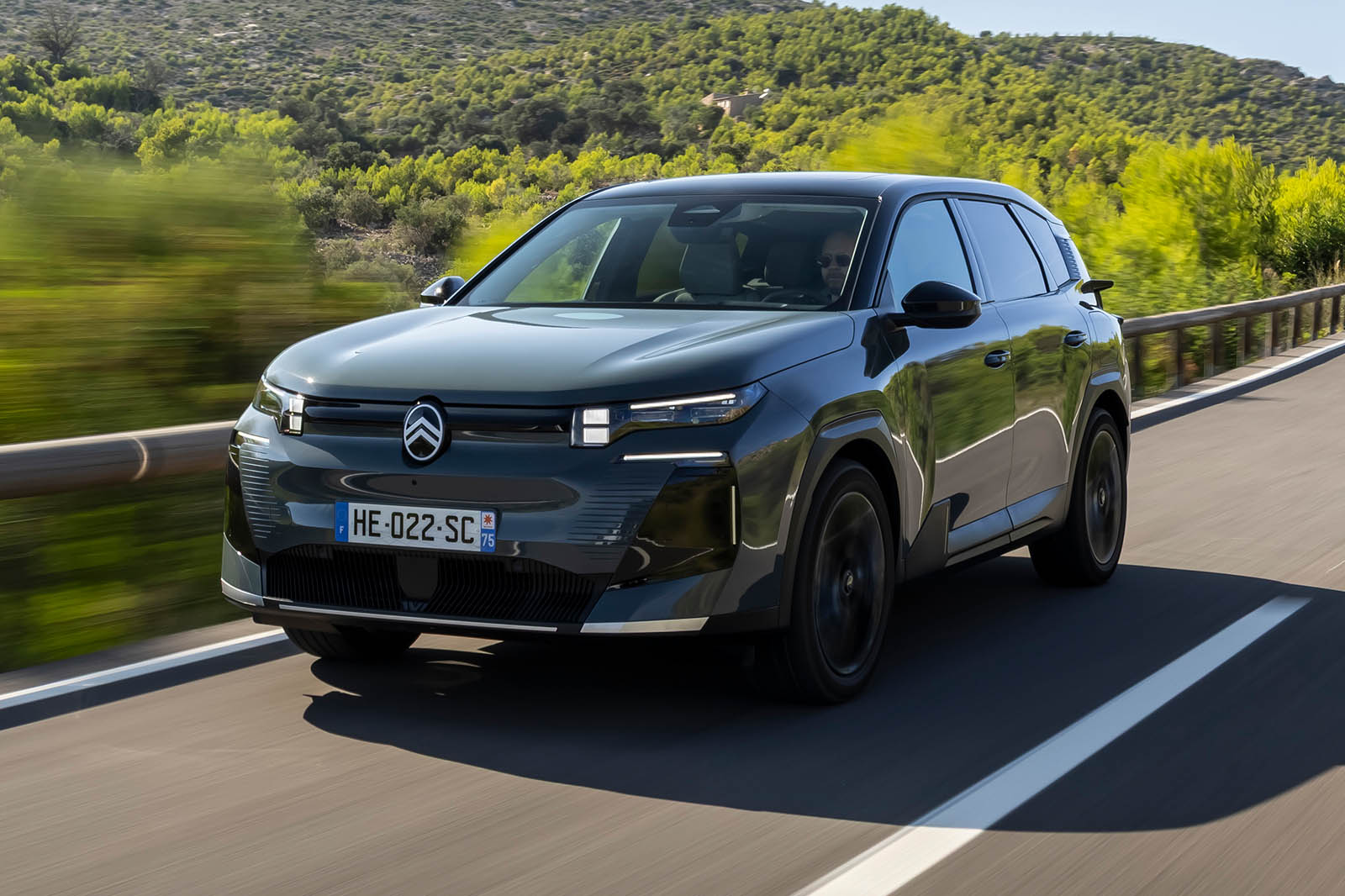
This car returns to the C-segment SUV ranks, lining up alongside the Nissan Qashqai, Dacia Bigster, Skoda Karoq or Elroq, and Renault Symbioz or Scenic E-Tech (depending on what kind of powertrain you’re pondering). And while an entry-level 48-volt hybrid model can be had from only a little over £30,000, an EV – a good-sized family car from an established European brand, with more than 400 miles of advertised range, no less – can be snagged for less than £33,000.
The biggest Aircross’s design is smarter, neater and tougher than was its predecessor’s. This is a big car for its class; more than 4.65m long in a niche where 4.5- is more typical, with a 565-litre boot no matter which version you buy (Skoda Elroq: 470 litres). With 48v hybrid petrol, plug-in hybrid petrol and full EV options to choose from, it caters to almost all-comers.
Like the Peugeot e-3008 and e-5008 and Vauxhall Grandland Electric, it adopts Stellantis’s STLA-Medium model platform, and shares some familiar characteristics. Single motor models are front-wheel drive, with either 211- or 228bhp (so the 210 and 230 derivative identifiers are slightly misleading whether you assume they describe metric- or imperial horsepower).
There are two options for battery capacity: a Comfort Range version with 73.7kWh of usable storage, or a Long Range version with 96.9kWh. For the latter one, the battery is built at the French joint venture factory that Stellantis shares with Mercedes-Benz, called ACC; while the former uses batteries made in China.
For suspension, the ë-C5 Aircross gets all-independent axles front and rear (an upgrade on the specification of the ICE-engined models, which use a torsion beam rear axle instead) very likely to reflect the greater weight of the EVs (which are, at best, some 550kg heavier than a Hybrid 145 model). The Long Range EV is only 62kg heavier than the Comfort Range car, however; a slight penalty considering the 30 per cent capacity hike.
Citroen is persevering here with its ‘flying carpet’ suspension; its slightly naive way of describing a system of coil springs, progressive-rate dampers and hydraulic bump stops, all tuned so that the springs can be softer and allow a more pliant and isolated ride in normal everyday driving. So goes the thinking, at any rate.