
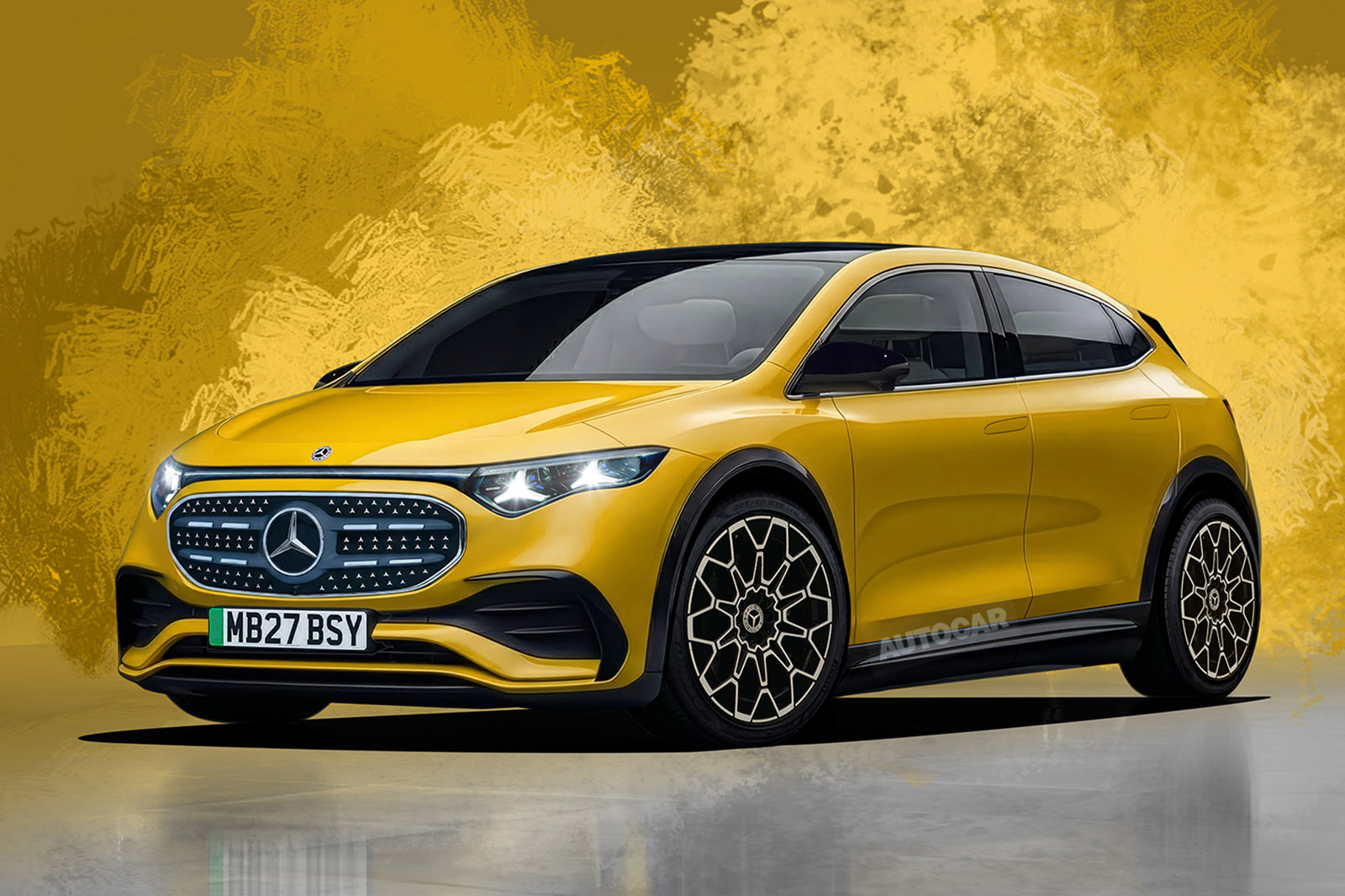
Changing the ride height would inevitably influence seating positions front and rear, but separate sources have told Autocar that doing so is a priority.
This, they say, is drawn from what they describe as consistent customer feedback and shifting buyer expectations.
Ease of access and better outward visibility are also described as key aims. This is because the fifth-generation A-Class is intended to appeal not only to current, younger customers but also to older buyers who previously chose the B-Class before production of that model ended in 2022 after two generations.
The B-Class had long catered to those seeking compact dimensions but a more upright driving position.
Despite this, our sources insist the A-Class won’t be a crossover, adding that the car will retain a driving position buyers expect of a hatch, even when raised.
Key styling elements are expected to include the latest evolution of the shark-nose front end, as seen on the new CLA and GLC.
Along its flanks, the A-Class will retain framed doors-unlike the frameless ones fitted to the CLA – and it will have a sloping roofline.
A conventional tailgate with an angled back window will remain.
Inside, it is set to offer seating for up to five. A sliding or adjustable rear bench is under consideration.
Whether the A-Class name will be retained remains unclear. The suggestions are that the new model is sufficiently differentiated from today’s A-Class that it could take a new name, possibly CSA (Compact Sports A-Class), into production, aligning it with the three-letter designations of the CLA, GLB and GLA.
The new model is likely to be produced alongside the CLA and GLA at Mercedes’ plant in Kecskemét, Hungary.
Platform
In a major departure, the new A-Class moves from the Modular Front Architecture, which dates back to 2011, to the newer Mercedes Modular Architecture (MMA), the same structure that underpins most of its stablemates.