
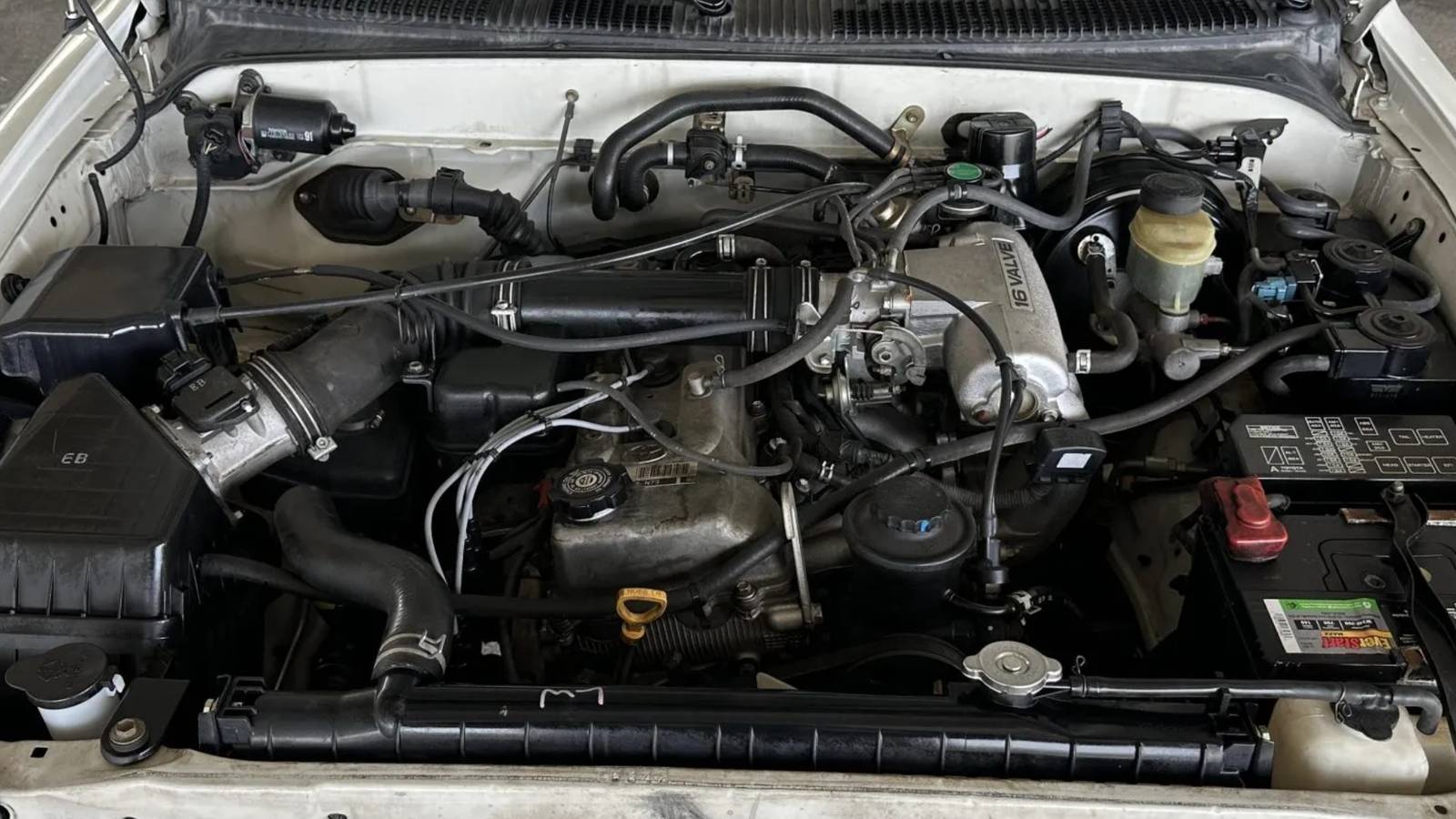
Plenty of consumers nowadays fear driving a vehicle for too long. While natural issues can start to occur around the 75,000 mark on most cars, many people trade in their finance deal vehicles for something newer, as they don’t want to start running into serious issues. It’s normal now for these road users to consider a 100,000-mile vehicle at the end of its life, and for some unmaintained or unreliable engines, this might be the case. However, there are plenty of engines that can double that reach, 200,000 or even 300,000 miles, with the right care and maintenance.
That’s when Toyota enters the conversation. In the world of high-mileage heroes, we often think about heavy-duty trucks, diesel engines, and, of course, Toyotas. Powertrains like the 2UZ-FE 4.7-liter V8 and the 3.5-liter 2GR-FE are renowned as being some of the most dependable ever produced, but Toyota’s hunger for longevity goes beyond the likes of V6 and V8 engines. What if there was a four-cylinder legend lurking in the shadows, having powered some of the most durable pickups, SUVs, and other hardworking vehicles of the 1990s and 2000s? In this article, we will explore the decade of service from an immortal legend and examine what makes it so special.
An Introduction To The Legendary 3RZ-FE Engine

In the 1990s, Toyota decided to retire its magnificent 22R-E powertrain, an engine with true legend status. It powered the famously indestructible 1980s Toyota Hilux, but by the turn of the 90s, its potential was becoming fully explored: with tighter emissions regulations and hunger for more power, it was time for replacement. The 3RZ-FE was to follow, and it had huge boots to fill. Toyota intended to make a punchier four-cylinder that could do the work of a V6 with true mechanical simplicity, and in 1994, it proved to the world just what it was capable of.

Most four-cylinders tend to have a displacement of around 2.0 liters. Toyota, however, yearned for the extra torque. The 3RZ had a 2.7-liter displacement, which provided more punch, and the four-cylinders meant it was cheaper to maintain and more efficient than the V6 competition.

10 Legendary Toyota Engines That Refuse To Die
These are the engines that built Toyota’s legacy of reliability.
What Cars Benefited From This Engine?

Some of the most notable cars in Toyota’s 1990s lineup housed the iconic 3RZ-FE engine – here are some of the most famous applications. The third-generation Toyota 4Runner is often considered the greatest generation of this vehicle that there ever was. The 3.4-liter V6 got most of the attention, but it was the 3RZ-FE that was truly unstoppable, making it the perfect choice for consumers who wanted an SUV that they could always rely on. The bulletproof Hilux also got its successor, featuring the 3RZ-FE alongside a 3.0-liter diesel engine. These two powertrains maintained the Hilux’s reputation for gold-standard durability, cementing its legacy even further.
Other Vehicles Which Utilize The 3RZ-FE Powertrain
- Toyota Land Cruiser Prado
- Toyota HiAce and Granvia vans
- Toyota T100
The 3RZ-FE Made The Toyota Tacoma A Revolution

While the 3RZ-FE blessed its presence in many vehicles in the 1990s and 2000s, there was one application that remains by far the most notable. The original Toyota Tacoma was released in 1995, and paired with this phenomenal engine, the Tacoma began to expand Toyota’s reputation. No longer were their trucks seen only as reliable but underpowered; the extra 40 horsepower of the 3RZ-FE compared to the 22R-E meant Toyota was finally seen as a worthy competitor in the US market, rivaling trucks that had previously far outclassed the Hilux.
1995 Toyota Tacoma Vs An American Pickup Rival
|
1995 Toyota Tacoma |
1995 Ford Ranger |
|
|
Powertrain |
2.7-liter 3RZ-FE |
3.0-liter V6 |
|
Transmission |
5-speed manual |
5-speed manual or 4-speed auto |
|
Horsepower |
150 |
145 |
|
Torque |
177 |
165 |
Not only was it more muscular than the Ford Ranger, but it was also more efficient. The uplift in power and torque compared to the outgoing 22R-E meant that Toyota had unlocked off-roading and hauling for a broader scope of consumers. Suddenly, heavier-duty work could be accomplished by a simple-to-maintain and not overly thirsty four-cylinder. It’s for that reason that the legacy of the Tacoma and the 3RZ-FE are so closely intertwined.
What Made The 3RZ-FE So Incredibly Reliable?

By the 1980s, Toyota had adopted a philosophy that led engines like the 3RZ-FE to have 300,000 miles on the clock and still feel like a newer engine: over-engineering an engine that would be under-stressed. While competitors were trying to get the maximum amount of power out of V6s, the efficient 3RZ-FE was able to do the work those engines were doing without being tuned for power. The rotating assembly of this engine was built to withstand way more stress than it ever would, as it produced just 150 horsepower. The crankshaft was made of forged steel, meaning it was incredibly resistant to snapping or warping.
More Reasons Why It Was So Durable
- An iron block instead of using aluminum
- A robust timing chain
- A double overhead cam
Toyota also engineered the powertrain to have far less vibration than a typical four-cylinder, and they did this by using two counter-rotating shafts inside the block that spin at twice the crank speed. The result was an engine that would rattle less, putting less pressure on critical components; hence, why the engine still feels reasonably smooth after hundreds of thousands of miles.

The Toyota Most Owners Don’t Know Can Last Over 400,000 Miles
Toyota’s reputation for durability is well-established, but the true extent of that longevity often surprises even experienced owners.
The Achilles Heel: Weak Points And Essential Maintenance

Even the most reliable engines suffer from one thing or another. It doesn’t mean the powertrain is unreliable; it just means there is something you need to take care of to unlock that longevity. The main weak point of the 3RZ-FE was the tight valves, which would eventually narrow. Over time, the valves get tighter as they slowly wear on, and if they get too compressed, the valves wouldn’t be able to shed heat. Eventually, this could lead to a burnt valve, which causes misfiring and a lack of compression. Through a disciplined mixture of maintenance and habits, you can strongly reduce the likelihood of this happening and enjoy over 300,000 miles of trouble-free motoring.

By refreshing your fuel injectors, utilizing a rich fuel mixture, and using the right spark plugs, you can ensure you are doing all you can to keep this issue at bay. The absolute most essential part of this equation, though, is a periodic valve check. Having a mechanic remove the valve cover and check the clearances, you can check the condition they are in and monitor it closely. Outside of that, routine oil changes, a timing chain replacement every 150,000 miles, and changing the spark plugs every 30,000 miles will be the easiest ways of ensuring this powertrain makes it to 300,000 miles and beyond.
Sources: Toyota, Bring A Trailer