
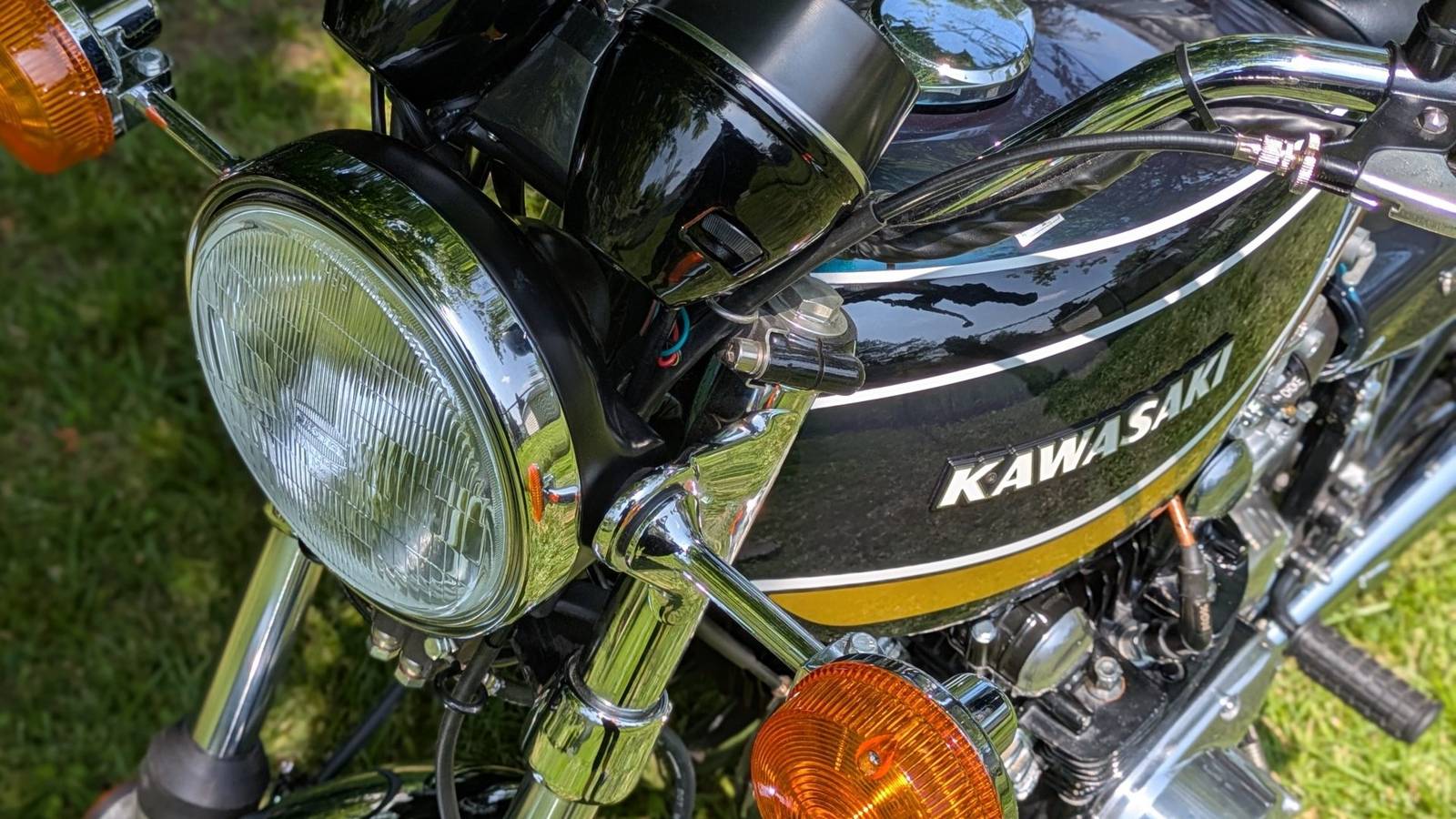
Kawasaki is a long-standing motorcycle maker, having been in existence for over 70 years. From the screaming two-strokes to four-stroke smoothness, this Japanese marque has done it all. Over the years, there have been a bunch of cool and rare Kawasakis that have helped sew the fabric of modern motorcycling.
One such motorcycle is a middleweight four-cylinder monster that came out in the 1970s. Ironically, its 750cc engine displacement was mandated by a Japanese government regulation. This helped Kawasaki engineers to push the envelope and create a fierce motorcycle in a relatively compact form factor. To give you an idea, this JDM-specific middleweight packs the same overengineered engine components as the now-famed and highly sought-after Kawasaki Z1 900 Super Four.
In fact, the Z1’s 903 cc engine was derived from a prototype 750 cc four-cylinder engine. The 903 cc Z1 was never intended to exist. But it does because Honda sent shockwaves with the now-iconic CB750. The Z1 was Kawasaki’s triumphant reply to the same. However, we want to divert your attention to Z1’s unsung “Little Brother”, the one that was rarer and equally advanced for the time.

The Kawasaki That Stole The Suzuki Hayabusa’s Thunder
The Hayabusa might be one of the iconic superbikes of the 2000s, but there is a Kawasaki that can beat it fair and square
The Rarest Kawasaki Motorcycles Made

There are many intriguing examples of rare Kawasaki bikes. The 98-horsepower 2000 Kawasaki ZRX1100, specifically the one painted green, has a production count of 200 units. Approximately 750–1,200 units of the 1982-1983 Kawasaki KZ1000R were made. This ’80s roadster garners a lot of attention owing to its 102-horsepower four-cylinder engine. Apart from factory production numbers, a segment of Kawasaki motorcycles has attained rarity status, primarily due to its JDM status and unavailability outside of Japan. As the years passed, many such Kawasakis were imported to the States.
One interesting example is the 1972 Kawasaki S1, of which only two were supposedly “imported” into the US. Rick Brett is the owner of one of these classics, and according to him, the second one was shipped off across the pond to England. Hence, Brett’s S1 is unofficially the only S1 in America, according to the stats. This is a humble city-bred motorcycle packing a 249 cc two-stroke three-cylinder engine, capable of producing 32 horsepower.

Furthermore, there are a bunch of race-bred “Green” Kawasakis that are not just ultra-rare but also go for insane money. There are only about 40–60 units of the 1970 Kawasaki H1R, which is a 500cc inline-3 racebike producing 75 horsepower. Its used prices start from $45,000 today. Next up is the 1975 Kawasaki KR250, powered by a 249 cc parallel-twin engine producing 45 horsepower. This Kawa has gone down in history as a winner with over eight championship titles to its name. Its legacy and rarity (limited to fewer than 30 units worldwide) are the reasons its $60,000+ used prices don’t come as a surprise.
However, the rarest of them all is the 1982 Kawasaki KR500 race bike, limited to just four units. Two of them were allocated to Team Kawasaki UK, and the others were used for competition and R&D purposes. It is powered by a 494 cc four-cylinder mill with 120 horsepower, and asking prices of well over $100,000 are the norm here.
Why The Kawasaki Z2 750 Stands Out From The Bunch
The Little Brother Of The Popular And Game-Changing Kawasaki Z1

Many are aware of the famed 1970s Kawasaki Z1, which, upon launch, obliterated the competition with its feisty four-cylinder power, making it the fastest motorcycle back in the day. It had enough brawn to run quarter miles in the low 12-second range. Its 903 cc four-cylinder engine is considered to be the first DOHC superbike from Japan, producing over 80 horsepower. It was well advanced for its time and so durable that 100,000 miles was a breezy affair. Furthermore, the engine’s robust construction also made it a favorite among drag racers, earning it a reputation as the “small block Chevy” of motorcycles. This motorcycle also played a crucial role in establishing the “Universal Japanese Motorcycle” (UJM) template and catapulting Kawasaki into racing.

The Small Kawasaki Most Buyers Don’t Consider
This right here is a hidden gem if you want a retro roadster to putter around town in style
The Z1 was advanced for its time, but was not rare. However, there was a smaller middleweight motorcycle modeled on the Z1, known only to purists. While the Z1 was in the spotlight around the world, Japan got the smaller Z2 750, which was even more impressive owing to its relatively compact appeal. This “downsizing” was mostly to comply with the Japanese domestic restrictions on engine size. But this government norm pushed Kawasaki engineers to go beyond the Z1’s sophisticated appeal and create an equally enticing motorcycle with a smaller engine.
Why Is The Kawasaki Z2 750 So Rare?

Since the Z2 750 was confined to the domestic market, it instantly became a rarity for the rest of the world. But many American service members returned home from Japan in the 1960s and 1970s, often bringing along souvenirs of their stay. Motorcycles were a popular choice. The Kawasaki Z2 750 was one such motorcycle that made it to the States. According to an exclusive piece from Motorcycle Classics, Kawasaki enthusiast Andreas Strieve states that about 25 to 50 specimens of the Z2 750 were imported into America back in the day. Being officially unavailable and the limited number of models imported by returning GIs make the Kawasaki Z2 750 an extremely rare and highly sought-after classic Japanese motorcycle.
The 1970s Kawasaki Z2 750 Was Too Advanced For Its Time

Despite having a similar construction to the larger 903 cc four-cylinder Z1 mill, the Z2 750’s 746 cc four-cylinder stands out because it packs similar levels of insane engineering in a smaller package. This was one of the rare few motorcycles with a modern DOHC setup. The advantages were superior valve control and higher RPMs. This helped the Z2 750 produce 69 horsepower at 9,000 RPM and 42.6 pound-feet of torque at 7,500 RPM to the rear wheel via a five-speed manual transmission.
Then came the crankshaft bearings. Unlike the ones used by the competition, Kawasaki used durable roller bearings designed for racetracks. It further helped with higher RPMs and also made the engine capable of being tuned to extreme ends. All of these features also helped the Z2 750 become a favorite among drag racers thanks to its durable and high-endurance construction.
Other Advanced Components That Got The Attention Of Suzuki And Honda Rivals

It packed a standard disc brake and electric start; rare features for the time. It broke convention by utilizing a 296 mm front disc brake while the chassis was designed to offer a balanced riding appeal. A double-downtune, dual-cradle frame that was specifically designed to handle the four-cylinder engine’s eager performance.

The Z2 750 came with a unique 4-into-4 exhaust system. This setup greatly helped with tuning, as each of the cylinders can be operated independently with individual tunes for each carburetor. Furthermore, individual exhaust piping for each of the four cylinders helped reduce exhaust pulse interference and achieve smooth, precise high-RPM flow. Its timeless design is also praiseworthy for its simple yet impactful lines. This Kawasaki’s gorgeous design is shared with the Z1, which, in turn, was conceptualized and built in California to appeal to American riders.
How Does The Kawasaki Z2 750 Differ From The Z1
While it was not as powerful as the Z1, the Z2 750 still packed enough punch to be a substitute that didn’t dull down the experience. This is very similar to how the Suzuki Gixxer 1000s and the 750s compare. While one is a middleweight and the other a liter-class machine, the GSX-1000’s thrill-seeking edge is not as superior as one would expect, making the smaller model a much more impressive bargain.

The chassis and body panels were shared between the two. Even the suspension and braking setup was similar. The major difference between the Z2 750 and the Z1 900 Super Four lies in its powertrain setup, including tweaked engine internals, carburetor size, and sprocket sizes. The Z2 750 packed a smaller 26 mm carburetor, and its rear sprocket had more teeth (42 instead of the Z1’s 35-tooth setup). Another notable difference lies in its instrument cluster. The Z2 came with specific Japanese lighting regulations, such as the 50 mph / 80 kph speed warning light.
How Much Is The 1970s Kawasaki Z2 750 Worth Today

Most of the supposedly 25–50 units of the Kawasaki Z2 750 on American soil are unofficial imports. This also makes it very rare and highly sought after. Very few have popped up for sale on used marketplaces, including Bring a Trailer and Mecum Auctions. The most expensive listed sale is of a 1976 Kawasaki Z2 750 for a whopping $33,000 via Mecum.

The Kawasaki Turbo That Tried To Beat The Superbikes
While this factory turbo really took the fight to the superbikes of the time, cracks began to appear in the whole concept of turbocharged motorcycles
It is a pristine-condition model painted in an enticing Diamond Dark Green shade and flaunting the cool, original 4-to-4 exhaust with upswept mufflers. The average used price of the Kawasaki Z2 750 is around $20,000. Another well-kept example of this Kawa was sold privately via Bring a Trailer last year for $16,500.
Sources: Bring a Trailer, Motorcycle Classics, and YouTube