
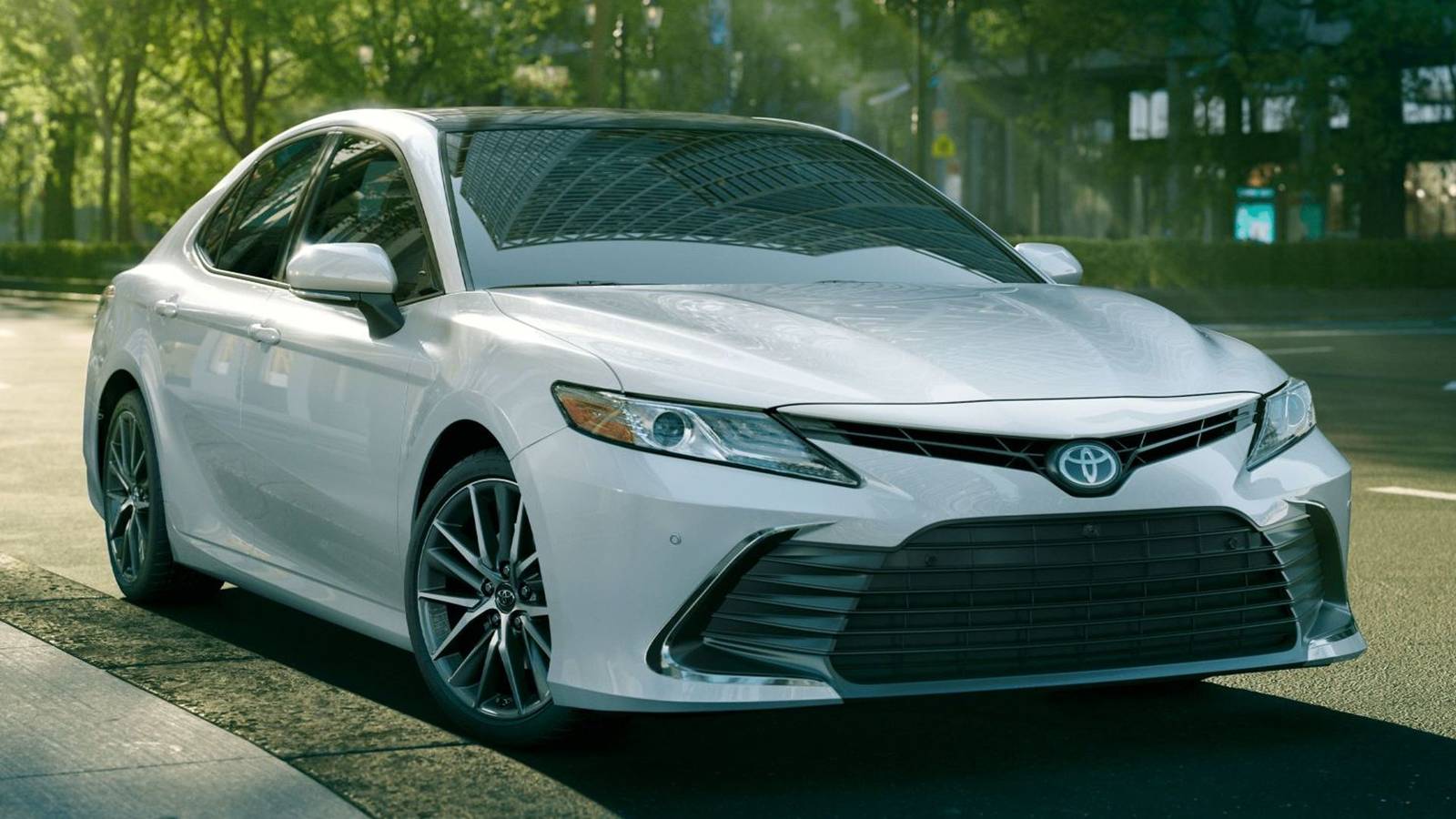
The current-generation Toyota Camry remains a competitively priced and in-demand midsize sedan in the American market, which is a considerable feat considering how crossovers and SUVs have all but taken over. Brands are positioning these high-riding options as more versatile and practical family cars, but there are many who still see the value in owning a sedan.


- Base Trim Engine
-
2.5L Inline-4 Hybrid
- Base Trim Transmission
-
Continuously Variable Automatic (CVT)
- Base Trim Drivetrain
-
Front-Wheel Drive
- Base Trim Horsepower
-
208 hp
- Base Trim Torque
-
163 lb-ft @ 5200 rpm
- Fuel Economy
-
51/53 MPG
- Make
-
Toyota
- Model
-
Camry Hybrid
- Segment
-
Midsize Sedan
With the 2026 model year now starting at $29,100 for the base LE, Many buyers now find this option beyond their budget. With that in mind, there may be a bit of value in considering a slightly used 2023 model year option. While they are technically different generations, the now-defunct ICE range remains a modern sedan that’s mechanically very similar to the new-generation one.
Toyota’s Most Important Sedan Option

The 2023 Toyota Camry Hybrid was a cornerstone of the brand’s midsize sedan lineup, serving as a bridge for consumers who wanted appealing fuel consumption returns without having to compromise on performance or practicality. Toyota positioned this model between the Corolla and Avalon sedans as a perfect halfway point.
Alongside the ICE Camry of the same model year, it maintained its title as the number one passenger car in America for the 22nd consecutive year. The hybrid specifically accounted for 35,445 copies sold in the U.S. throughout 2023. Its primary target market consists of practical-minded families and long-distance commuters who prioritize Toyota’s bulletproof reliability and low ownership costs.
Continuing A Legendary Legacy

The Toyota Camry debuted in the U.S. in 1983 as a compact replacement for the Corona. Just shy of a decade later, Toyota transitioned it into a midsize sedan that better caters to American tastes and vehicle requirements. It very quickly rose to become the best-selling passenger car in the country, which the Japanese brand achieved by mastering its unbreakable reliability and practical comfort.
The 2023 Toyota Camry Hybrid reflects a major evolution for the badge by transforming it from a niche, efficiency-first experiment, into a high-performance cornerstone of the lineup. Toyota launched the hybrid variant of the Camry in 2007, which many regarded as a boring ownership experience. The 2023 model took full advantage of the TNGA-K platform and introduced sport-tuned XSE trims, and a more sophisticated drivetrain to improve market appeal.

Ranking The Top 10 Toyota Camry Hybrid Models Years For Reliability
While many Camry years are known for their reliability, these model years stand out with the most reliable hybrid variants.
Strong Resale Value Performance

According to Edmunds, 2023 Toyota Camry Hybrid models are currently selling for between $19,683 and $29,767, depending on the mileage, condition, and specification. J.D. Power groups the entire Camry catalog together in its estimation, but still highlights a more generous $21,390 to $34,928 price range for examples currently sitting on used car lots.
When new, Toyota started pricing for the base LE at $28,655, followed by the $30,190 SE, $31,190 Nightshade, $33,545 XLE, and $34,095 XSE. One of the Camry’s greatest strengths is its value retention, which the 2023 hybrid model certainly excels at. According to Edmunds, if you buy a base 2023 Toyota Camry Hybrid LE today, it will go on to lose $9,061 over the next five years, which is just 30 percent of its original purchase price.
The 2023 Camry does sit with a relatively lower 3.8/5 overall score on the Edmunds consumer review section, consisting of 58 independent submissions from previous and existing owners. These reviews highlight key strengths as the car’s fuel efficiency, safety, and engaging driving experience, but it does suffer from a loud road noise at speed, delivering sub-par acceleration, and a poor infotainment system experience.
Toyota’s Reliability Champion

Reliability is a fundamental strength for the 2023 Camry, with the hybrid being no exception. iSeeCars indicates that you can expect this model to cover an average lifespan of 13.1 years or 171,009 miles, with a favorable 31.2-percent probability of reaching 200,000 miles. J.D. Power, also gives this model with an 83/100 consumer-verified overall score, including 88/100 for quality and reliability, 81/100 for the driving experience, and 80/100 for resale.
Edmunds suggests that you will find yourself spending $4,698 on maintenance and $2,127 on repairs over five years and 60,000 miles. The 2023 Toyota Camry follows a 5,000-mile or six-month maintenance interval. Services alternate between basic tire rotations and inspections at 5,000 miles, and comprehensive visits including oil changes and cabin filter replacements every 10,000 miles.
Major 30,000-mile intervals add engine air filter replacements and deep system inspections. RepairPal estimates annual maintenance costs at approximately $388, while Kelley Blue Book projects a $380 cost, both of which are highly favorable and competitive for a used vehicle.
The 2023 Toyota Camry Hybrid has been subject to a safety recall regarding improperly tightened lug nuts, which could cause a wheel to loosen or detach while the vehicle is in motion. Another significant concern involved insufficiently welded head restraint brackets on the second-row seats, posing an increased risk of injury to passengers during a collision.

The Highest Mileage Toyota Camry Hybrid In The World
This Toyota Camry Hybrid has been doing taxi duties in Dubai without any major issues.
Fully Equipped Interior Experiences

The 2023 Toyota Camry Hybrid isn’t too different from the current-generation model, but there are some noteworthy specification differences. The base LE trim comes standard with dual-zone automatic climate control, an eight-way power-adjustable driver’s seat, and 60/40 split-folding rear seats. For entertainment, it comes with a seven-inch touchscreen compatible with Apple CarPlay, Android Auto, and Amazon Alexa, paired with a six-speaker audio system and three USB ports.
The SE adopts sport SofTex-trimmed upholstery for the seats and a leather-wrapped steering wheel and a sport-tuned suspension for better handling. The SE Nightshade edition is an aesthetic upgrade, adding unique 19-inch bronze alloy wheels and blacked-out exterior accents, while maintaining the SE’s interior comfort and tech suite.
Impressive Value From Premium Trims

Moving into the XLE adds full leather upholstery with multi-stage heated front seats and a power-adjustable passenger seat. The Smart Key System with push-button start, a larger seven-inch multi-information display for the driver, and rear-seat air vents bolster convenience. Improving the entertainment aspect is a larger nine-inch touchscreen and a Qi-compatible wireless charging pad. The XSE adds a patterned metal interior trim and a sport-tuned suspension, as well as 19-inch gloss-black wheels and a dual exhaust with quad chrome tips.

What Toyota Camry Hybrid’s Battery Replacement Costs In 2025
Replacing a Toyota Camry Hybrid battery isn’t the most common maintenance task, but if you own one, here’s how much it could cost if it comes to it.
Toyota Efficiency Shines Bright

The 2023 Toyota Camry Hybrid returns highly favorable EPA fuel consumption estimates. The LE is the most efficient model, returning a 51/53/52 MPG consumption result on the city/highway/combined cycle, with a 686-mile range claim from the 13.2-gallon tank. It also indicates that this will save you up to $4,000 in fuel costs every five years and costs $1.53 to drive every 25 miles.
Other trims are slightly less fuel-efficient, with the EPA indicating that it returns a 44/47/43 MPG result with a 607-mile range claim and suggests that this will save you up to $3,250 in fuel costs every five years and cost $1.73 to drive every 25 miles.
Moderate Performance Returns

The 2023 Toyota Camry features a 2.5-liter four-cylinder engine and one permanent-magnet motor driving the front wheels via a direct-drive eCVT system. The result is a combined 208 horsepower output at 5,700 RPM. Toyota doesn’t disclose combined torque figures, but it confirms that the powertrain generates 163 pound-feet of torque.
Toyota doesn’t declare the model’s performance capabilities either, but independent reviewers prove that you can cover 0 to 60 MPH in around 8.0 seconds. The brand caps the model’s top speed at 115 MPH. Toyota opted to forgo an all-wheel drive system for this generation of the Camry, but a dual-motor configuration is available for the hybrid-only current-generation range.
Sources: Edmunds, iSeeCars, J.D. Power, and the EPA