
Turbocharged engines for street cars offer better performance from a smaller engine, giving improved fuel efficiency and reducing emissions. Ford introduced its EcoBoost engines in the US as early as 2011, at a time when the economy was still wobbly after the Great Recession of 2008–2009. These engines featured smaller displacement, turbocharging, and direct injection for greater efficiency. The current EcoBoost lineup has two inline-fours, a 2.0-liter and a 2.3-liter, and three V6s, ranging from 2.7-liter to 3.5-liter.
Any turbocharger works by using an exhaust-driven turbine to spin a compressor on the other end of the turbine’s shaft to build up pressure in the air intake, forcing more air into the engine. That higher pressure is not instantaneous, as it uses exhaust gas to spin the turbine, and building up that pressure takes a bit of time, causing a delay between pressing the accelerator and when the engine gives you full power. That delay is called turbo lag, and drivers hate it, even as they enjoy the benefits of turbocharging as a whole. Lots of carmakers have worked on solving this problem, and here is the story about how Ford went about it.
What Is Anti-Lag And Why Ford Uses It

Anti-lag technology is a system designed to reduce or mostly eliminate turbo lag, the delay between when the driver wants the power and the engine can deliver it. Because a normal turbo uses exhaust gas to spin its turbine to build pressure, closing the throttle will drop the energy, which slows the turbine and reduces the boost.
Anti-lag systems counteract this by keeping the turbo spinning even when the throttle is lifted, allowing the engine to return to more power more quickly. Scenarios where this will be most noticeable are during quick throttle changes such as at corner exits or during off-road throttle inputs.
What Turbo Lag Is

Turbo lag is the delay between throttle input and power delivery. Traditionally, turbochargers used exhaust gas to spin the turbine wheel to power the compressor, which forced more air into the engine. When the throttle closes, exhaust flow drops, and this slows the turbo. The whole process needs to build up speed and pressure again when the throttle is opened again, and this takes a tiny amount of time. The aim of anti-lag tech is to keep the turbine spinning, and so reduce the delay when power is needed again.
Ford’s Performance Focus

Ford’s foundation in developing anti-lag was born in its GT racing program from 2016 to 2020, where it used 3.5-liter twin turbo EcoBoost engines, resulting in a class win in 2016 at Le Mans. Innovation in racing invariably leads to improvements in production cars. Notable examples are the Baja Modes used in the Ranger and Bronco Raptors, which kept the turbos spinning for a short time after the throttle had been lifted, making the next throttle response almost immediate.

Ford Performance Just Made the EcoBoost Bronco Way More Desirable
The kit also makes some changes to the transmission and the axle ratio.
How Ford’s Anti-Lag System Works Mechanically

Most anti-lag systems work with extra fuel being sparked in the exhaust manifold, creating pressure on top of the exhaust flow. This is crude, not efficient. Ford’s answer is to use existing engine systems, including the throttle control, valve timing, and exhaust gas recirculation (EGR). These will keep the turbo spinning with less heat and using far less fuel.
This works especially well in production cars where factors such as emissions, drivability, and reliability are important, while still giving better throttle response and performance across the RPM band.
Blow-Trough Air Delivery

Ford used a technique called blow-through air delivery. This moves intake air below the turbo compressor to the exhaust manifold upstream of the turbine. This is done through a combination of external EGR and positive valve overlap, using the engine’s variable valve timing system to keep both intake and exhaust valves open at the same time. These push compressed air toward the turbo even when the throttle is shut, and this keeps the turbo compressor and turbine spinning at sufficient speed to recover boost quickly when needed.
Valve Timing, Throttle, And EGR Management

Ford 3.5-Liter EcoBoost V6
In short, Ford’s system works by tweaking engine parameters. Positive valve overlap allows air to pass into the exhaust stream through the open intake and exhaust valves. In certain cases, the throttle can be held slightly open just after throttle lift to keep air flowing. The EGR is vital because it routes compressed air into the exhaust port to help keep the turbo spinning. This system avoids overheating and poor fuel economy common to traditional bang-bang systems.

Ford Ranger vs. F-150: Which Truck Fits Your Needs?
It’s not about which truck is bigger or more powerful—it’s about matching the tool to the task. Get that right, and you’ll get the perfect truck.
Software And Control Logic Behind The System

Any anti-lag technology, whether used in racing or during daily driving, requires advanced electronic controls. The one used by Ford continuously monitors the turbo speed and the conditions in the engine. This allows the anti-lag mode to deploy quickly when needed, and stop when its use would have a negative effect on the working of the engine and fuel economy. Ford’s anti-lag systems require really advanced ECUs to optimize airflow, fuel, and spark in real time.
Turbo Speed Sensing And Activation

An anti-lag system should not work all the time, only when conditions require it to boost performance. Ford’s system uses a turbo speed sensor to measure turbine RPM and supply data to the system in real time. When the turbine speed drops below the required threshold, the ECU will activate the anti-lag, either holding the throttle open or using valve timing to continue airflow.
When these anti-lag adjustments cease to provide benefit and start to affect combustion stability or torque output, the ECU can move away from them and use EGR to feed air into the exhaust.
Driving Mode Integration

One of the most noticeable applications of Ford’s anti-lag technology is when used in specific drive modes. For example, the off-road Baja Mode in Raptor vehicles, where quick throttle response is critical. In this case, the system keeps the compressed air flowing and the turbo spinning a short time after the throttle has been lifted, giving consistent power over rough terrain and when crossing obstacles.
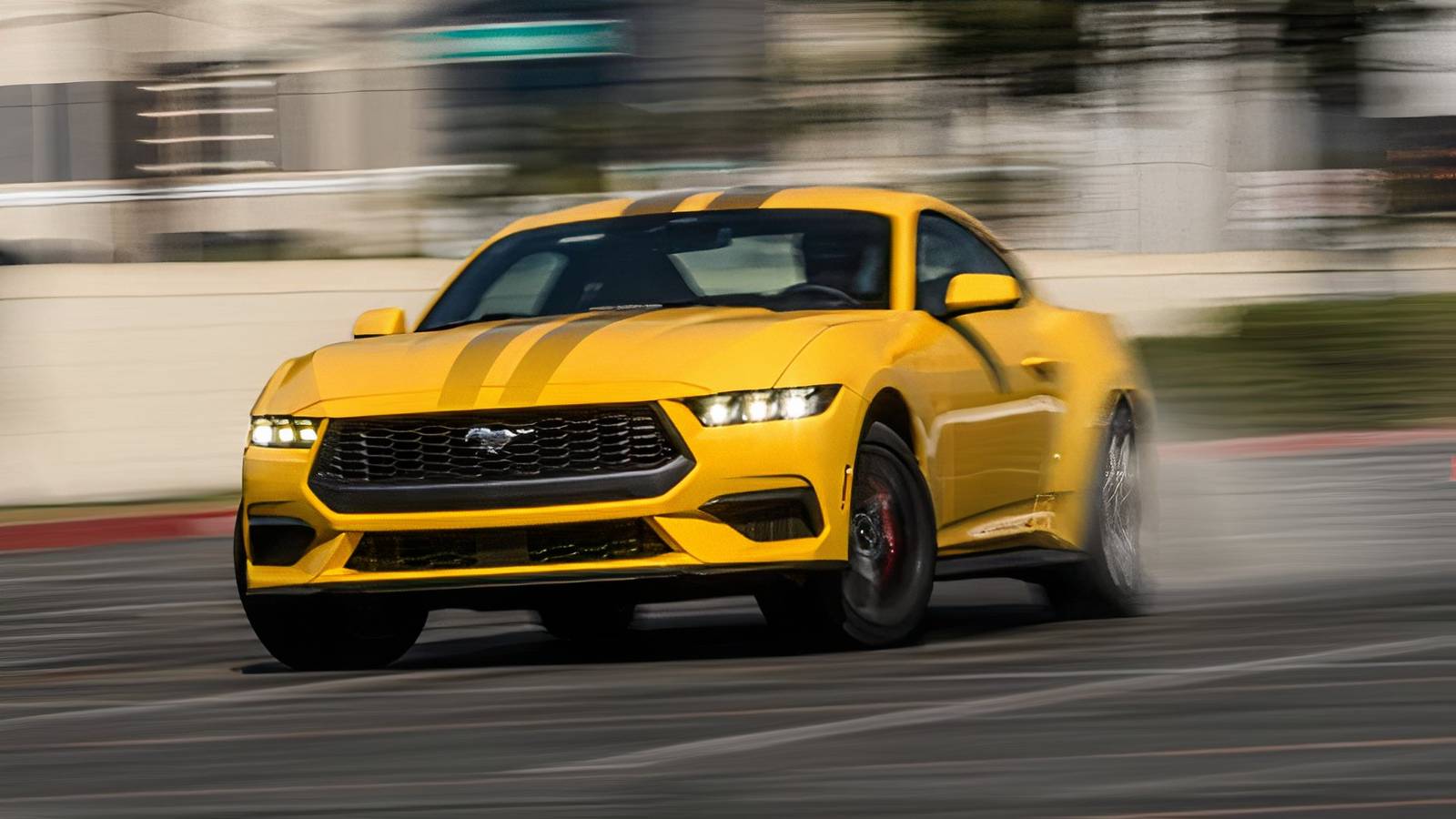
Performance cars like the Mustang RTR also use this tech, based on Ford’s racing programs, to improve mid-range turbo response during hard driving.
Benefits And Trade-Offs Of Ford’s Anti-Lag System

Any complex technology like Ford’s anti-lag system, though providing real-world improvements in throttle response, dynamic performance, and fuel efficiency, does come with the downside of greater mechanical complexity, component stress, and emissions compliance.
Enhanced Performance And Drivability
Old school anti-lag systems work by late ignition of fuel in the exhaust, generating heat, wasting fuel, and creating loud bangs. This can cause stress on turbos, the manifold, and catalytic converters. Ford’s system avoids these drawbacks by replacing off-throttle combustion with air routing and timing to sustain turbo speed. This reduces head buildup and additional emissions.
Reduced Heat And Fuel Penalty

Even though Ford’s system is better than the old bang-bang anti-lag solutions, there are still some trade-offs. Ford’s system needs complex control logic and very precise calibration to maintain the balance between performance, emissions, and mechanical stress. If used aggressively or outside intended modes, it can create stress on the turbo and valves.
Sources: Ford