
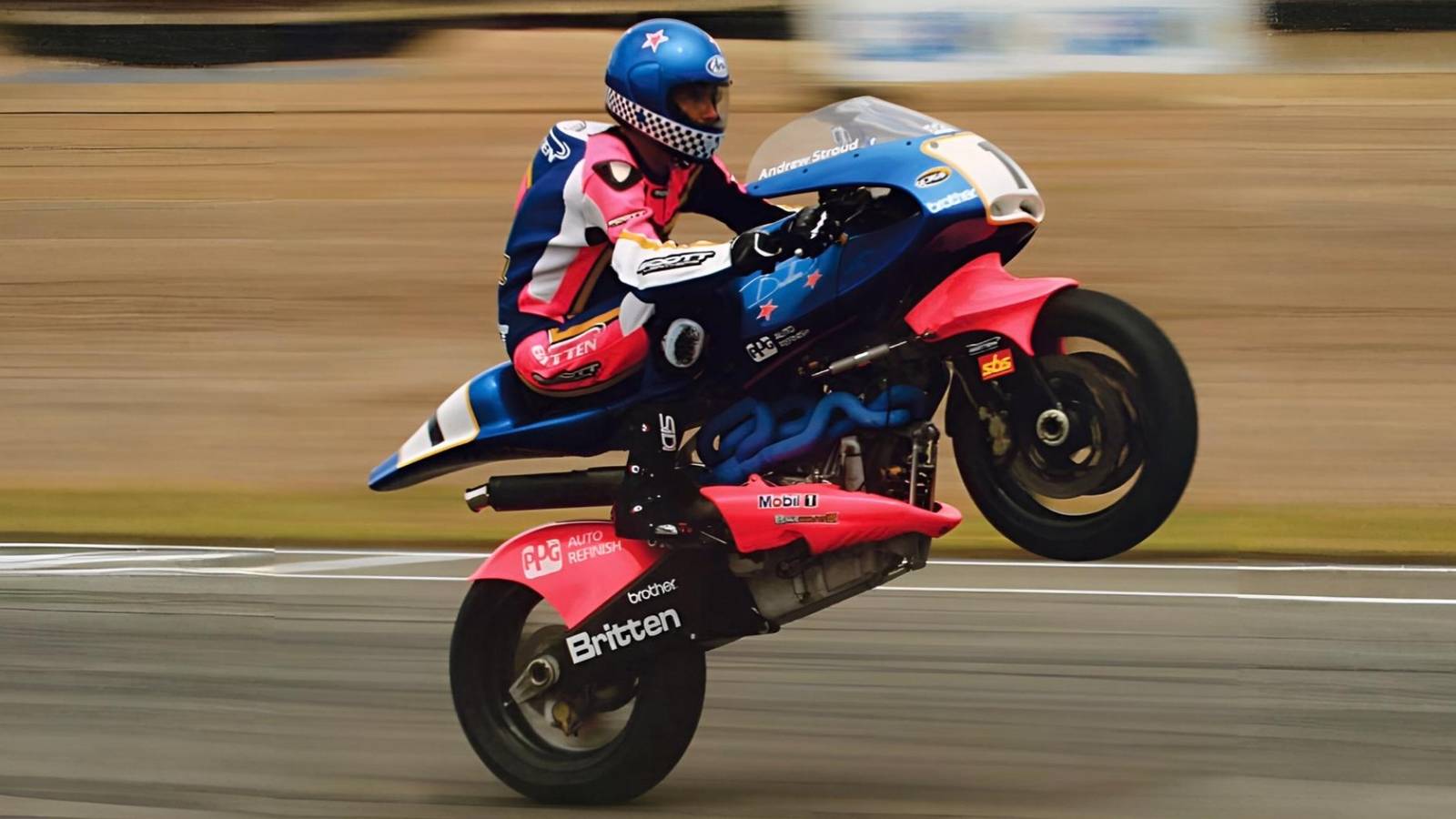
All the way through the 90s, we were getting one incredible flagship sports bike (aka superbike) after another. Manufacturers had become obsessed with speed, and it was easy to see why. At the time, speed was selling motorcycles. Having the fastest production motorcycle meant something to the marketing department, and if you couldn’t deliver that, then you needed to be competitive out on track.
At one point, even Harley-Davidson got in on the act, pouring millions of dollars into a superbike project which subsequently failed to deliver on track. Strangely, this made a degree of sense when you take into account that Ducati were the team to beat back then because they ran V-twin engines. Something Harley knew a thing or two about. Other manufacturers running four-cylinder bikes struggled to keep up thanks to the fact that they were all limited to a displacement of 750cc compared to 1000cc for the twins. With all this happening, you might think that this would have been a pretty strange time for a privateer to enter the fray with a bike built in a shed. But, the Britten V1000 wasn’t just any racing bike.
To give you the most up-to-date and accurate information possible, the data used to compile this article was sourced from Britten New Zealand. Whereas, the opinions are our own.

The 20-Year-Old Honda Superbike Worth Buying In 2025
This old race bike is still affordable, and offers a rider experience like no other
The Britten V1000 Was A Product Of One Man’s Dream
Taking On The Elite

John Britten, the man behind the bike, is a legend in his native New Zealand, but outside the country he is relatively unknown. His creation which bears his name has most certainly outlived him. It almost goes without saying that he was already a fairly accomplished engineer before taking on this incredible project, but nothing he did before, not even his own house – which he designed – comes close to what went into building this motorcycle.
The Britten V1000 went on to win several races in the early 90s, but just as it was starting to perform more consistently on the global stage, setting several records in the process, John succumbed to cancer at the relatively young age of 45. At the time, the V1000 was widely regarded as one of the most advanced motorcycles ever built and even though it was built in a small shed, it was able to take the fight to some of the most famous racing bikes of the 90s. It is fair to say that even though he died before his time, he had lived out his dream. The V1000 is far more than just a bike, but rather his legacy, and a physical representation of his impossible dream that came true.
FIM Speed Records (1994)
- Flying mile: 302.7km/h (188.1 MPH)
- Standing Start 1/4 Mile: 134.6km/h (83.6 MPH)
- Standing Start Mile: 213.5km/h (132.7 MPH)
- Standing Start Kilometer: 186.2km/h (115.7 MPH)
The V1000 Has A Hand-Built V-Twin Engine
Nothing about the V1000 is conventional, least of which, the engine. It is without doubt the centerpiece of the design, with everything essentially hanging off the engine. The engine was designed and built by John and his team, which is a truly incredible undertaking when you consider that most racing teams at least start with the manufacturer’s engine casings and some of the internals.
Staggering Tech Helped The Engine Produce Serious Power

In the 90s, a V-twin engine configuration made a lot of sense for a superbike. Back then, superbike racing allowed for V-twins to go up to 1000cc, while four-cylinder bikes were limited to 750cc. It also made sense in terms of packaging, because the way this bike was designed, the engine acted as a fully stressed member – not just a stressed member – but it acted as the chassis itself. No matter how unconventional the design was, it was still a modern lump with sequential fuel injection, titanium internals and a truly unique set of spaghetti headers. With 166 horsepower and a top speed of 188 MPH, the bike wasn’t just competitive, it was well and truly in the hunt for podium finishes.
Engine Specifications
|
Engine Type |
V-Twin, liquid-cooled |
|
Displacement |
999cc |
|
Max Power |
166 HP |
|
Transmission |
5 or 6-speed |

Why Racing A Motorcycle Can Be A Life-Changing Experience
TopSpeed recently went racing in a one-make championship with TVS Motors, and here’s why it should be on your to-do list
The V1000 Doesn’t Have A Chassis

Conventional wisdom dictates that you need a chassis. A chassis is supposed to hold everything together, as well as provide stability while cornering – something especially important to a race bike – but that just added too much weight for Britten’s liking. This is what made it so important for them to build their own engine. All the mounting points for the suspension are cast into the engine casings. This is quite simply not something a manufacturer would ever even consider doing. The cost involved would be astronomical, and for this bizarre idea to work it would require just about everything else outside the engine to be made of composite materials. Which all of it was.
The Superbike Launched In The Face Of Convention

The swingarm, wheels – which is now illegal – and girder forks were all made of carbon composites. This was around a decade before any of the major motorcycle racing teams started experimenting with carbon fiber. Girder forks are technically so outdated they wouldn’t have even been on any other racing team’s radar. But, the one thing you can do with girder forks is adjust them easily to alter the geometry of the bike, which allows the team to set the bike up perfectly for just about any track around the world.
That said, it took time and one spectacular failure to get this unconventional set-up working right, but once it did, they had the lightest 1000cc race bike ever seen. With a wet weight of just 304 pounds and almost 170 horsepower, it had a truly astonishing power-to-weight ratio that made just about every other bike seem heavy by comparison. Even by modern standards, the engineering behind this motorcycle was advanced, but back in the 90s while it was still racing, it was essentially a small spaceship.
Chassis, Suspension, And Weight Specifications
|
Chassis |
Fully stressed engine |
|
Front Suspension |
Double wishbones with girder, Öhlins shock |
|
Rear Suspension |
Swing arm with adjustable three bar linkage, Öhlins shock |
|
Front Brakes |
Dual 320mm discs |
|
Rear Brakes |
210mm disc |
|
Weight |
304 lbs |