
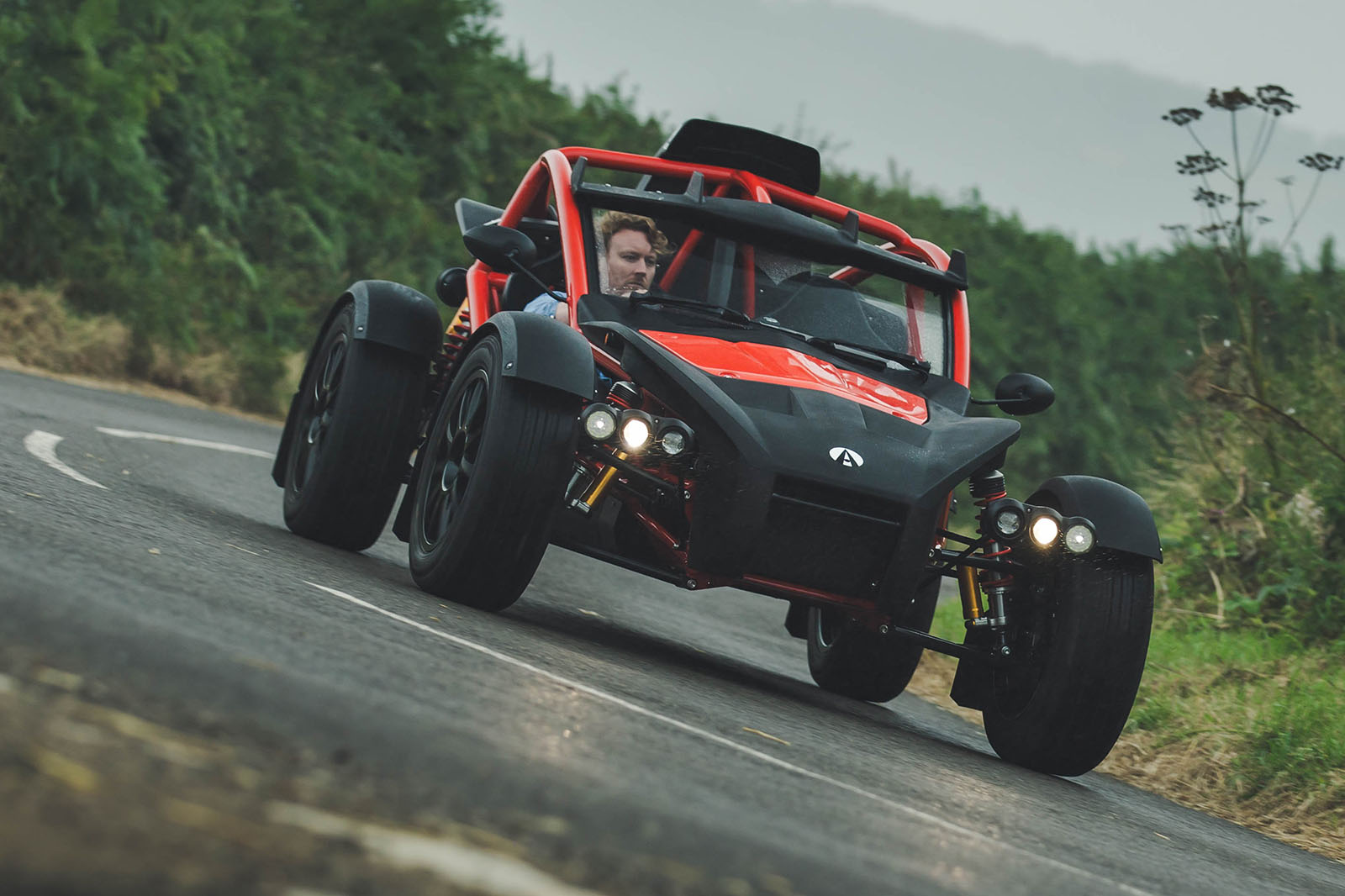
It’s a push-button start and the Ford unit fires up more with a boom than a rasp, then you almost need only think the Nomad 2 into motion, so smooth and forgiving is the clutch action, quite at odds with the car’s intimidatingly hardcore aura.
This car’s 18in Yokohama Advans are as road-leaning a tyre as you can have on your Nomad. All-terrain Geolander rubber on a smaller, 16in wheel is a popular option, but for road use, and for our performance testing, these are best. As for properly launching the Nomad 2 against the clock, it’s a fantastically old-school event. Sure, there’s now a launch control function, where you dial up the desired revs then fix them in place by pressing a button on the dash before dumping the clutch, but we found this of limited appeal. With such a forgiving clutch, pedals so deliciously weighted, reassuring squat in the suspension and torque-instigated over-rotation of the tyres, your tailbone feels mechanically connected to the back axle, so a brisk getaway is fairly intuitive.
With its boost turned up to the maximum, this car hit 60mph in 3.8sec – seven tenths up on the Nomad 1 we tested in 2015. That car made 70bhp less, but it also carried 151kg less mass. The new Ariel’s straight-line speed feels like progress, then, especially when you consider that our test car represents an unusually heavy specification. On a warm day, in a lighter car, you might find half a second or more.
In-gear performance is also dramatically improved thanks to the new turbo engine. The Nomad 2’s 5.3sec from 30-70mph in fourth gear comfortably beats the 6.5sec of its predecessor and roughly matches the figure returned by the Porsche 911 Carrera 4 GTS Cabriolet tested recently. The difference in the Ariel is that you can revel in the lightness of the machine as a bubble of torque swells to its thuggish 382lb ft peak at just under 3000rpm and whisks you away. As ever with such machines, the numbers only convey so much. The torque has the added benefit of making the Nomad 2 less demanding company off road.
Our test car was fitted with a six-speed Ford gearbox that arrives with the engine. It has a short shift action but perhaps lacks the precision of the old Honda unit. This not an issue in practice, and you’re unlikely to miss the gate even during a flustered red-line upshift; along with the burlier character of the engine, which no longer fizzes and rasps quite as much as in the Nomad 1, it contributes to a shift in personality.
The character of the powertrain is for sure the biggest change. This unit might disappoint a touch in an Atom, and Ariel will continue to use the Honda motor in that application, but the subtly woolly pick-up, the bassy note and the swelling bubble of whooshy, abundant torque through the mid-range do suit the Nomad. Torque builds conservatively, then dramatically, then tapers neatly towards the redline. It’s never dull.