
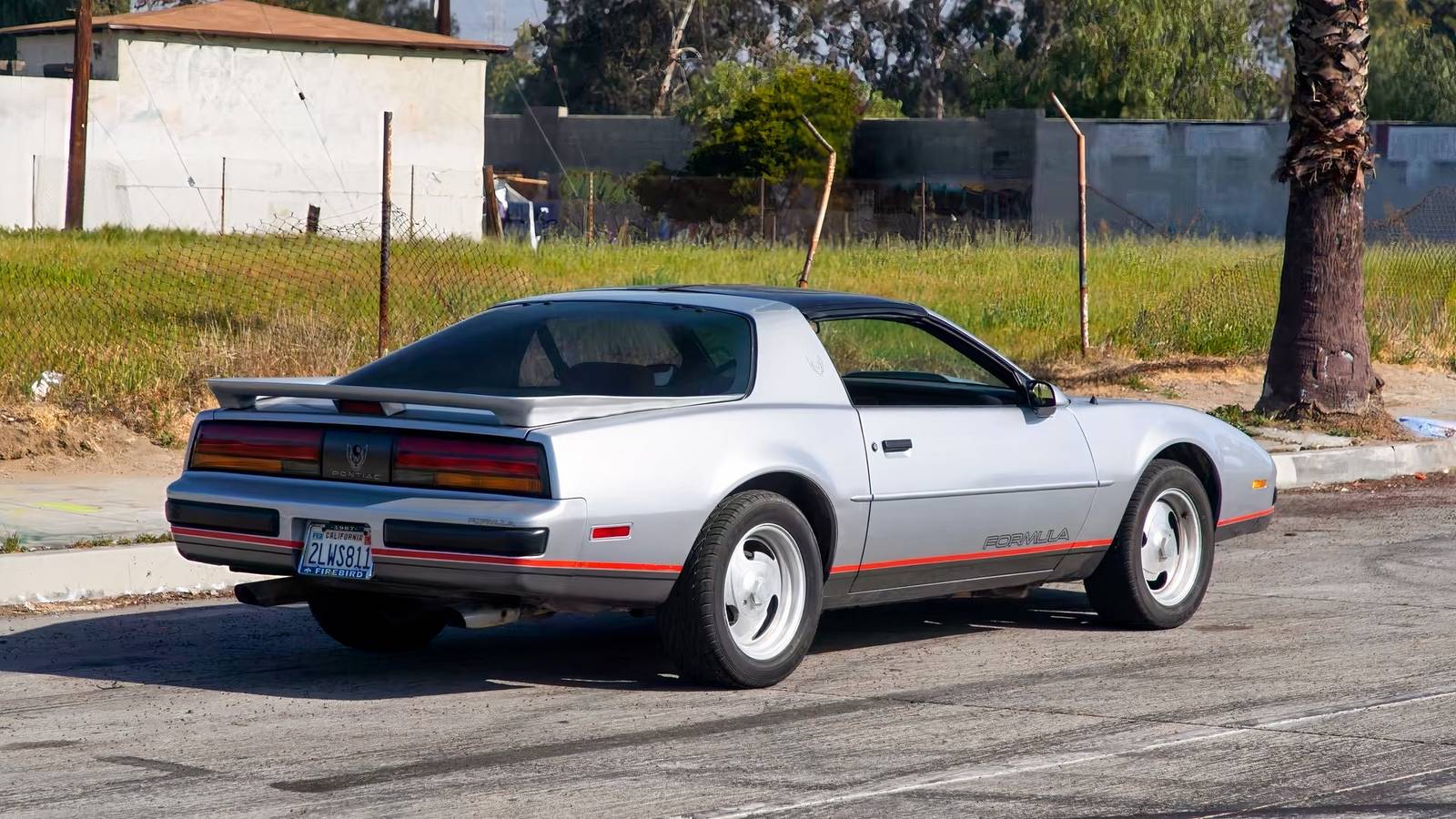
There’s a chance you’ve heard your older parents, family members, friends, or coworkers complain about their cars. Typically, something along the lines of how complicated cars are “these days.” Hell, it might be you throwing out the complaints. It’s not ridiculous to long for the emissions-be-damned days of analog, carbureted fuel delivery systems. And if it’s the newest factory-carbureted sports car with an American badge you’re looking for, there’s one name you should know: Firebird.
Sports car, sports coupe, muscle car– call it what you will. The 1987 Pontiac Firebird Formula and Trans Am kept the two-door, rear-wheel drive, V8 front-engine recipe of its siblings and rivals. But, while the Chevrolet Camaro ditched its L69 V8 the year prior, the sharkish Pontiac offered a choice of a carbureted engine or a tuned port injection V8. It was a chapter halfway between the age of carbureted V8s and the fuel-injected standard of the future.
Pontiac Kept The Carb Until The Late ‘80s

Back in the 1960s, small-and-big-block V8s were unapologetically carbureted. However, the squeeze of the Clean Air Act and the oil crisis of the 1970s changed the rules. Efficiency and emissions were of increasing consideration, and the days of the fuel-sucking carb were numbered. However, one automaker refused to give up the carburetor until the last possible moment.
In 1987, buyers could get a Pontiac Firebird in a couple of fuel delivery flavors: a tuned port injection system or a delightfully old-school Rochester Quadrajet four-barrel carb. Now, tuned port fuel injection made things smoother, more efficient, and better-running at altitude and during cold starts. What it didn’t do, however, was provide the yesteryear driving experience of the Rochester four-barrel.
A Carbureted Sports Car In Showrooms Through 1987

“Oh, but a Pontiac Firebird isn’t a sports car, it’s a muscle car!” “Actually, it’s more specifically a pony car than a traditional muscle car.” The needless debate can rage on (and it will). Just as we have fingers and thumbs, we have categories within categories. Like it or not, a muscle car is, more often than not, a sports coupe. That includes America’s last carbureted sports coupe, the 1987 Pontiac Firebird and Firebird Trans Am.
Before 1988, you could waltz into a Pontiac showroom, pick out a Firebird Formula, and drive away in an American, factory-carbureted sports car. It might not be your classic picture of a sports car, but it was the last of its kind. The carbureted holdout. However, it wasn’t the only fuel delivery option for the 1987 Pontiac Firebird.
The Trans Am And A Formula For Carbureted V8s

Buyers had a choice between the 1987 Pontiac Firebird and Trans Am. A carb fan could still get a Firebird with a carbureted LG4 5.0-liter (305-cubic-inch) V8. However, at about 155 horsepower and around 250 pound-feet of torque (some sources claim 240 pound-feet of twist), the carbureted 1987 model didn’t live up to the output figures of the TPI models. The larger of the TPI engines, the 5.7-liter (350-cubic-inch) mill, was rated to as much as 210 horsepower and 315 pound-feet of torque.
Other American Performance Cars Ditched The Carbs Earlier

While Pontiac waited until 1987 to kill off the last of the carbureted two-door performance cars, other GM brands did the deed earlier. The Chevrolet Camaro gave up its carbureted L69 5.0-liter V8 before 1987, leaving TPI options like the LB9 V8 in the mix. The Chevrolet Corvette ditched its carburetor a bit earlier, going all-fuel-injected by 1982. Chevrolet switched America’s original sports car over to the Cross-Fire fuel injection system as part of its early 1980s updates to the C3.
Of course, Corvette dabbled with earlier styles of fuel-injection with models like the 1957 Chevrolet Corvette and its Ramjet fuel injection system. One of the Pontiac Firebird’s pony car segment rivals, the Ford Mustang, also went fuel-injected by 1985 during its Fox Body years.
The Final Holdout Before The Modern Muscle Age

The departure of the 1987 Pontiac Firebird meant the end of the two-door, performance-oriented carbureted American car. As 1988 rolled around, fuel injection was already the standard. Tuned port injection continued to feature in GM performance cars like the Chevrolet Corvette until the second-generation SBC, the LT1, took over. More recently, modern muscle cars have used fuel injection exclusively, from the pushrod LS family of GM small block engines to the DOHC Ford Coyote V8.

10 Things You May Have Forgotten About The Pontiac Firebird/Trans Am
The Pontiac Firebird/Firebird Trans Am was a car made famous by many movies, but it was still underappreciated!
Collectible, But Not Pricey

There’s a collectibility factor to just about any “first” or “last” car. Being the last of the carbureted American muscle cars, a 1987 Pontiac Firebird or Firebird Trans Am has collector’s potential. That said, they aren’t prohibitively expensive for first-time collectors or hobbyists quite yet. The average sales price for a 1987 Pontiac Firebird is $23,145.
As for the Trans Am, the average sales price is a bit higher at $24,294. Those numbers depend on a multitude of factors, like mileage, condition, and whether the vehicle is numbers-matching. Still, shrewd shoppers can find them for cheaper if they know where to look. For instance, a North Carolina-based 1987 Pontiac Firebird Trans Am with 31,583 miles on the odometer sold earlier this year for just $12,500.

So, Should You Buy One?

It’s apropos that the third-generation Pontiac Firebird had the moniker “Formula.” Put simply, it’s a charming example of the period. Pop-up headlights, hard angles, and an era-characteristic retro-futuristic look make it (arguably) more of a looker than the third-gen Camaro of the same timeframe. Add the purist-forward recipe of a carbureted V8, and the 1987 Pontiac Firebird is something of a collectible. Also, with a liftback rear end, a third-gen Firebird is surprisingly utilitarian. Of course, where there’s a will, there’s a way, and the Firebird isn’t the only way.
Should you desire the shake, rumble, and roar of carbureted engines past, there are plenty of options. As mentioned, the Firebird’s closest sibling, the Chevrolet Camaro, was a carbureted affair until 1986. That means you can snag a third-generation Camaro with a carburetor in place of fuel injection. And, like the 1987 Pontiac Firebird Formula, buying a mid-eighties Camaro likely won’t break the bank. What’s more, the mechanically inclined can always swap a fan favorite engine, like a carbureted Chevrolet or Ford small block, into a Malaise-era “muscle” car. The sky’s the limit.
Sources: CarBuzz, Classic.com, Hagerty, Mecum, 3rd Gen Formula