
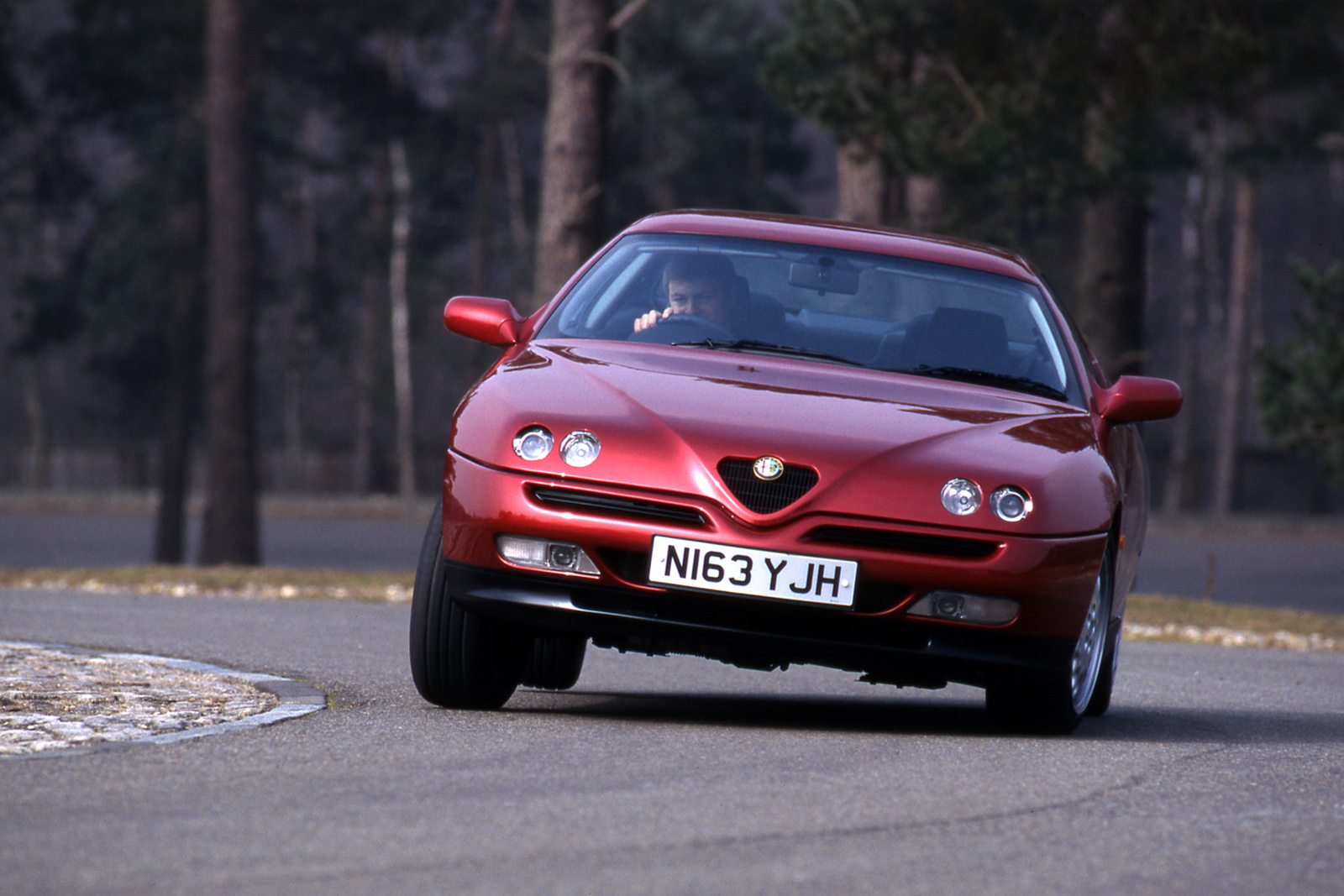
The base metal wasn’t so promising. A platform that started life beneath the boxily functional, galvanised bodywork of the 1988 Fiat Tipo was to be the core building block of a car that had created legends for its maker, and was sufficiently difficult to replace that it had been out of production for seven years.
The outgoing Alfa Romeo GTV was a rear-wheel drive four-seater coupe designed by Giorgetto Giugiaro, as its much-admired predecessor had been, and while this Alfetta-based coupe had its issues – a habit of dissolving, the fractious relationship between its rear-mounted gearbox and a reluctant gearlever – it was a sophisticated beast of some charm.
The new GTV and its Spider convertible sister would inevitably be front-wheel drive being Tipo-based, and there were plenty of critics, this columnist included, who reckoned that this source platform would prove inadequate for the task.
But not if one Giancarlo Travaglio had his way. Travaglio was Alfa Romeo’s chief chassis man back in the early ‘90s, he and his colleagues selecting for benchmarks the long-forgotten (but rather brilliant) Honda Civic VTi hatch of the era, and the front-drive Lotus Elan.
At the Spider’s launch Travaglio told me of his habit of performing 115mph drifts “to learn about chassis equilibrium”, and of his enthusiasm for the Elan.
Much of whose dynamic magic stemmed from clever suspension and subframe bushing that effected firm but fluent control over the wheels and their geometries while in frenzied rotating motion, a development not lost on Alfa’s chassis team.
Early on in their development life the GTV and Spider had been narrower, their rear-ends suspended by some disappointingly simple chassis design that would have instantly betrayed their humble Tipo beginnings. But part-way through the programme there emerged an ultimately aborted plan to relaunch Alfa Romeo in the US, market research demanding that the cars appear more imposing. Around the same time Fiat Auto CEO Paolo Cantarella, a genuine car nut, decided that the Spider and GTV chassis weren’t good enough.
So, the crude rear suspension was ditched in favour of a multi-link system mounted to a super-stiff alloy subframe, the back-axle kinematics designed to provide a controlled smidgen of rear-wheel steering.
At low to middling cornering forces the rear wheels would counter-steer, while at high speeds – Travaglio’s 125mph drifts, no doubt – they would steer fractionally in phase with the fronts.
There wasn’t the scope (or the skill) for this scribbler to confirm the Alfa’s behaviour at 115 squealing mph, but at lower speeds it cornered with an understeer-banishing obedience that was both a joy and a surprise. And, you could lift-off mid-bend and find the car tightening its line. It wasn’t as much fun as a tail-out drift in a Mazda MX-5, but it was definitely entertaining and a bit more dependable in rain.
Heightening the fun was Alfa’s new range of Twin Spark motors. These were completely new engines, featuring one big and one small spark plug per cylinder for a total of eight, twin cams, the lobes of the inlet shaft flicking between two positions for deeper breathing and just as unusually, a pair of balancer shafts for smoothness.
The result in 2.0 litre form was 150bhp, 138lb ft of torque, plenty of rort and a 7000rpm redline. In fact, this engine would see 7300rpm before the rev limiter called curfew.