
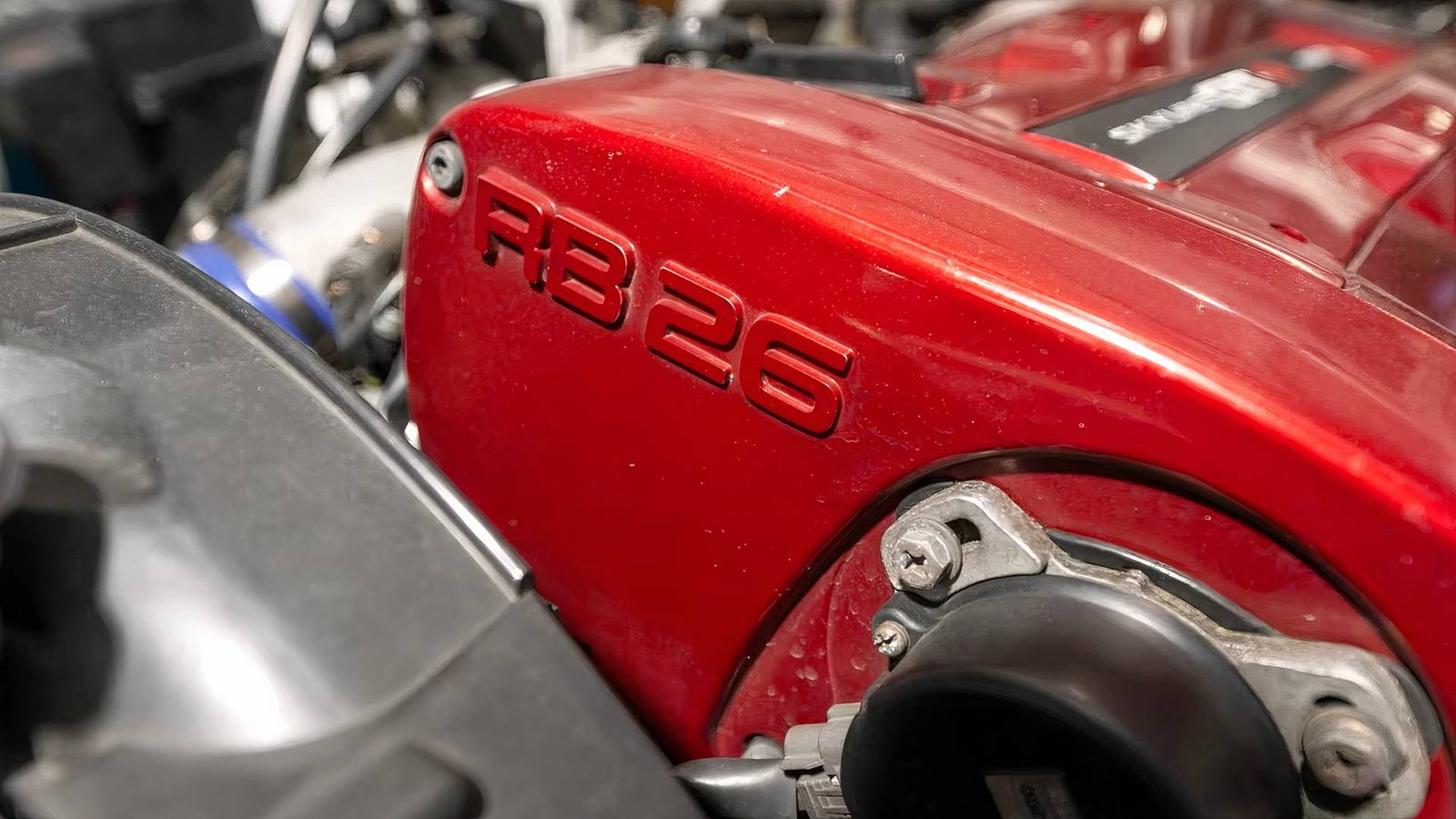
Some cars make a name for themselves. The same can be said for race cars. Then you have the engines that create a cult following. The Toyota 2JZ, the Mezger 4.0-liter flat six, the thunderous 454-cubic-inch Chevrolet big-block V8. All of these mills reside in the all-time great engine hall of fame. Then you have Nissan’s contribution. Alongside the beloved VQ series of engines, the Nissan RB26 is a cult favorite and one of the brand’s very best performance weapons.
For starters, the RB26 powered some of Nissan’s most coveted performance cars, most notably the R32, R33, and R34 Skylines. However, the RB26DETT has something of a reputation for putting up with some serious power and punishment. Not the NSFW kind, but rather durability on and off the track. If that wasn’t enough, race teams and car builders stretch the RB26 well past factory horsepower ratings. And as long as they work out issues and stay on the reasonable side of things, the RB26DETT comes back for more. Of course, even Godzilla isn’t completely indestructible.
The Nissan RB26: A Reputation For Withstanding Abuse

Nissan’s RB26DETT has something of a reputation. Enthusiasts and fans know the twin-turbocharged 2.6-liter inline-six-cylinder mill for its tunability. Builders will often throw on a freer-flowing exhaust system, install a high-performance intercooler, upgrade fuel system components, and find a solid tune for an RB26 to make more power without compromising the everyday usability or durability. And therein lies another part of the RB26’s renown: it’s one tough engine. Nissan built the twin-turbo inline-six to go racing. As such, fans often call Nissan’s RB26 “over-built.” While that sounds like a scathing jab you might get from your gym buddy for spending too much time working on your calves, it’s not an insult for the RB26. Far from it.
Over-Engineered For Racing

Nissan started with a cast-iron block for the RB26DETT. Now, before you start knocking the use of iron for its weight, just wait. Cast-iron blocks are more durable and resistant to heat-related damage and warpage than their aluminum counterparts. Let’s face it, the demands of Group A racing include running at high temperatures for a long time, and a heavy-duty cast-iron block is up to the task. Nissan opted for beefier, more motorsport-focused internals, too. Speaking of heat, the RB26 deals with the added heat of its twin turbochargers with a set of sodium-filled exhaust valves. The sodium-filled valves pull heat away from the face of the valve at high temperatures.

Instead of hydraulic lifters, the RB26 used solid lifters. Sure, the solid lifters are a bit more maintenance-intensive and noisy, but they’re more stable at higher RPMs. That’s exactly what Nissan wanted while drivers were knocking on the RB26DETT’s 8,000-RPM redline. If you can’t keep your pistons as happy as possible while racing, you might be doomed from the start. Nissan installed a set of oil cooling jets that spray the underside of the pistons while under high-load, demanding driving. You know, like racing.

Cars We’re Looking Forward To In 2026
The 2026 model year is shaping up to be an exciting one for car peeps, weekend adventurers, and everyday drivers who want something fresh.
DOHC, EFI, And Two Turbos

So, let’s talk DETT. What does that crazy acronym mean for the RB26? In short, it means the RB26DETT is a dual-overhead cam engine (DOHC) with electronic fuel injection (EFI), and (you guessed it) two turbochargers. All of these attributes are staples in performance engineering.

The DOHC application in the RB26 allows the engine to have four valves per cylinder as opposed to two. That means the RB26 “breathes” better than a two-valve application with twice as many intake and exhaust valves. Similarly, electronic fuel injection is a performance and reliability improvement over carbureted engines. In stock configuration, the overbuilt nature of the RB26 makes it one robust application for street driving and spirited circuit work. That said, the RB26’s twin turbos and their ceramic turbines can fail if pushed well beyond stock boost levels.
The Skyline’s The Limit

The Nissan RB26’s cast-iron block can stand up to heat and the relentless demands of Group A racing. It’s also a popular choice for tuners looking to make decent power with a cult-favorite inline-six engine. Some builders will look to the aftermarket for performance parts or crate RB26DETTs to make serious horsepower in their own R32, R33, and R34 Skylines.

NISMO (Nissan Motorsport) knew it wanted even more from the RB26 years ago, developing the N1 block in the process. The N1 block featured a 1.0-millimeter-thicker deck surface, as well as a tougher cast iron. While the stock block could handle abuse, the more robust N1 took things to the next level. Of course, the RB26 wasn’t completely invulnerable. For instance, the stock oil pump was prone to failure when pushed to well above factory horsepower levels. Similarly, running an RB26 with too much boost can cause the ceramic turbines in the turbos to fail prematurely.

This Is What Makes The Nissan Skyline R34 The Ultimate Japanese Legend
In an era where modern performance cars are often weighed down by electronic interference and artificial character, the R34 remains refreshingly pure.
A ‘Gentlemen’s Agreement’

Interestingly enough, Nissan rated the RB26DETT in the R32 Skyline at 276 horsepower. Sounds low? That’s because it is. In the 1990s, Japanese automakers struck a “gentleman’s agreement” to limit horsepower output to an arbitrary 276 ponies. Why? Automakers like Nissan, Toyota, Subaru, and Mazda wanted to avoid intervention from lawmakers as the glory days of JDM were in full swing. That, and Japanese car brands believed the limit would prevent an all-out automaker arms race. Trouble is, the rating was a lie. Many of the 1990s JDM greats produced more than 276 horsepower, and did so without publishing accurate horsepower and torque figures. In reality, a stock R32’s RB26DETT produced closer to 310 or 320 horsepower before the addition of aftermarket magic.

The Nissan Skyline GT-R EV You’ve Probably Never Heard About
A group of Nissan engineer volunteers converted an R32 GT-R into an EV, and it premieres at Tokyo Auto Salon.
A Superpowered Legacy

Tragically, the RB26 lives right at the nucleus of an issue that broke many hearts among stateside car fans. U.S. Federal Motor Vehicle Safety Standards (FMVSS) and EPA regulations stopped the R32, R33, and R34 Skylines dead in their tracks. That meant interested buyers had to wait until the cars were a quarter of a decade old before they could legally import them, in accordance with the United States’ 25-year importation rule. That didn’t stop Americans from importing the cars when they became legal.

In fact, the oft-coveted R34 and its RB26DETT turned 25 just a couple of years ago. The importation restrictions also didn’t stop Americans from swapping the RB26 into their own project cars. However, the forbidden-fruit Skylines and the twin-turbo inline-six also paved the way for a ballistically quick successor: the R35 Nissan GT-R. Instead of a sonorous inline-six, though, the R35 packed a twin-turbocharged 3.8-liter VR38DETT V6. Each one was assembled in a dust-free environment at the Nissan plant in Yokohama. With intelligent all-wheel drive working hard for grippy launches, later R35 GT-Rs could launch and handle with supercar-killing athleticism. Not a bad legacy.