
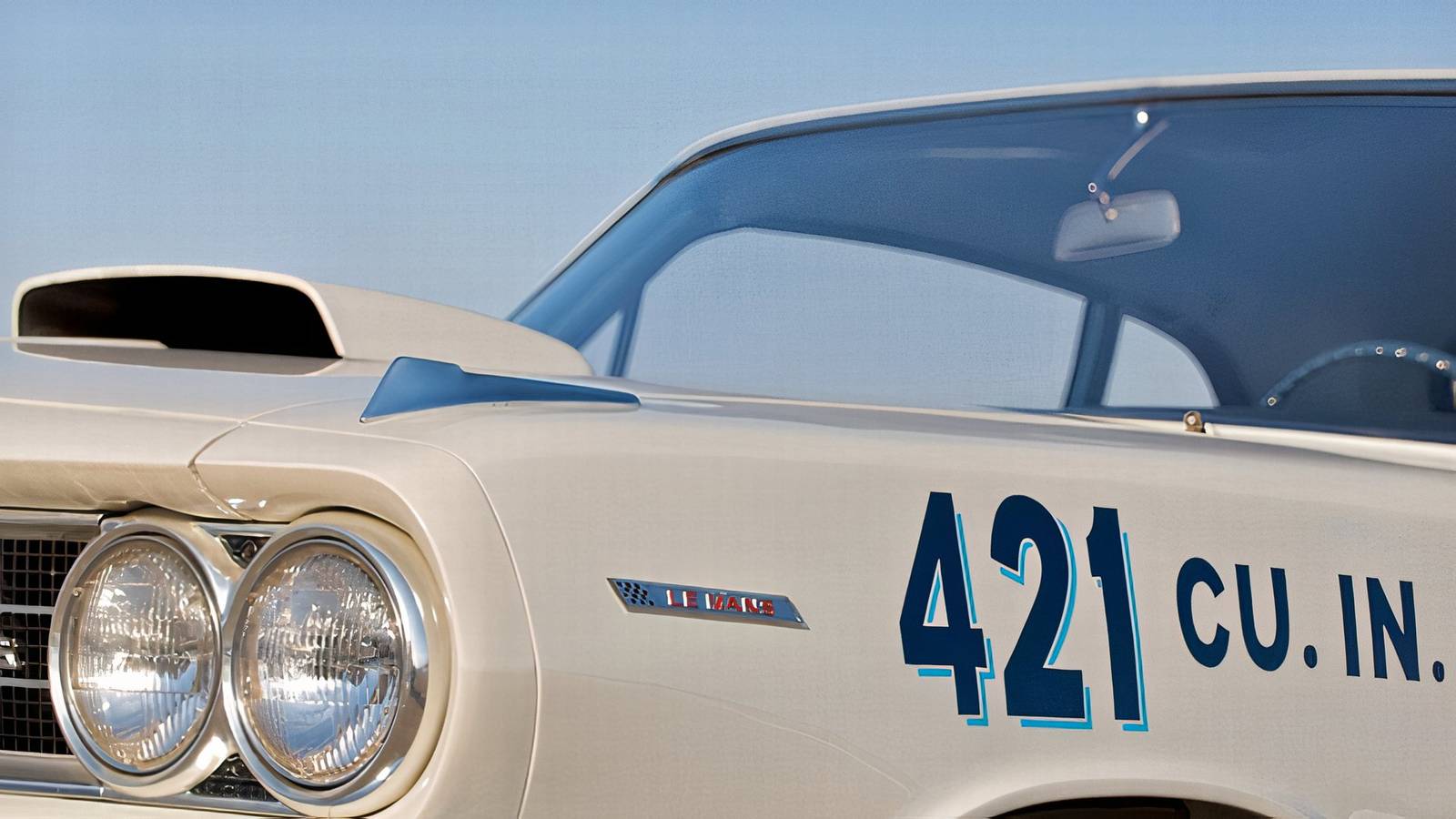
We look back upon the 1960s muscle car scene with a sense of enormous pride and nostalgia, an automotive industry so incredibly different from the one we are faced with today. It was a time of raw, unplugged power, no matter the emissions, and no matter the lack of efficiency. While such ruthless brute force would not stick for consumers today, it was an era that birthed some truly legendary cars: the Ford Mustang, the Dodge Challenger, and the Corvette Stingray, to name a few. All of them are esteemed for their bellowing V8s and classic American style.
Whilst most of these cars held a certain mischievous defiance, there is one particular muscle car that was not only immensely powerful, but was born out of pure rebellion. A true monster, and one that was so rare, nobody seems to remember. It was rather similar to the Pontiac GTO, but its vigor was on another planet, and barely any were ever made.

The 1963 Pontiac Super Duty was a troublemaker right from the moment it was even considered. In 1962, GM decided it would be the safest bet to enforce a ban on all factory-backed racing due to the fear of potential investigations from the Department of Justice. But a small handful of the passionate engineers at Pontiac weren’t going to let their aspirations of untamed performance die so easily. They spent the 1962 Christmas break committed to hand-assembling 12 of these so-called “Tempest Super Duties” and completed the project a moment before the late January ban of 1963. Whilst some disguised their true nature, underneath lay something truly special.
What The Engineers Did To Make The Tempest Unique
- Rear-mounted trans-axle, two two-speed autos joined to create a four-speed
- Incredible 50/50 weight distribution for better launch traction
- Unique flexible steel driveshaft
- Aluminum body for extreme weight loss
The Result Was Astonishing Performance

With the creation of the Tempest Super Duty and the Pontiac GTO the next year in 1964, the company had something accidentally spectacular. They had an influential and usable muscle car for the masses, one of the very first credited with such an accolade, and created the unhinged, rebellious Super Duty — whether GM wanted it or not. With a dedicated commitment to performance, the small team at Pontiac not only focused on transmission and weight-saving measures but also used a ludicrous 6.9-liter Super Duty V8 that proved to be quite the driving force.
Pontiac Tempest Super Duty VS Pontiac GTO
|
Vehicle |
1964 GTO |
1963 Tempest Super Duty |
|
Powertrain |
6.4L V8 |
6.9L V8 |
|
Transmission |
3-speed manual |
4-speed Powershift |
|
Horsepower |
325 |
465 (recorded) |
|
Torque |
428 Ib-ft |
500 Ib-ft (recorded) |
|
0-60 mph |
6.6 seconds (Curbside Classic test) |
4.6 seconds |
|
Weight |
3,500 Ibs |
3,200 Ibs |
Whilst the masses could enjoy ample performance in 1964 with the GTO, the performance of the Super Duty was truly mind-bending at the time. With an initial 1/4 of a mile drag race time of just 12.1 seconds, the Tempest is still enormously fast today. That is the same as a modern 6.4-liter V8 Dodge Challenger.

10 Classic American Muscle Cars That Still Dominate Auctions
Some classic muscle cars are cooling off price-wise, but these icons are still scorching the auction block.
Accolades Of The Insane Super Duty

The defining moment for the Super Duty came in the 1963 250-mile Daytona Cup. This was a huge opportunity for that small group of Pontiac engineers to prove what is possible with true, logical mechanical skill. Up against million-dollar European prototypes, Corvette Z06s, Ferrari 250 GTOs, and E-types, the Tempest had strong competition. But it didn’t matter. The Super Duty lapped Ferrari eight times and managed to embarrass everything else on the field.
Pontiac Super Duty VS Speedfreak Competitors
|
Vehicle |
0-60mph |
1/4 mile time |
Top Speed |
|
Pontiac Super Duty |
4.6 seconds |
12.1 seconds |
160 mph |
|
Ferrari 250 GTO |
5.4 seconds |
13.5 seconds |
174 mph |
|
Shelby Cobra 289 |
5.5 seconds |
13.8 seconds |
135 mph |
|
Corvette Z06 C2 |
5.8 seconds |
14.2 seconds |
150 mph |
And then came the 1963 NHRA Winternationals, the Tempest in its element. Whilst the 426 Stage II Max Wedge cars were seemingly unbeatable at the time, the Super Duty was around a second faster per run than anything else, and their incredible consistency gained them a win. Not only that, but a new record was set, with the fastest run by the Pontiac coming in at a remarkable 11.89 seconds.
The Fate Of The Super Duty

Because only 12 of these were ever built, only a few still exist. Originally, six coupes and six wagons existed. In 2026, it is said that only two or three coupes are still around. The wagons are even rarer. For years, hope was lost, until one was found in the 1980s and sold for $450,000 in 2010 in museum-ready condition. There was another story from 2008, which involved a rusty old Pontiac from the early 1960s. Whilst the starting bid was $500 and the owner didn’t know what it was, muscle car collectors flocked to the listing, and the winning bid was $226,521. It was sold again, eight years later, for $335,500.

The most valuable Tempest was restored to pristine condition in 2017 and has been valued at over $500,000 due to its astonishing originality. But there are so many unanswered questions: what on earth happened to the other vehicles? Due to a mix of factors, from GM possibly destroying them for legal reasons, crashed examples, and the curious possibility that one is still out there in a barn waiting to be discovered, there are only a few left.

10 Fast Cars From The ’60s That No One Talks About
1960s are known for classic muscle cars, but there was actually a ton super-fast, high-performance rides that aren’t a part of the usual conversation.
The Verdict On The Rare And Ridiculous Tempest Super Duty

Whilst most legendary muscle cars of the 1960s were built with sensible targets in mind that involved sales figures as well as raw V8 performance, the Tempest Super Duty was a devil from day one. Born out of distaste towards corporate overlords and from a few dedicated engineers’ passion for racing, the Tempest stands as a symbol of what can be done in a short time period by a team of truly talented people. Whilst GM deemed racing risky and not worthwhile, the astonishing victories of the Super Duty showed them what their on-ground engineers were truly capable of: beating Ferrari, and beating everyone.

With seriously impressive technology like the rear transaxle and flexible rope drive, the Super Duty managed to achieve truly remarkable landmarks of driving dynamics for a massive muscle car. With ahead-of-its-time technology working hand in hand with good, old-fashioned weight saving by drilling holes into the chassis, and the more refined solution of an aluminum body working in unison, it gave the perfect platform to support a monster. And that was a powerful 6.9-liter engine, which propelled all the adjustments, both innovative and primitive, into the spotlight with wins at Daytona and dominating fierce competitors on the drag strip.
Sources: Bring A Trailer, Pontiac/GM, Ferrari, Classic.com