
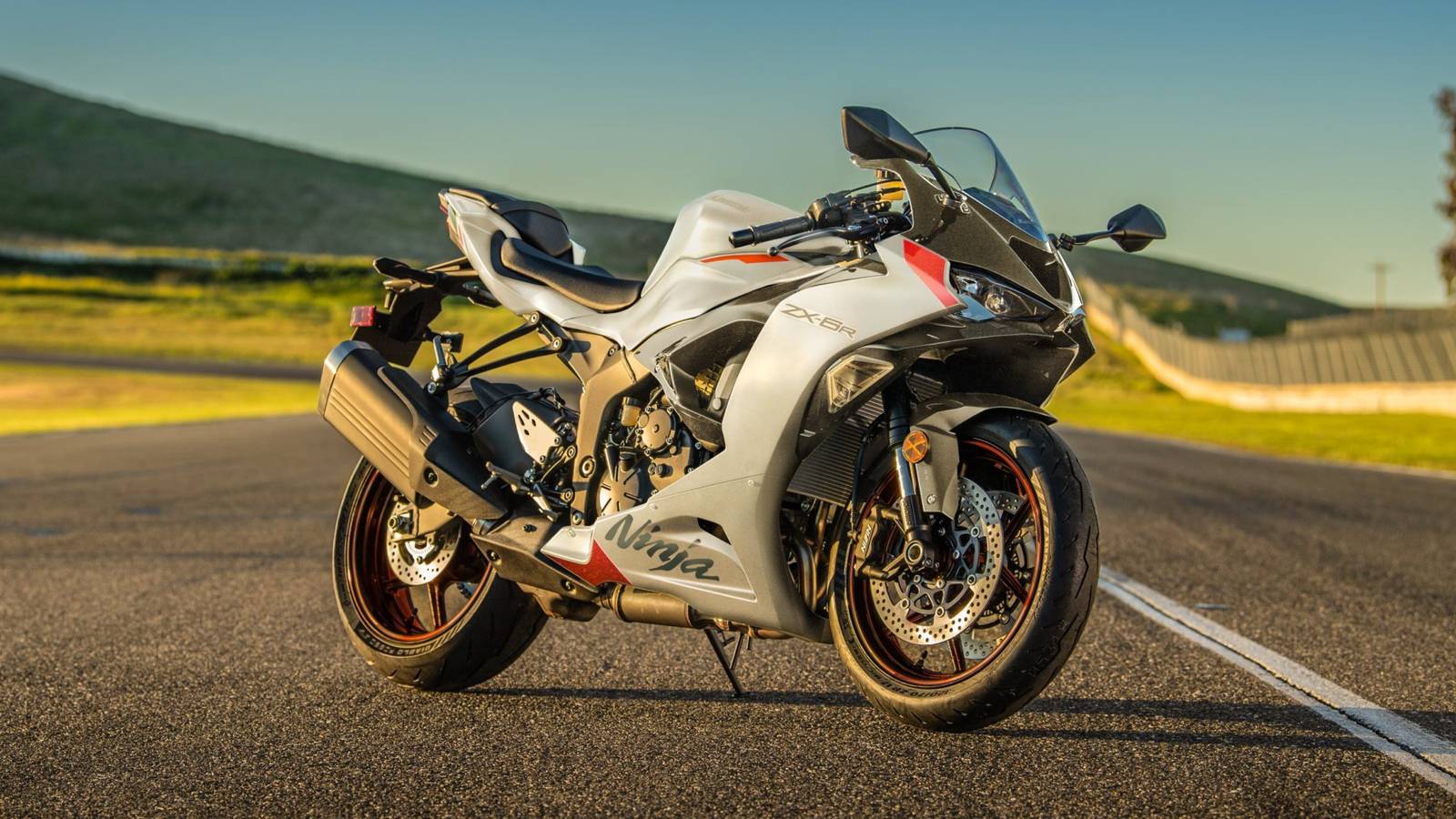
Say ‘Kawasaki‘, and a lot of screaming motorcycles come to mind. For instance, the Kawasaki H2 Mark IV, which was the last of the big-displacement two-stroke production bikes to rule the top speed charts. The ZX-11 and ZX-12 also dragged the brand into the top speed history books. More recently, the H2’s supercharged engine remains the only forced induction production motorcycle.
Oh, and who can forget the KLR? If there ever is a nuclear holocaust, all that will remain are cockroaches, Corollas, and KLRs. In the same breath, there is a left-field Kawasaki engine that has been reliable and stood the test of time. It is an anomaly in its segment by meeting modern-day norms while still promising immense performance.
The Kawasaki Ninja ZX-6R Is The Kawasaki Engine So Reliable It’s Still In Production After Decades

The Ninja has been around for an incredibly long time. In that time, this has ranged in displacement from a mere 125 cc all the way to the world’s biggest-ever inline four engine in a production motorcycle, with the ZX-14R’s 1,441 cc engine. Somewhere in the middle lies the Ninja ZX-6R. Saying that it is the Kawasaki engine so reliable it’s still in production after decades feels strange, because the 600 cc supersport has been cutthroat for a long time. Yet, the engine has proven extremely reliable since its debut years ago, and it somehow meets modern emission norms. In fact, this was the only global 600cc supersport on sale until Honda resurrected the CBR600RR in Europe in 2024.
Kawasaki Ninja ZX-6R Price: $11,599

The Ninja ZX-6R is priced in the same ballpark as the other Japanese middleweight supersport machines. At $11,599, ABS is an optional extra, and it demands an extra $1,000. There is also a KRT Edition available, but because it is a 2025 model, it is now a little cheaper, at $11,399 and $12,399 for the non-ABS and ABS versions. Yes, its like-for-like rival (the CBR600RR) has gotten cheaper in 2026, although you don’t get the same level of modern equipment there.
Kawasaki Ninja ZX-6R Engine

The ZX-6R was launched in 1995 with a 599 cc inline four, but the 636 cc engine that we know and love first saw the light of day in 2003. It was then discontinued from 2007 to 2012, and made a comeback in 2013 in the exact same form that it was in before. In 2019, a few tweaks were made for better emissions compliance.
In the current form, it has a compression ratio of 12.9:1 and generates 127 horsepower at 13,000 RPM and 52.1 pound-feet at 10,800 RPM. It has fuel injection and liquid cooling, of course, but it has a ‘screamer’ firing order, which is great for power but not torque. A cable throttle and individual throttle bodies are present, alongside a second set of oval throttle bodies in line with these four that are computer-controlled to smooth out power delivery.
In its recent avatar, Kawasaki also shortened the gearing for more punch and tractability. Electronics were also updated, as you get KTRC traction control, two power modes, and an upshift-only quickshifter. In addition, the six-speed gearbox has an assist and slipper clutch. Although these are basic bits by modern mid-weight sports bike segment, this is still better than the CBR600RR and GSX-R600.

10 Most Powerful Kawasaki Motorcycles Ever
As expected, there are a bunch of Ninjas and Zs in the list. But not in the order you’d expect!
Kawasaki Ninja ZX-6R Chassis

There is an old-school aluminum perimeter frame here, with a dual-sided swingarm. A 41 mm Showa separate function big piston fork offers preload, compression, and rebound adjustment. It has top-out springs as well. The rear shock has stepless compression and rebound damping adjustment, along with fully adjustable preload. Suspension travel is 4.7 inches at the front and 5.9 inches at the rear.
Moving on, the brakes comprise twin semi-floating 310 mm discs with radial four-piston fixed calipers and a 220 mm petal disc with a single-piston caliper. The Ninja ZX-6R is available without ABS, but dual-channel ABS is an optional extra. This is a smart system that acts as rear wheel lift mitigation and takes into account downshifts and engine braking for the rear brake as well. 17-inch alloy wheel rims and sticky tires complete the ZX-6R.
Kawasaki Ninja ZX-6R Dimensions

The ZX-6R is nearly 80 inches long, with a 32.7-inch seat height. The wheelbase is 55.1 inches, and the ground clearance is appreciable at 5.1 inches. With its fuel tank full, the 6R weighs 430 pounds wet. That is normal for a four-cylinder, 600 cc supersport but it is lower than modern-day mid-weight bikes.
Kawasaki Ninja ZX-6R Features

The Ninja ZX-6R’s features are mostly geared toward performance, so it doesn’t have a lot of the creature comforts we’ve come to expect from a modern motorcycle. Still, Kawasaki updated it in 2024 and gave it a 4.3-inch TFT display. It has smartphone connectivity via the Kawasaki Rideology app, which offers comprehensive control over various parameters of the motorcycle. Although a TFT, this is a basic display by segment standards.

Classic Kawasaki Motorcycles That Are Now Worth A Fortune
The mean-green Kawasaki has a list of lovely oldies which will have you reach into your bank account should you want one.
Kawasaki Ninja ZX-6R Competition

We can’t put any other Kawasaki here, since there is no second model like the ZX-6R in its lineup. However, the Japanese have been making middleweight supersport motorcycles for a long time. We’ll eliminate the Yamaha YZF-R9 ($12,499) because while the CP3 engine has been on sale for a decade, the R9 itself is a relatively new product. Then there is the Honda CBR600RR ($11,499), which was launched in 2013, and this is the generation that is still sold in the US despite the world moving on in 2020.

However, the likeliest contender is the Suzuki GSX-R600, which was launched in 2011 and hasn’t changed since then. It sticks to the sub-600 cc displacement, which makes it lag slightly in the power and torque departments. Still, it has better brakes from Brembo, which should help it keep up with the ZX-6R at least on a racetrack.
Kawasaki Ninja ZX-6R Vs Suzuki GSX-R600
|
Model |
Kawasaki Ninja ZX-6R |
Suzuki GSX-R600 |
|
Price |
$12,599 |
$12,199 |
|
Displacement |
636 cc |
599 cc |
|
Power |
127 HP @ 13,000 RPM |
124 HP @ 13,500 RPM |
|
Torque |
52.1 LB-FT @ 10,800 RPM |
51 LB-FT @ 11,500 RPM |
|
Curb Weight |
436.6 pounds (wet) |
412 pounds (wet) |
Source: Kawasaki USA