
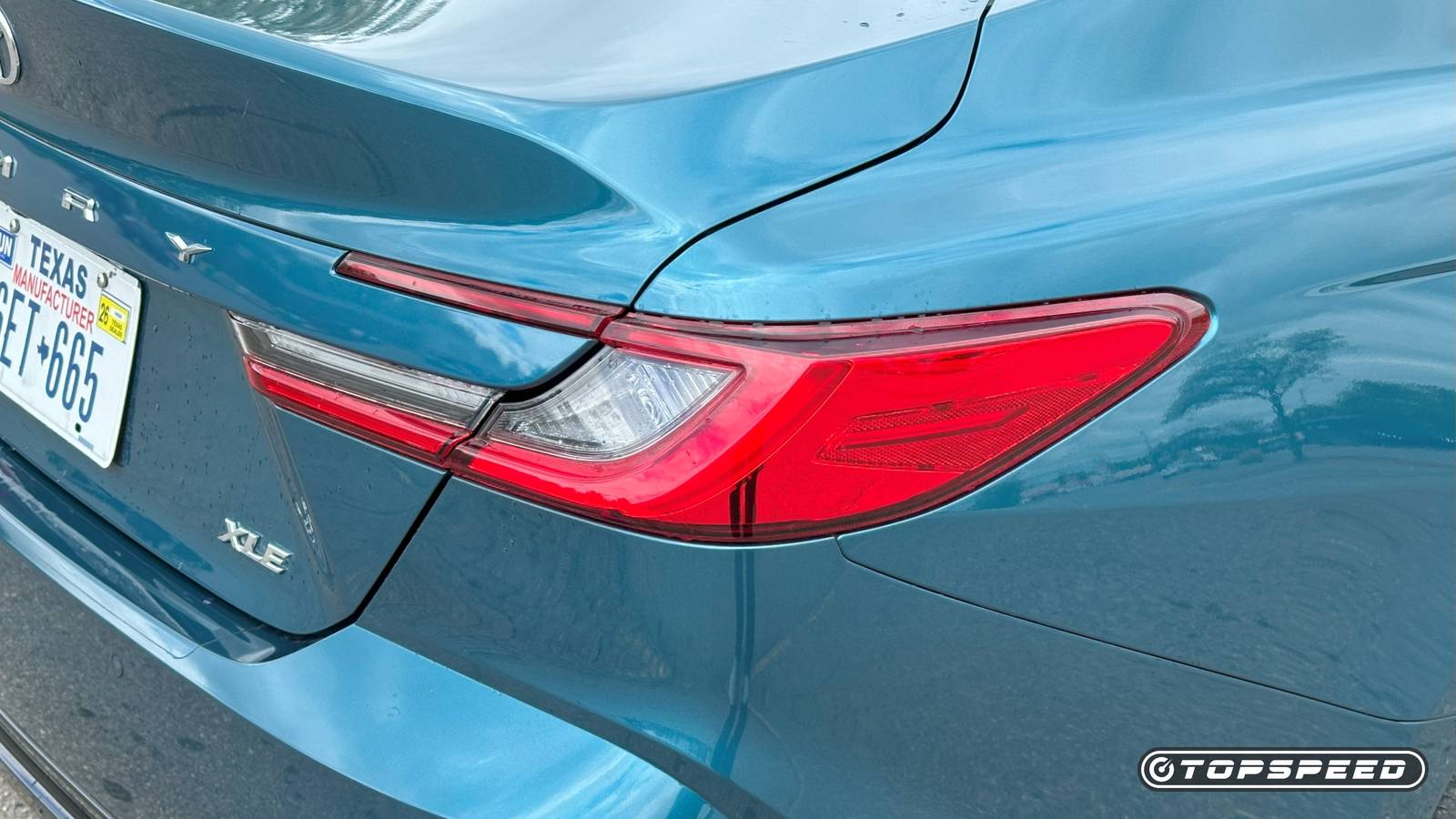
Toyota has published its January 2026 sales for the U.S. market, revealing some very interesting insights. This includes the continuation of the Toyota Camry‘s immensely successful run, with the hybrid-only midsize sedan sitting at the very top of the Japanese brand’s electrified sales chart.
Toyota introduced the all-new generation Camry as a hybrid exclusive in the last half of 2024, which proves to be a good decision just based on its sales performance alone. Midsize sedans have slowly been on the decline over the last decade, as SUVs and crossovers continue to grow in popularity. This doesn’t seem to affect the Camry, which has always been a staple option among many American new car buyers.
The Camry’s Dominance Continues

For January 2026, Toyota managed to sell an impressive 21,759 individual copies of the Camry. This reflects a 10.1 percent sales increase compared to the model’s performance during the same month last year. Most of Toyota’s electrified range suffers from a drop in sales this month, but the Camry pivots the catalog into a much more successful HEV offering.
By comparison, the soon-to-be-replaced Toyota RAV4 Hybrid sold 5,017 individual copies, resulting in a 73.1 percent year-on-year sales decline. This excludes the 800 copies of the PHEV that Toyota sold, leading to a 63.4 percent sales decline. This dramatic decline in sales is because Toyota has ended production of this model, in preparation for the all-new hybrid-only generation, of which deliveries will commence before March.
Competitive Pricing Remains A Key Strategy

Pricing remains a fundamental component as to why the Camry continues to set new sales records and dramatically surpass the rest of Toyota’s electrified catalog. Toyota kicks the range off at $29,100 for the base LE front-wheel drive model, making it the most competitively priced hybrid vehicle in the segment. A lower starting price point for a newer car is always going to be a strong strategy, which is a factor that is clearly evident in its sales results.
The most expensive Camry option is the XSE, which starts at $35,500. Toyota offers the all-wheel drive system across all trims for an additional $1,525. All of these prices exclude the brand’s $1,195 destination fee. There are some optional extras available across all trims, but they are relatively far and few, as the brand prefers to take a more defined five-trim pricing strategy.

What It Costs To Own A 2026 Toyota Camry: Hidden Fees You Didn’t See Coming
This is what it really costs to buy, own, and run a 2026 Toyota Camry. There may be some hidden costs you didn’t know about.
A Broad Range Of Balanced Trims

The 2026 Toyota Camry range consists of five unique trims, namely the LE, SE, Nightshade, XLE, and XSE. The base LE sets a high standard with dual-zone automatic climate control including rear vents, a seven-inch digital gauge cluster, and six-way manually adjustable front seats with fabric upholstery. On the entertainment front, you get an eight-inch touchscreen, a six-speaker audio system, wireless Apple CarPlay and Android Auto, and a standard Qi-compatible wireless charger.
Upgrading to the SE and Nightshade trims adds a sporty aesthetic with SofTex-trimmed seating and an eight-way electrically-adjustable driver’s seat, while also adding a leather-trimmed steering wheel and aluminum pedals.

The premium XLE and XSE trims significantly elevate the cabin experience by making the 12.3-inch multimedia touchscreen and 12.3-inch fully digital gauge cluster standard. Bolstering comfort are multi-stage heated front seats, a heated steering wheel, and acoustic noise-reducing front side windows for a quieter ride.
The XLE features a more premium and sophisticated leather and microfiber-trimmed upholstery, while the XSE adopts a shooting star perforated leather design. Both luxury trims also include an auto-dimming rearview mirror with HomeLink and ambient interior lighting, complemented by a nine-speaker JBL Premium system, ventilated seats, and a 10-inch Head-Up Display. Some of these are optionally available on the lower trims via packages and individual options.
Equally Appealing Ownership Costs

According to Edmunds‘ True Cost To Own calculator, you can expect a new base front-wheel-drive 2026 Toyota Camry LE to cost you $37,987 over the course of five years. This includes $10,239 worth of depreciation, $7,631 on insurance, $3,196 on maintenance, and just $773 on repairs. Your taxes and fees will also be incredibly low, with the calculator showing that you’re only likely to spend $3,617. If you opt to finance the base 2026 Camry, this will add $5,336 to your ownership costs, while fuel will cost you $7,195, based on average driving distances in the U.S.
According to CarEdge, you can expect to spend $36,433 on your Camry over the same period, which includes $14,274 on depreciation, $4,530 on fuel, and $1,512 on maintenance.


Find 2026 Toyota Camry and more cars for sale on our Marketplace
iSeeCars issues the Camry range with an 8.2/10 overall score, including 8.1/10 for reliability, 8.6/10 for retained value, and 8.0/10 for safety. The publication indicates that the model will run for 13.1 years or 171,785 miles without encountering any noteworthy mechanical issues, together with a 31.7 percent probability of hitting 200,000 miles.
In terms of depreciation, the publication indicates that the model will lose $10,829 or 37.7 percent of its sale value after five years or 60,000 miles, which is a bit less than the average competitor in the midsize hybrid sedan segment.
J.D. Power issues the 2026 Toyota Camry model year with an 82/100 consumer-verified overall score, including 80/100 for quality and reliability, 82/100 for the driving experience, 92/100 for resale, and 76/100 for the dealership experience.

Camry Vs. Accord: Which One Offers More For The Money?
Whether you value Toyota’s proven reliability and fresh hybrid system or Honda’s stalwart feel and techy interior, you will find value here.
A Drivetrain You Can Trust

The current-generation Camry range carries over the previous-generation model’s trusty naturally aspirated 2.5-liter four-cylinder Atkinson-cycle engine, which produces 184 horsepower and 163 pound-feet of torque in isolation.
The front-wheel-drive model features a pair of electric motors that generate a combined 134 horsepower and 153 pound-feet. Toyota doesn’t give us a combined torque figure, but it confirms that it limits peak power to 225 horsepower. The all-wheel drive model adds a third electric motor to the rear axle, producing 40 horsepower, 62 pound-feet, which increases the peak output to 232 horsepower.
The Camry is only offered with a hybrid powertrain. Some pundits are sure to gripe about this strategic decision, decrying the loss of the standard four-cylinder engine and optional V-6, but for Toyota, this is 100 percent the right choice.
– Craig Cole for TopSpeed
Toyota doesn’t declare any of this car’s performance specifications, so we can’t tell you how fast it is, but Edmunds reveals that the front-wheel drive model sprints from 0 to 60 MPH in around 7.8 seconds, making it slightly faster than its rivals, while MotorTrend confirms a 6.8-second 0 to 60 MPH sprint result for the all-wheel drive model.
Prioritizing Efficiency Without Compromise

The main reason why you’d even be considering a new Toyota Camry is to save fuel. The front-wheel-drive LE is the most efficient model, returning a 53/50/51 MPG consumption result on the city/highway/combined cycle, with a 663-mile range claim from the 13-gallon tank. It also indicates that this will save you up to $4,000 in fuel costs every five years and costs $1.59 to drive every 25 miles.
The all-wheel-drive XSE is the least frugal model, but this is only by a fractional amount. The EPA indicates that it returns a 44/43/44 MPG result with a 572-mile range claim and suggests that this will save you up to $3,250 in fuel costs every five years and cost $1.84 to drive every 25 miles. Expect to pay $41 to refill the 13-gallon tank, featured in all derivatives.
The Camry’s Name Holds Clout In The U.S.

The 2026 Toyota Camry remains a powerhouse in the U.S. market by successfully rebranding itself as a high-efficiency midsize sedan with an added premium touch without losing its relative affordability appeal. As fuel costs continue to rise amid some level of economic uncertainty, Toyota’s strategic pivot to an exclusive hybrid lineup across all trims has solidified its relevance, especially against those who have prioritized fully electric cars and SUVs.
Its success in the first month of 2026 proves that the brand’s best-of-both-worlds value proposition is a meaningful strategy. The new-generation model inherits some much-needed cabin refinement and digital tech akin to some of its more premium alternatives, while maintaining the bulletproof reliability and low maintenance costs that have defined the nameplate throughout the moniker’s existence.
While the market continues to shift toward crossovers, the Camry captures a massive demographic of pragmatic buyers, commuters, and families who prioritize long-term resale value and predictable ownership over the rugged image of an SUV. The added benefit of an optional all-wheel drive system, available across the entire range, means that Toyota has effectively neutralized the primary reason buyers used to flee sedans, ensuring the Camry remains the gold standard for sensible, sophisticated American transport.
Sources: The EPA, iSeeCars, Edmunds, CarEdge, and J.D. Power.