
Over the years, cars have become increasingly expensive. In case you weren’t aware, we’ve entered a new era in 2026—the era where you can no longer buy a new car for under $20,000. The rise in vehicle prices has partly to do with what consumers are buying in droves these days—pickups and SUVs in both body-on-frame and crossover form.
On the upside, the pickup segment has never been more accessible, thanks to the rise of the compact pickup. The trucks we’ve come to love over the decades have become so big and so posh that some of their primary buyers have been priced out. There’s a saying that beggars can’t be choosers, and that somehow applies when you’re looking for affordable items. You simply can’t expect leather-clad interiors with wood trimmings on an affordable car, or even cutting-edge tech features. But could you? What if there’s an affordable pickup truck that punches above its price category in terms of its perceived quality? Well, that’s what we’re here to find out.
The Santa Cruz Is Where It’s At

There are only two affordable pickup trucks suitable for consumer use: the Hyundai Santa Cruz and the Ford Maverick. Both models received a mid-cycle facelift fairly recently, but it’s the Hyundai that ends up having a slightly more premium feel in base form versus the Ford.
Sleek Interior Design

Whereas the Ford Maverick already gives you the impression that it’s mostly going to be a tool, the Santa Cruz leans on the avant-garde side. Yes, the Santa Cruz is just a Tucson that got its rear chopped off, but that already sets the tone for what you can expect in this small pickup. Even in base SE form, the updated interior of the Santa Cruz has soft-touch materials and dense leatherette surfaces. The Maverick makes no pretense of being a budget truck, with an interior that’s filled with hard plastics. Even in terms of tech, the Hyundai’s simpler and easier-to-use connected car Navigation Cockpit (ccNC) operating system looks sleeker, thanks to how its 12.3-inch screen integrates well with the segment-type digital gauges.

The Ford, however, comes with an actual full-color eight-inch digital gauge cluster screen, along with a larger 13-inch screen for the SYNC4 infotainment. Splurge for the higher trims of the 2026 Santa Cruz, though, and the Hyundai pulls ahead with its 12.3-inch full-color digital gauge cluster, along with additional premium materials in the interior. Even features like cooled front seats, a Bose sound system, a sunroof, and a retractable bed cover are fitted in higher trims. The Ford, however, has more functionality, thanks to plenty of smart storage areas, along with the Blue Oval brand’s so-called Ford Integrated Tether System (FITS), which are tethers dotted around the cabin and the bed. FITS allows you to purchase accessories from Ford or third-party brands, or even create your own, since the design of the FITS tethers is open for all to see.
A Tucson With Its Rear Chopped Off

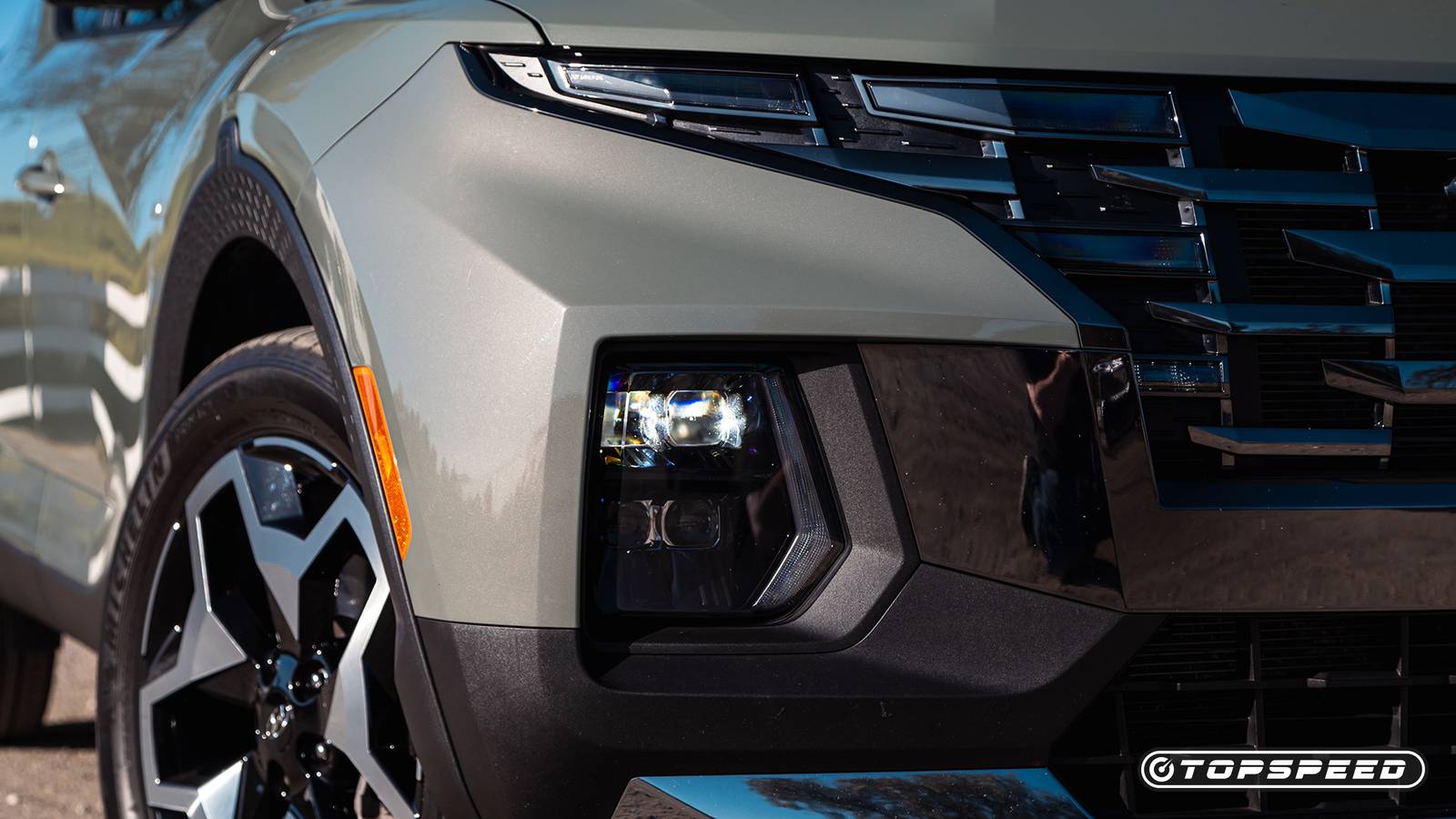
Moving on to its exterior design, the Hyundai Santa Cruz received a mid-cycle facelift beginning with the 2025 model year. Following the Tucson’s footsteps, the Santa Cruz has a curvaceous silhouette, though the facelift made the design more angular to enhance the vehicle’s ruggedness. LED headlights with hidden LED daytime running lights are standard, along with nice two-tone 18- or 20-inch wheels. Go for the XRT model, and you get a more rugged design and all-terrain tires. Lastly, moving towards the rear, this is where the Santa Cruz may start to look controversial, especially with its wide LED taillights.

Versus the Maverick, the Santa Cruz looks very distinct, but it’s also what divides opinion towards this South Korean pickup. The Maverick’s more straightforward looks will appeal to a wider demographic, though we can’t deny that the sporty Lobo variant does look handsome.

Ford F-150 Lobo: A Factory Street Truck For the U.S.A.
“Street truck” culture isn’t new, but factory versions wax and wane. The F-150 Lobo joins the Maverick Lobo. And maybe a Bronco Lobo’s coming?
Santa Cruz In Two Flavors

The Hyundai Santa Cruz receives a minor powertrain update for the 2026 model year. Previously, an eight-speed automatic was offered in the base non-turbo 2.5-liter, while the turbo 2.5-liter got a fast-shifting eight-speed dual-clutch transmission that felt clunky in low-speed driving. Thankfully, the eight-speed auto is now the standard transmission choice.


Find 2026 Hyundai Santa Cruz and more cars for sale on our Marketplace
A Just-Right 2.5-Liter

The 2.5-liter four-cylinder of the Santa Cruz produces 191 horsepower and 181 pound-feet of torque, and you get front-wheel drive (FWD) as standard and all-wheel drive (AWD) optional for this powertrain. Based on our experience with this powertrain, the 2.5-liter four-cylinder merely feels adequate for the Santa Cruz. Not underpowered nor powerful, but just right. With this engine, the Santa Cruz has a 3,500-pound towing capacity, along with a combined MPG figure of 25 for the FWD and 24 for the AWD.

On the flipside, if you’re looking at the Maverick, the engine that matches this version of the Santa Cruz is the 2.5-liter series-parallel hybrid with a planetary gear e-CVT. Though the e-CVT doesn’t deliver the most linear driving feel versus the eight-speed auto of the Santa Cruz, the electrified drivetrain gives the Maverick one heck of a fuel economy advantage. Though the 2026 model has not yet been EPA rated, the 2025 model is rated at 38 MPG combined, with a one MPG penalty for the AWD version—nearly as good as a hybrid compact sedan.
A Mighty Turbo Engine

Fitted as standard in the XRT and Limited is the mighty 2.5-liter turbo four-cylinder that produces 281 horsepower and 311 pound-feet of torque. Our team has driven the Santa Cruz Limited with this engine, and there’s no doubt that the upcharge for this engine is pretty much worth it. It’s also capable, too, with a higher 5,000-pound towing capacity that even exceeds the 4,000 pounds that the Ford Maverick 2.0-liter turbo EcoBoost can haul. Of course, this comes at another cost, which is slight thirst at the pumps, but at a combined 20 MPG, we think the trade-off is worth it.
2026 Hyundai Santa Cruz Specs
|
Hyundai Santa Cruz |
Ford Maverick |
|||
|
Engine |
2.5-liter four-cylinder |
2.5-liter turbo four-cylinder |
2.5-liter four-cylinder hybrid |
2.0-liter turbo four-cylinder |
|
Drivetrain |
Front engine, FWD or AWD |
Front engine, AWD |
Front engine, FWD or AWD |
Front engine, AWD |
|
Horsepower |
191 hp |
281 hp |
191 hp |
250 hp |
|
Torque |
181 lb-ft |
311 lb-ft |
155 lb-ft |
277 lb-ft |
|
Transmission |
8-speed A/T |
e-CVT |
8-speed A/T |
|
|
EPA Combined MPG |
25 MPG (FWD) 24 MPG (AWD) |
20 MPG |
38 MPG (FWD) 37 MPG (AWD) |
26 MPG |
|
Base MSRP |
$29,750 |
$28,145 |
||
The eight-speed automatic also has a minor trade-off versus the dual-clutch it is replacing, and that’s with the slower shifts of the traditional slushbox. The result, however, is a far more linear and smoother driving experience in all driving scenarios, whereas the dual-clutch will shift snappily during high-speed driving, but would feel clunky during low-speed driving. Guys, there’s a reason why Hyundai is slowly removing dual-clutch transmissions.

10 Midsize SUVs With Incredible Resale Value
Some SUVs are renowned for holding their value well, but these 10 models are the best mid-size SUVs for resale value.
Premium-Ness In The Drive

Once again, another advantage of the Hyundai Santa Cruz is how it drives. Unsurprisingly, with its bones being shared with the Tucson‘s, its driving nature is very car-like.
Refinement At Its Core

Looks already play a role in giving us a refined impression of the Santa Cruz, and that translates to the driving experience, too. The Tucson is already a refined car, and its transformation into a pickup has kept that trait largely the same. Add to that the standard acoustic windshield and the copious sound insulation, and you’ve got a truck that drives the least like a truck and more like a tall sedan with a bed at the back.

Even the ride is superb, thanks to its independent rear axle versus the solid rear axle of traditional body-on-frame pickups. Of course, all of this comes at the expense of off-road capability, especially since, unlike the Maverick, whose Tremor trim has electronic locking differentials, the Santa Cruz doesn’t have any. Yes, even the XRT trim, which is only differentiated by tow hooks, all-terrain tires, and a slightly taller ride height. A gnarly off-roader, the Santa Cruz ain’t.
Along With Taut Handling

But the road-biased nature of the Santa Cruz pays dividends to another aspect—handling. As our team notes, the Santa Cruz has the composure of a hot hatch, along with its giddy-up as well, when equipped with the 2.5-liter turbo. Ride and handling balance is excellent, soaking up the bumps really well whilst maintaining a good degree of body control. Whether splurging for the XRT or Limited, the Santa Cruz has great on-road driving dynamics, though the Ford Maverick Lobo might have something to say about that.
It’s downright fast in this all-wheel-drive configuration with the 2.5-liter engine, and that transmission shifts sports-car-quick. It’s one of the few trucks out there that isn’t a total bore to drive every day because of this.
– Chase Bierenkoven for TopSpeed

We’ve also driven the Maverick Lobo, which aims to make the street truck genre popular in 2026. If a sporty pickup is what you’re after, Ford has you covered better than the Santa Cruz. Unlike the Santa Cruz XRT, which has no mechanical differentiation from the standard Santa Cruz, the Maverick Lobo has a sportier suspension tune and unique programming for the torque-vectoring AWD system through its “Lobo Mode.” Lobo Mode sends more power to the outside wheel during hard cornering, which, based on our own testing, does transform the Maverick into an autocross carver. Of course, as a pickup, its dynamic abilities are limited, but the Maverick Logo is as sporty as any pickup can get.
Sources: Hyundai, Ford, The EPA