
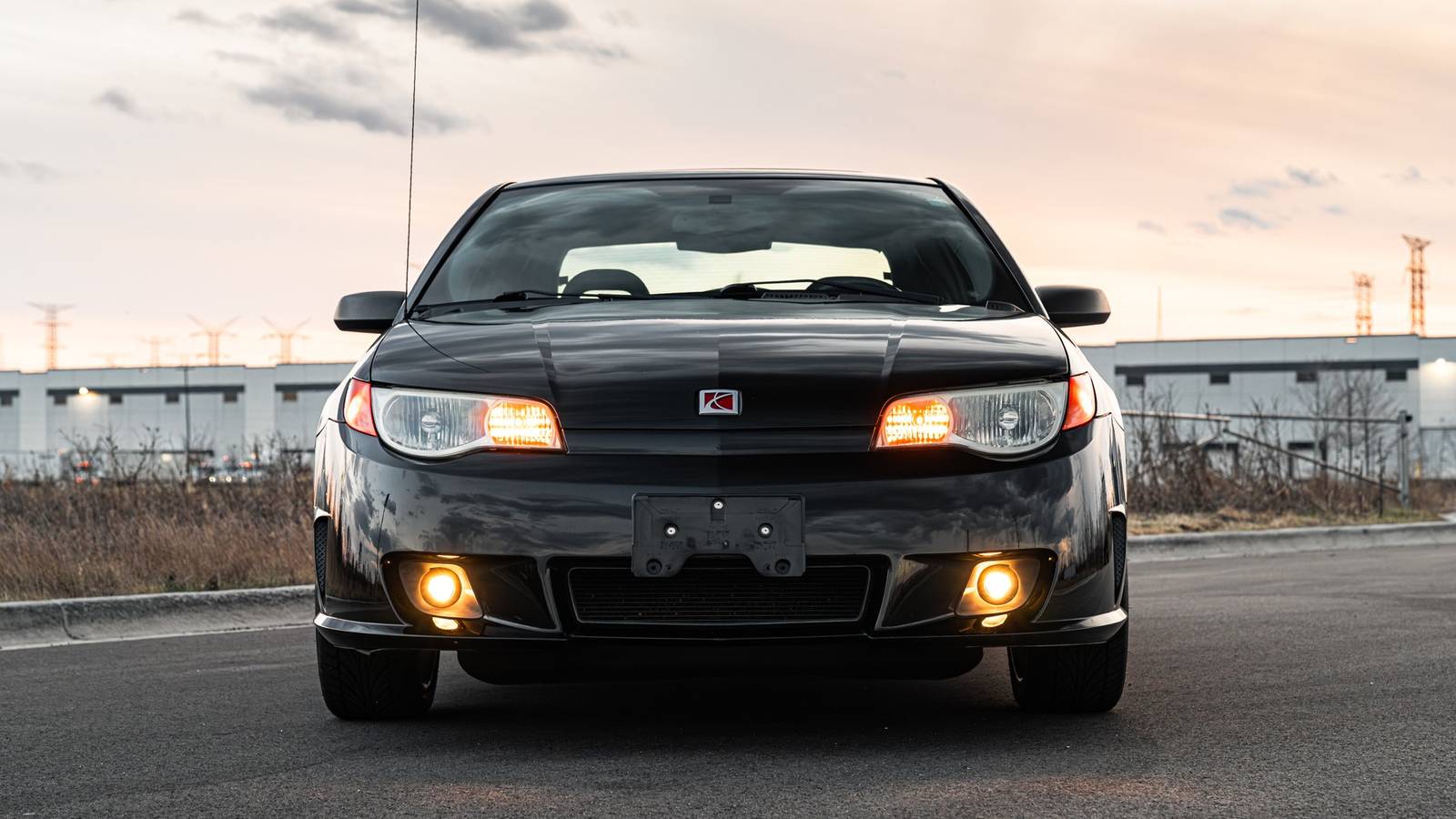
Saturn is a defunct subsidiary of General Motors that sought to rewrite how people viewed affordable American cars. In fact, it was a bold attempt at reintroducing GM as a modern automaker with unique engineering, manufacturing, and marketing efforts. Creating a parallel to the iconic automaker, Saab, and its bold cars is not a far-fetched deduction here either. Despite being affordable, Saturn managed to create some cool everyday cars, including the S-Series coupe/sedan, the Astra, the Ion, and even chunky-looking SUVs like the Outlook. The sportiest of them all was the Saturn Sky sports car.
However, there was a special sporty car based on the mainstream Ion that perfectly showcased a sleeper car all about hustle. It looked rather mundane but was loaded with serious driver-centric performance and technology underneath the daily-drivable skin. If Saturn were up and about today, this car would have been the arch-rival to the iconic Honda Civic Type R. We tell you all about the underappreciated Saturn Ion Red Line and the features that make it cool.

10 Attainable Cars That Will Get You More Attention Than A Ferrari
Some of the world’s most interesting cars prove that you don’t need Ferrari money to sit with the popular crowd
The “Sporty Hustler” Version Of An Otherwise Mundane Car
The Red Line Was A Saturn Ion On Steroids

If the Saturn Ion were offered today, it would easily fit between the likes of the Toyota Corolla, Nissan Versa, Chevy Malibu, and Volkswagen Jetta. It was a no-frills compact sedan designed for the daily haul, with frugal, refined powertrains and a practical, spacious cabin. It was underpinned by the versatile GM Delta platform, which featured a front-wheel-drive layout and was even capable of handling SUV and coupe characteristics.

Other cars that utilized this platform during the 2000s were the Chevy Cobalt, the Pontiac G5/G4/Pursuit, and the Chevy HHR. There was nothing fancy here. Just a practical sedan/coupe body style powered by a frugal 2.2-liter four-cylinder engine, coupled to a five-speed manual and powering the front wheels. Pricing was also typical for the segment, with the base Saturn Ion starting under $13,000, underscoring its value-for-money proposition. However, things took a surprising turn when a “Red Line” badge was added to the mix. It unlocked a dormant sporty side to this otherwise ‘boring’ sedan that took everyone by surprise.

It packed a smaller displacement engine but was supercharged for extra punch. Saturn also gave the Ion Red Line some clever weight-saving features to elevate its sporty driving appeal. These include some features that were unexpected from an entry-level nameplate. General Motors even offered two Performance Kits for the Ion Red Line that boosted performance without voiding the warranty. To give you a perspective, a fully tricked-out Saturn Ion Red Line packed enough punch to lock horns with the likes of the Honda S2000, the Volkswagen Golf R32, and a slew of Type-S Acura offerings from the 2000s.
Features That Made The Saturn Ion Red Line A Desirable Sleeper Sports Car
- Supercharged engine
- Performance manual gearbox
- Stiffer suspension
- Bigger brakes
- Factory performance tuning options



Powered By A Supercharged Four-Cylinder
This Engine Is Also Found On The 2000s Chevy Cobalt SS

The standard Saturn Ion packed a 2.2-liter naturally aspirated four-cylinder engine, good for a modest 140–145 horsepower and 145–150 pound-feet of torque. At most, a 2.4-liter mill was offered as an option for the higher trims, packing 175 horsepower and 164 pound-feet of torque. But the Red Line really spiced things up with a smaller 2.0-liter four-cylinder mill equipped with a Roots-type supercharger.

This engine was also used on the Chevy Cobalt SS. The engine’s all-aluminum design lowered the weight, and the supercharger forced in 12.0 PSI of boost, translating to 205 horsepower and 200 pound-feet of torque. This mill was exclusively paired with a tuned five-speed manual transmission, which helped the Ion Red Line reach 0–60 mph in around 6.3 seconds.
Add-On Performance Packages Raise The Heat Further

Making things more interesting were factory-tuned packages that bumped up the performance of the Ion Red Line. The Stage 1 Upgrade included an ECU tune and larger fuel injectors, which helped bump horsepower to around 236. This upgrade offered improved low-end torque, optimized timing, and a raised speed limiter.

These Are The First 10 Production Cars In History With Factory Turbochargers
We may love a good turbo today, but they had to start somewhere – here are the first 10 production cars to boast a turbocharged engine under the hood.
Next up, the Stage 2 Upgrade, built on the Stage 1 package, added a smaller supercharger pulley, bumping output to a grin-worthy 241 horsepower. This was thanks to a higher boost (~18 PSI) and a higher redline around 7000 RPM. For reference, the base 987 Porsche Boxster produced 245 horsepower from its 2.7-liter flat-six engine. The coolest factory upgrade package of the Red Line, however, was the Competition Package, which added a limited-slip differential.
Underpinned By Serious Race-tuned Hardware
Stiffer Suspension And More Hardcore Brakes

Compared to the standard Ion, the Red Line featured a “racetrack-bred” sport-tuned suspension setup. This included stiffer springs, larger stabilizer bars, and harder shocks. All of these helped lower the ride height by 10 mm, improving grounded handling thanks to a lower center of gravity. To further improve its sporty driving dynamics, GM took the Ion Red Line to the Nürburgring to refine its handling, especially in corners.

The Red Line also flaunted quicker steering thanks to a reduced lock-to-lock ratio (of 2.9 as compared to the standard model’s 3.5). This helped make the steering feel more direct and the ride more flickable. Braking duties were taken care of by disc brakes at all four ends. The front featured larger rotors than the standard Ion. ABS was standard here, and so was Electronic Brakeforce Distribution (EBD). Contributing further to its sporty appeal were 17-inch forged alloy wheels that helped keep weight in check. These were wrapped in performance tires designed for high-grip duties.
A Highly Practical Sports Car
Flaunts Rare Rear Suicide Doors

Notable Features That Highlight The Practical Side
- Standard four-wheel ABS
- Standard heated power mirrors
- Remote trunk release
- Post-Collision safety system
To emphasize its sporty nature, the Ion Red Line was designed to look like a coupe, despite its four-door body style. Saturn has cleverly fused practicality and sportiness here. A prime example of this feat is its cool rear suicide/scallop doors, which make ingress to the second-row seats much more comfortable than in other four-seater “coupes.”

Another sports car that deployed the same door formula was the Mazda RX-8. Despite a relatively compact 185-inch length of 185 inches, the cabin offers a spacious area, with a cozy front-row legroom of 42.2 inches and a cargo capacity of 14.2 cubic feet. While the second-row seating space is not as lavish as that of a regular four-door sedan, Saturn has made efforts to maximize comfort with the “sporty” restrictions of the Ion Red Line.
Cool Exterior Features
- Prominent hood scoop
- Standard front fog lights
- Unique front grille design
- Standard rear spoiler (or optional “aero-wing”)
- Unique 17-inch six-spoke aluminum alloy wheels
- Aggressive front and rear bumper redesign with air inlets
The Interior Is All About Being Sporty And Cool
Quirky, Driver-focused Gauges Made The Cockpit A Special Place

Based on the standard Saturn Ion, the Red Line’s interior was not devoid of convenience, comfort, and everyday-use technology features. It has CD storage, cupholders, foldable rear seats, and door pockets, enhancing its practicality. The sporty essence was spread throughout the cabin with standard Recaro sport seats (similar to those used on the Chevy Cobalt SS), shift lights, a boost gauge (with the Competition Package), and sporty metallic trimmings. Convenience was also added to the mix, with features like large climate controls and steering-wheel-mounted cruise controls.
Here’s How Much A Saturn Ion Red Line Is Worth Today
Exclusivity Adds To The Saturn Ion Red Line’s Desirability

Even when new, the 2000s Saturn Ion Red Line offered smashing value for a nearly 240-horsepower “practical” sports coupe. Today, depreciation has done its work, and we can have a used Saturn Ion Red Line for as low as $2,700, as per KBB. The average used price is $3,175. This is surprisingly low for a car offered for just four model years, with total production not exceeding 6,000 units. Furthermore, it remains a practical daily driver thanks to solid reliability ratings and affordable maintenance costs.

10 Underrated American Performance Cars You Can Buy Under $25,000
If you’re searching for an underrated American performance car that delivers excitement without a supercar price tag, this list is for you.
As per J.D. Power, the Saturn Ion has a solid reliability rating of 82/100. Consumers have also rated the Saturn Ion 4.3/5.0 for Reliability, according to Kelley Blue Book Consumer Reviews. According to RepairPal, the average annual repair cost of the Saturn Ion is $338 on average. So yes, not only is buying a used Saturn Ion Red Line a dirt-cheap affair, but living with one is an equally stress-free experience too. This is an underrated used gem that should be on your radar.
Sources: GM News, J.D. Power, RepairPal, Kelley Blue Book