
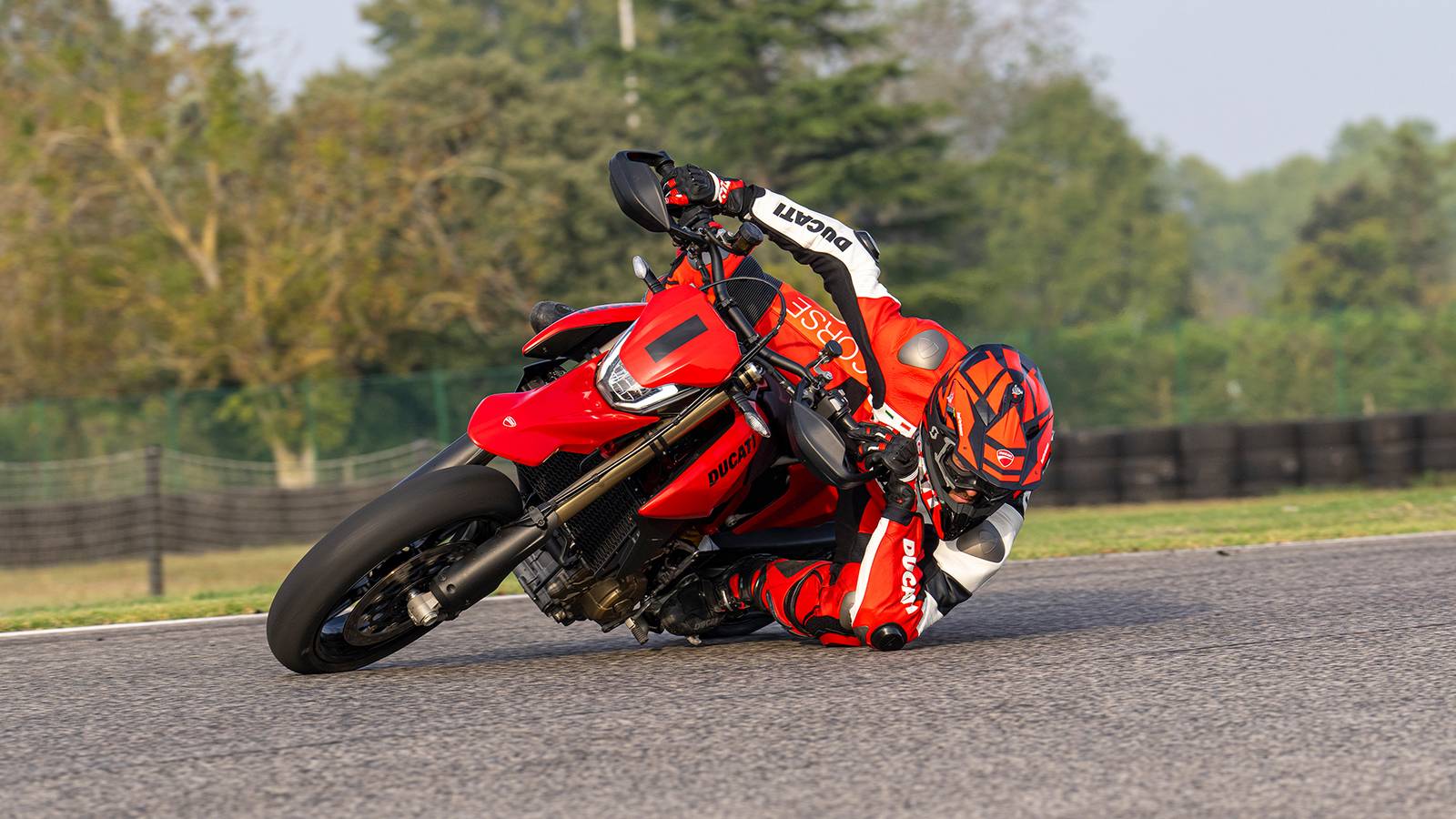
If you can’t handle a little bit of pain, motorcycles might not be for you. Any experienced rider will tell you that it is not a matter of “if” you will fall, but rather “when.” It will hurt, not only your body, but your pride, too. It is just part of the experience, but there is a reason why we get up and go again.
The overall experience is most certainly worth the pain. While motorcycles are inherently dangerous vehicles, that is simply part of the thrill; it is part of why we ride. The level of engagement does vary from one motorcycle to another, but if you are looking for a bike that defines the “reward” of motorcycling as opposed to the risk, only one comes to mind.
To give you the most up-to-date and accurate information possible, the data used to compile this article was sourced from Ducati. Whereas, the opinions are our own.

The Ducati Superbike That Leads The Segment In Track Performance
It happens to be the latest Panigale by the Bolognese giant
The Ducati Hypermotard 698 Is The Everyday Motorcycle With Serious Weekend Performance
MSRP: $13,995

Like most supermotos, the Hypermotard 698 has a relatively tall seat and certainly won’t be the most pragmatic choice for shorter folk. For the rest of us, it offers a level of sophistication that makes it a fair bit more user-friendly than one might expect. With a host of modern safety features and a lightweight chassis, it really can be used as a commuter. There isn’t much in the way of competition in this niche space, but the competition that does exist is equally good.

When Ducati first launched the model, it was the most powerful single in production. This fact clearly stung KTM because the LC4 engine found in the 690 SMC R had long since held this unofficial title. This year, KTM hit back by updating the LC4, adding four horsepower, and wrestling that title back from Ducati. In reality, the power it has is somewhat moot because it has always been about how it delivers its power. While it has a similar features list, the SMC R has a serious wild side and is also a seriously fun motorcycle.

The Husqvarna 701 Supermoto also got updated this year, but it is simply a slightly better-looking KTM. The only other bike competing in this space is the Suzuki DR-Z4SM. It only has half the horsepower of the KTM, Husky, and Ducati, but it most certainly is not half the motorcycle. It will be the more pragmatic choice for those primarily looking for a commuter, offering a similar list of features and Japanese reliability.
The Hypermotard 698 Has Half A V-Twin Engine
Power: 78 Horsepower

Back when the Superquadro V-Twin went out of production, Ducatisti from all over the world lamented the demise of the iconic engine. By that time, it was making in excess of 200 horsepower and had very much hit its performance ceiling. While the Superquadro Mono is not a V-twin, it pays homage to that exceptional powertrain.
The Superquadro Mono Makes Use Of Desmodromic Valve Timing

In recent times, Ducati has been moving away from Desmodromic valvetrains. Both the Granturismo and recently updated V2 feature conventional valve springs and modern variable valve timing. Obviously, Ducati is moving with the times. Desmo valves were a solution to a problem that quite simply no longer exists, but by moving away from the system, there is no denying the fact that the brand loses some of its identity.
The Superquadro Mono is a thoroughly modern engine in most respects, but it retains the demodromic valvetrain it inherited from that old twin. It doesn’t quite have half the power of the old V-twin, but it does have almost half the torque. It also has fairly long service intervals – scheduled every 9,000 miles – but when the time comes to do the Desmo service, you will just have to grin and bear it once you get to 18,000 miles.

Here’s What You Need To Know About Ducati’s Desmodromic Valve Train
It’s almost a Ducati trademark, but what is it, why did Ducati adopt the technology, and will it survive?
The Hypermotard 698 Has All The Necessary Modern Tech

Frankly speaking, the Hypermotard 698 is not a practical motorcycle. But the fact that it is packed with lots of modern tech makes it viable to use it as a commuter. Most importantly, it has ride modes, cornering ABS, and lean-sensitive traction control. All these safety features help keep its punchy single in check while navigating city streets. At just 333 pounds (no fuel), it is also incredibly light and nimble enough to handle even the tightest of city streets. This is not, however, its primary use case.
Motorcycling Fun Distilled Into Its Purest Form

This is a motorcycle designed from the ground up with only one purpose, and that is to be a fun bike. In a market dominated by incredibly versatile motorcycles promising everything to everyone, this bike only promises to deliver the very best rider experience. Unlike the other bikes competing in this space, it is not a rehashed or updated platform, but an all-new bike. That means all the tech wasn’t added; it was developed alongside the powertrain and chassis so that everything works in harmony.
No spec sheet will be able to validate what a difference this makes, only a test ride. We all want different things from our motorcycles, and most manufacturers have done a fantastic job of compromising and building machines that can appeal to a broad spectrum of riders. This is not one of those bikes. It will only appeal to a select group of riders who don’t need a bike that can wear many hats, but rather just one, a fun one that almost laughs in the face of logic.
Chassis, Suspension, And Weight Specifications
|
Chassis |
Steel trellis |
|
Front Suspension |
45 mm Marzocchi USD fork, fully adjustable |
|
Rear Suspension |
Fully adjustable Sachs monoshock |
|
Weight |
333 lbs (no fuel) |