
It seems impossible to believe, even 60 years after the fact, that General Motors (GM) banned all of its divisions from racing participation and development in 1963. Part of this silly rule included a mandate that no intermediate car could have an engine bigger than 400 cubic inches of displacement, with an exemption for the Chevrolet Corvette. This group-think corporate edict essentially ceded the muscle car wars over to Mopar, with their mighty 426 Street Hemi, which dominated the classic era.
It didn’t have to be that way, however, as Chevrolet developed an engine that would have beaten a Hemi car any day of the week, coincidentally enough, also in 1963. The 427ci Z11 V-8 had more horsepower and torque than a Chrysler 426ci Hemi, and had it found its way under the hoods of Camaros and Chevelles, enthusiasts might not even remember the Dodge Charger or Plymouth Road Runner. Even Ford started dropping 428ci and 429ci V-8s into their production cars, but Chevy and Pontiac were limited to 396ci and 400ci engines.
That amazing 427 Z11 engine did actually find a home in the 1963 Impala Z11 factory drag car. It was produced in extremely limited numbers and sold to professional drag racers, so it’s unlikely any of them ever blew the doors off a Max Wedge Dart in a red light challenge on Van Nuys Blvd. The car did demonstrate what a killer V-8 it was with dominating quarter-mile runs, and should have impressed the GM execs enough to get them to lift the arbitrary big engine ban in time for the muscle car craze of 1964.

This Forgotten Chevy Muscle Car Had More Torque Than A Coyote Powered Ford Mustang
The Ford 5.0-liter Coyote V-8 is a marvel of modern automotive technology, but back in the day, Chevy had an engine with way more torque.
The 1963 Chevrolet Impala’s 427 Z11 V-8

Nowadays, people kind of think of 1960s-era Impalas as low-riders, because of the simple fact that so many of them have been dropped to the pavement, but back in 1961 it was a badass performance ride. Chevy introduced the SS package, which included the new 409ci V-8, which by 1962 was cranking out 409 ponies, making one horsepower per cubic inch of displacement.

The Beach Boys were so impressed that they immortalized the Impala SS in their hit song “409.” They should have held off until 1963 to write an Impala song because that’s when Chevy came out with the 430-horsepower 427ci Z11 V-8, and equipped it in a small number of cars.

|
Engine |
Bore x Stroke |
Power |
Torque |
|---|---|---|---|
|
7.0-liter Cowl (naturally aspirated) V-8 |
4.3125 x 3.65 inches |
430 HP |
575 LB-FT |
Z11 Big Block Specs
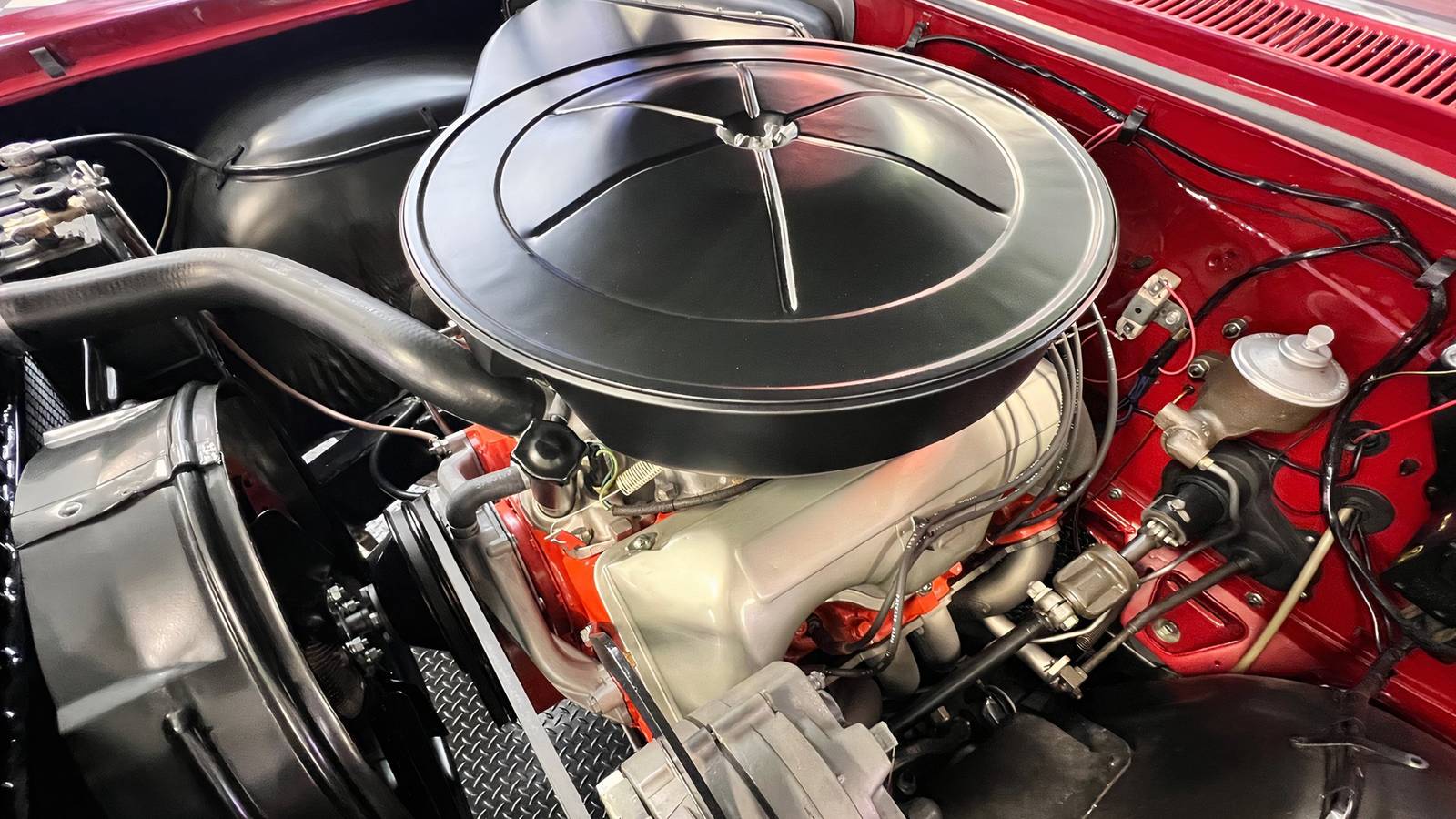
The 427 Z11 was based on the W-series 409, but it had a longer stroke, creating those crucial extra cubic inches of fury. It was a cowl-induction engine with a high-rise, two-piece aluminum intake manifold to accommodate two Carter AFB carburetors. The quicker an engine can consume fuel, the more powerful it is, and dual four-barrel carbs are a great way to feed a hungry V-8. The 426 Street Hemi was a 2×4 engine and produced 425 horsepower, while the Ford 429 had a single four-barrel and only generated 375 ponies. Needless to say, the 2×4 427 Z11 was a monster, blasting out 430 horsepower and a bone-rattling 575 pound-feet of torque.
Z11 Drag King

The 427 Z11 V-8 went into Impala factory drag cars, so it wasn’t just the engine that made it different from the normal production models. Obviously, putting a vehicle on a diet is the first step for a drag car, and the Impala Z11 had lightweight aluminum body panels, and all non-essential components were stripped. The result was a 3,500-pound car that weighed 500 pounds less than a production Impala. Actually, the result of the engine and weight-loss regimen was a 4.3-second 0-60 time and a 10.8-second quarter-mile run, which is definitely worthy of a Beach Boys song.
’63 Impala Z11 Production

The production numbers for the ’63 Impala Z11 tell a confusing story. Most sources claim Chevrolet built 57 of these purpose-built drag racers, but official company documentation only accounts for 50 units. This discrepancy isn’t surprising given Chevrolet’s historically spotty record-keeping when it came to production figures. Regardless of the exact count, these cars remain exceptionally rare.
The Z11’s legendary 427 engine wasn’t exclusive to complete vehicles. Chevrolet produced roughly 20 additional Z11 powerplants as standalone crate engines, making the motor itself slightly less scarce than the cars that originally housed it. Back in 1963, the Z11 package commanded a steep $1,240 premium over a standard Impala’s base price, pushing the total MSRP to approximately $4,000. Adjusted for inflation, that equals about $41,149 in today’s currency – a bargain by modern performance car standards. Finding a factory-built, track-ready performance machine for around $40,000 in 2025 is virtually impossible.

The Forgotten Engines That Made Classic American Muscle Legendary
Hemis and LS6s were amazing, but the Golden Age of American Muscle was powered by working class V-8s that don’t get quite the recognition.
The Other Chevy 427

General Motors’ corporate policy restricting large-displacement engines in mid-size cars included a notable exception for the Corvette. The fiberglass sports car gained access to the potent 427-cubic-inch V-8 in 1966, followed by the even more impressive “Tri-Power” variant in 1967. While the Corvette technically qualified as a compact sports car rather than a full-size vehicle, it benefited from special consideration within GM’s product hierarchy.
This preferential treatment for the Corvette extended well beyond the muscle car era. The company consistently protected its halo sports car from internal competition, sometimes at the expense of other promising projects. A prime example came in the 1980s when Pontiac engineers proposed installing a V-8 engine in the mid-engine Fiero. The concept would have created a formidable performance machine, but GM executives killed the idea specifically to avoid cannibalizing Corvette sales. This decision demonstrated how the company’s internal politics often shaped product development, sometimes limiting innovation in favor of protecting established franchises.
1967 Corvette Sting Ray L88 Power and Performance

|
Engine |
427ci Tri-Power V-8 |
|---|---|
|
Horsepower |
435 HP |
|
Torque |
460 LB-FT |
|
Transmission |
Four-speed manual |
|
0-60 Time |
4.7 seconds |
|
Quarter-mile |
13.6 seconds |
|
Top Speed |
151 MPH |
In any case, the 1967 Corvette Stingray was bestowed a 435-horsepower triple-barrel carb 427 V-8, making it the ultimate Chevy performance ride until the 2010s. The ’67 is often cited as the hands-down most gorgeous Corvette ever made, and, when combined with the 427 L88 engine, made it the fastest American production car of the decade. 1967 was the last for the C2 Corvette, and sales were down, because many buyers were waiting for the C3. As such, only 22,940 were sold, with just 20 L88s produced.
Yenko Super Camaro

GM’s arbitrary big engine ban wasn’t just frustrating for Chevy fans, it was infuriating for Chevy dealers. Former race car driver and Chevy dealership owner Don Yenko actually started swapping the Corvette 427s into Camaros to make a proper performance muscle car in 1967. By 1968, he discovered a loophole in the GM Central Office Production Order (COPO) system in which he could special order Chevy cars with 427ci V-8s. He then sold them as Yenko Super Cars, and they were quite popular with his customers.
Yenko Super Car Production:
- 1967 Camaro – 54 units
- 1968 Camaro – 64 units
- 1969 Camaro – 198 units
- 1969 Chevelle – 99 units
- 1969 Nova – 38 units
- 1970 Nova – 175 units
Yenko didn’t stop with the Camaro, outfitting Chevelles and even Novas with the massive 427 V-8. Just try to imagine a compact car like a Nova with 425 horsepower, and it’s possible to appreciate his mad genius. In a good news/bad news situation, GM finally lifted their goofy engine ban for the 1970s, and Chevy went 454 crazy, while Pontiac went nuts with the 455. The thing is, neither of those engines were as powerful as the 427. This all goes back to the fact that cramming gas into an engine makes it faster, and while the 427 was a 3×2, the 454 and 455 had a single four-barrel carb setup.

This Classic Muscle Car Could Outrun Modern Performance Cars
The 1970 Chevelle SS 454 set a muscle car performance standard the lasted almost four decades and still impresses.
The Z11 Could Have Ruled The Muscle Car Era

To recap: GM randomly banned engines over 400ci for its divisions in 1963, right on the cusp of the Golden Age of American Muscle in 1964. Chevrolet had both the Z11 427 and the 427 Tri-Power V-8 engines, which were good for 425–435 horsepower, but were not allowed to put them in either the Camaro or the Chevelle. Meanwhile, Mopar had the 425-horsepower 426 Max Wedge in the early ’60s, and in 1966 the equally-powered, but more torquey 426 Street Hemi.
’68 Muscle Car Drag Race
|
Muscle Car |
Engine |
Horsepower |
Quarter-mile |
|---|---|---|---|
|
Plymouth Road Runner |
426ci Hemi V-8 |
425 HP |
13.4 seconds |
|
Dodge Charger R/T |
426ci Hemi V-8 |
425 HP |
13.5 seconds |
|
Plymouth GTX |
426ci Hemi V-8 |
425 HP |
13.5 seconds |
|
Dodge Coronet R/T |
426ci Hemi V-8 |
425 HP |
13.55 seconds |
|
Pontiac Firebird |
400ci V-8 |
330 HP |
14.1 seconds |
|
Pontiac GTO |
400ci V-8 |
360 HP |
14.4 seconds |
|
Chevrolet Camaro SS |
396ci V-8 |
325 HP |
14.5 seconds |
|
Chevrolet Chevelle SS |
396ci V-8 |
350 HP |
14.7 seconds |
To demonstrate what a travesty this situation was, it’s important to put these muscle cars on the line and settle things on the quarter-mile track. 1969 was probably the height of the classic era of muscle cars, so throwing the fastest Dodge and Plymouth cars against the top Chevy and Pontiac models is the best way to demonstrate the futility of GM’s engine ban. In a drag race, a tenth of a second is almost a full car length, while in a half second or more there’s a full-on gap between the winner and loser, which is also known as an ass-whooping on the track.
Chevy’s 427 Z11-Powered Unicorn Car

The ’63 Impala Z11 was a serious quarter-mile champion, and its engine could have given Chevy dominance in the classic muscle car era. There is, however, no point in living in the past, because it can’t be changed. In the present, the Impala Z11 has become a high-dollar collectible. There were only 50-57 ever made, and the very nature of a drag car indicates that more than a few have been destroyed doing what it was meant for. Even if every single one survived to this day, they are still among the rarest and most collectible GM muscle cars of all time.
Factory Drag Car Top Sales:
- 1965 Dodge Coronet A990 – $134,750
- 1964 Ford Fairlane Thunderbolt – $220,000
- 1964 Mercury Comet Cyclone GT – $238,000
- 1965 Chevrolet Chevelle Z16 SS – $262,500
- 1963 Chevrolet Impala Z11 – $328,500

Since these bad boys were meant for drag racing, most of them were actually used for drag racing. For whatever reason, real race cars aren’t worth as much as rare factory originals, but that doesn’t mean Impals Z11s are budget pick-ups. Not many come up for auction, and when they do, they often don’t sell. The most recent auction of a ’63 Impala Z11 failed to sell when the top bid $289,000 failed to hit the reserve. Realistically, a super-rare high-performance Chevy muscle car like the Impala Z11 should be a million-dollar ride, so it’s actually an incredible bargain until collectors wise up.