
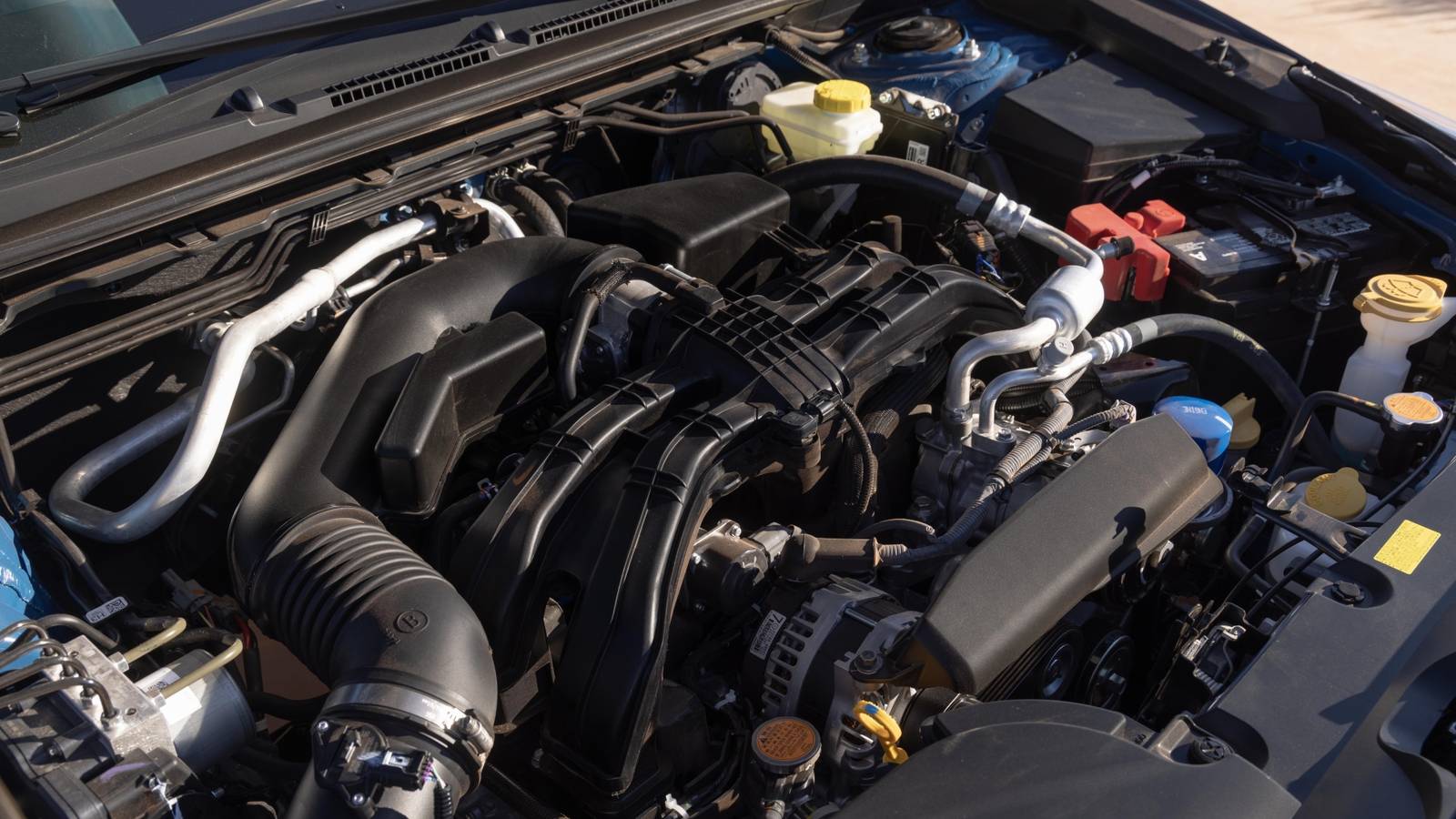
You know it when you hear it: the grumbly, all-too-unmistakable sound of an approaching Subaru and its characteristic flat-four-cylinder engine. Since the mid-1960s, the boxer engine has been a fundamental part of the Subaru formula. Now, nearly 60 years after the brand introduced the first Subaru 1000, the four-banger boxer is inseparable from Subaru, powering everything from the family-friendly Outback to the athletic Impreza and BRZ sports cars.
Now, like Ducati and the Desmodromic valve system, the argument could be made that Subaru simply refuses to give up on its beloved technology. In earnest, though, there are a couple of pretty solid reasons why Subaru won’t send the flat-four to the graveyard, even in new cars like the 2026 Subaru Forester and Impreza Hatchback. Part of Subaru’s unwavering belief in the boxer is its ability to make a car safer in the event of a crash. However, performance fanatics will know that the rest of the method behind the madness is a balanced, low-riding engine with a penchant for all-wheel drive.
Subaru’s Legendary Boxer: Smooth, Balanced, Low

So, just what is a boxer engine? In short, a boxer engine uses a horizontally opposed layout of pistons in its internal combustion process. To give you an idea of how it compares, most engines use a V-configuration or vertical, inline layout for cylinders and pistons, hence V8 or inline-six. Subaru didn’t commit to the flat, or “H,” configuration just to be gimmicky. No, the brand saw the layout as an opportunity to engineer a smooth, less friction-prone engine with the potential to provide vehicles with a low center of gravity.

In a boxer engine layout, the crankshaft and drivetrain can sit lower, effectively dropping a vehicle’s center of gravity. As a result, a vehicle with a low-riding flat engine enjoys better stability and less naturally occurring body roll while cornering. By contrast, a V-configured engine tends to carry more of its weight vertically in the engine bay, creating a higher center of gravity. It’s one of the reasons the Porsche 911 refuses to give up its iconic flat-six all these years later.
Not Just For Performance

Granted, Subaru’s horizontally opposed engine configuration allows engineers to keep things low and balanced in the engine bay. However, Subaru asserts that there are other benefits behind the boxer. For instance, the operation of a flat engine works to reduce the sort of noise, vibration, and harshness you’d find in a more conventional inline-four-cylinder configuration. As the pistons move in and out along a flat path, the primary vibrations actively cancel each other out. The result? A boxer engine tends to vibrate in its mounts less and create less friction than other ICE applications.

Of course, Subaru’s latest ad campaigns don’t highlight smooth operation or vibration-resistance. Instead, Subaru beats its marketing drum to the tune of safety, reminding buyers that the brand consistently snags top marks from the IIHS and NHTSA. Consequently, Subaru says the boxer engine has its safety qualities, too. Specifically, the boxer’s safety credentials lie in the compact nature of the engine and its low mounting point. Interestingly enough, the low position of a flat, front-mounted engine may allow the mill to “drop below” the front passenger space in the event of a forward collision, rather than thrusting a more vertically oriented engine into the cabin.

Next-Gen Toyota GR86 Will Ditch Subaru Boxer Engine And Get An In-House I4
Toyota executives announced the update during a Q&A session at Rally Japan 2024.
A Perfect Pairing For All-Wheel Drive

Like Audi and Quattro, Subaru is readily associated with all-wheel drive. So, as you might imagine, the brand’s tenured boxer engine goes hand in hand with the brand’s Symmetrical All-Wheel Drive System. Given the low-riding engine placement in Subaru’s current lineup, the marque connects its Symmetrical AWD system directly to the brand’s flat-four-cylinder engines. All told, just one gas-powered Subie goes without all-wheel drive for the 2026 model year.

Paired with ideal weight distribution, sending power to all four wheels is ideal for off-road driving and performance applications. Better yet, the standard all-wheel drive system provides a vital increase in grip in inclement weather over all-wheel drive or rear-wheel drive. That said, a healthy set of seasonally-appropriate tires will do more for handling and braking than all-wheel drive on all-season rubber.
Right At Home In A Little Rear-Wheel Drive Sports Coupe

Granted, Subaru’s boxer engine is most at home powering all four wheels. But that doesn’t mean the flat four-cylinder mill isn’t happy pushing a small, eager sports coupe from the rear wheels. In 2012, Subaru rolled out the first-generation BRZ. Rather than imbuing the diminutive sports coupe with all-wheel drive, as the brand has with many iterations of rally-inspired performance cars, the BRZ offered rear-wheel drive as its exclusive drivetrain option. That wasn’t a concession, though.

Now, some 15 years later, the second-generation Subaru BRZ knows exactly what it is: a back-to-basics driver’s car. Three pedals, a stick in the middle, a sharp chassis, and rear-wheel drive– the recipe for a peppy sports car. And at its heart? A naturally aspirated, 228-horsepower 2.4-liter boxer engine. While that might not seem like gobs of power in the age of superpowered sports cars, the rev-happy boxer is more than enough to keep things athletic and, above all else, fun.

The Most Powerful Naturally Aspirated Flat-Six Ever Put In A Production Car
This venerated manufacturer is known for its high-performance six-cylinder sports cars, and one of them has the most powerful N/A six in the game.
Improved Over Time

In 1966, the public got its first taste of the Subaru 1000. The “1000” in the name references the little Subaru’s water-cooled engine, which, at 0.977 liters, is near as makes no difference 1,000cc. More importantly, though, it was the company’s first boxer-powered passenger car. Now, nearly 60 years later, Subaru still puts a horizontally opposed engine in every one of its gas-powered cars.

That doesn’t mean, however, that Subaru stopped innovating its boxer engine. Modern technology has found its way onto the brand’s flat-four engines, including variable valve timing and direct injection. Forced induction is now very much part of the equation, too. While the Subaru 1000 produced a paltry 54 horsepower, you’ll find a comparably Herculean 271 horsepower in the new Subaru WRX courtesy of a turbocharged 2.4-liter flat-four-cylinder engine.
Rally-Validated Performance

Don’t believe the Subaru boxer engine has bragging rights? You need only look at its motorsport history. Boxer-powered, all-wheel-drive Subarus have a history of sliding, jumping, and kicking up dirt on the way to victory. Take Scottish rally racing driver Colin McRae, for example. In 1995, a boxer-powered Subaru Impreza carried McRae to a win in the World Rally Championship. The EJ20 and EJ25 boxer mills were at the heart of McRae’s WRC success, proving that the flat Subaru engines could put it on the line.

10 Off-Road Upgrades Make The 2026 Forester Wilderness a True Adventure SUV
The Forester is Subaru’s best-selling and practical SUV that just got even better at tackling the wilderness thanks to these features.
The Sky’s The Limit

Beyond factory applications, enthusiasts treasure the Subaru boxer engine for its aptitude as a canvas for tuners. Subie fans will often modify their stock flat-four engines, adding bolt-on tweaks like an out-of-the-box tune, an exhaust system, and a cold air intake. What’s more, many Subaru builders will rely on the boxer’s robustness and forged internals to dial up the amount of boost a turbocharged application will handle. Be warned, though; any engine, especially extensively modified or overbuilt engines, can suffer a catastrophic failure. Play at your own risk.