
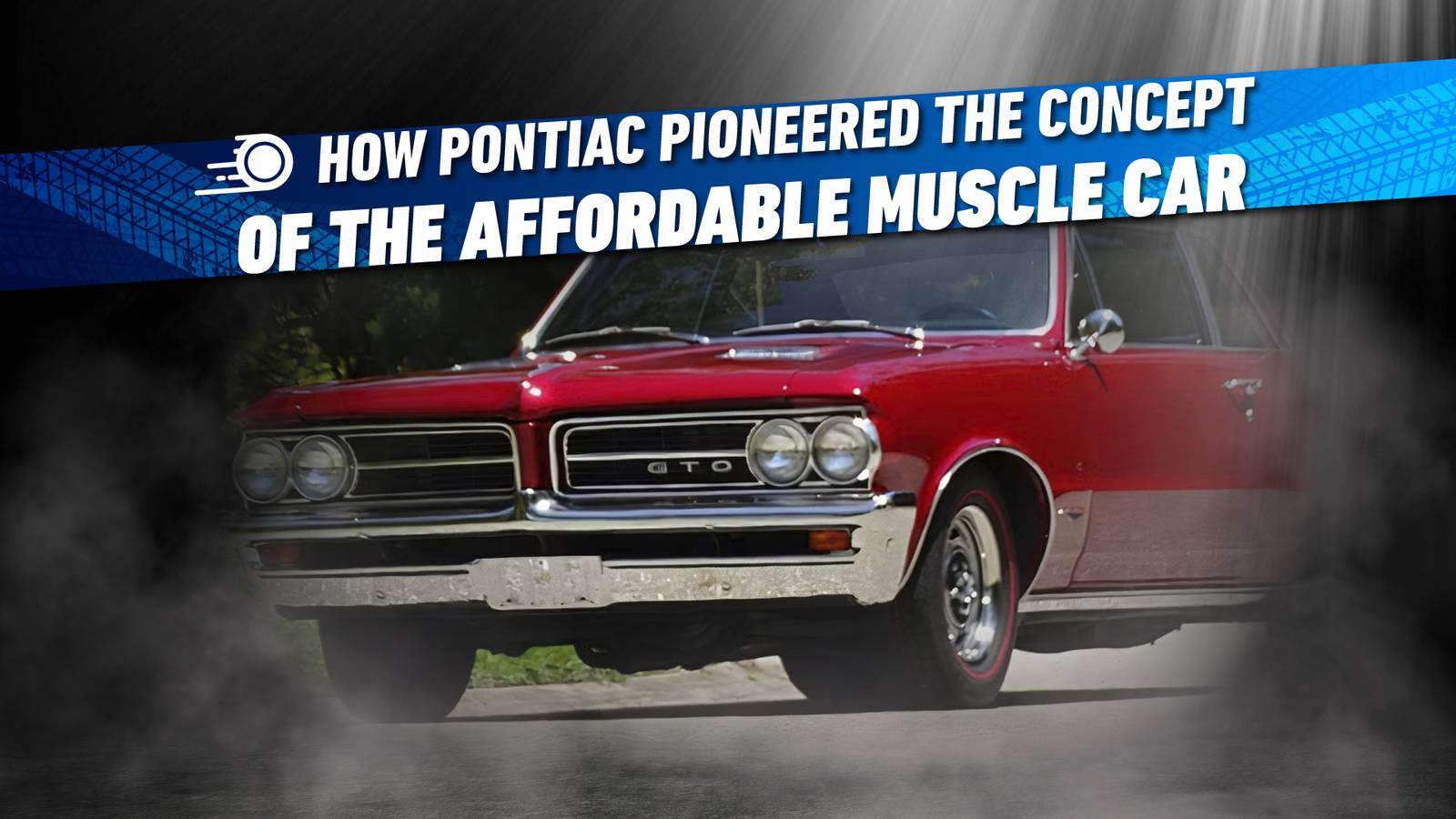
When it comes to the American automotive industry, very few segments have been as impactful as the muscle car. As a nation, the U.S. has become synonymous with these bold, powerful cars that offer an experience behind the wheel like no other, with countless cars contributing to the segment’s rich history. While models such as the Ford Mustang and the Dodge Charger have been on the market for decades, there’s one brand that deserves equal recognition for opening up the muscle car to the masses decades ago.
The muscle car itself can be traced back to the 1940s, but the idea of a massive V-8 under the hood of a boxy, wide, light shell seriously started to become popular in the 1960s, which moved through into the early 1970s. The market did already have its fair share of large, powerful cars, but many of them fell into the luxury segment and fetched high price tags. In 1964, however, Pontiac introduced a model that has now become one of the most iconic American cars of all time and allowed the mass market to experience performance that was reserved for motorsport up until that point, kickstarting the golden age of the muscle car.

How The Pontiac GTO Revolutionized Muscle Cars In The ‘60s
The Pontiac GTO isn’t just the G.O.A.T., it started a revolution of American performance and launched the Golden Age of muscle cars.
Proto-Muscle Lights The Fuse

|
Engine |
Horsepower |
Torque |
0-60 MPH |
|---|---|---|---|
|
5.0-liter 303 cubic-inch V-8 |
135 HP |
263 LB-FT |
12.2 seconds |
1949 Oldsmobile Rocket 88 Performance Specifications
There were fast intermediate cars before the GTO, but they weren’t actual muscle cars for a variety of reasons. They, however, most certainly were the spark that led to the explosion in 1964, at least in terms of bringing factory power to the streets. The 1949 Oldsmobile Rocket 88 is often cited as the first proto-muscle car because it was a relatively light vehicle with a big-for-the-time V-8.
Its 159-horsepower engine doesn’t sound that impressive now, but back then it was good enough to make the Rocket 88 the dominant car on the NASCAR circuit. In 1955, Chrysler came out with the 300-horsepower C-300 that they touted as the “America’s Most Powerful Car”, mostly because it was. It was also a full-size luxury ride that hardly qualifies as affordable muscle.
Muscle Car Precursors

- 1949 Oldsmobile Rocket 88
- 1955 Chrysler C-300
- 1956 Studebaker Golden Hawk
- 1957 AMC Rambler Rebel
- 1962 Dodge Dart Max Wedge 413
- 1962 Studebaker Avanti
- 1963 Dodge 330 Lightweight
- 1963 Ford Galaxy R-Code
- 1963 Chevrolet Impala Sport Coupe Z11
The Studebaker Golden Hawk, introduced in 1957, had a 275-horsepower V-8 and an amazing power-to-weight ratio, but it too was a personal luxury car. Perhaps, the closest thing to hitting the definition of a muscle car in the pre-GTO days was the 1957 AMC Rambler Rebel.

|
Engine |
Horsepower |
Torque |
0-60 MPH |
|---|---|---|---|
|
5.4-liter 327 cubic-inch V-8 |
255 HP |
345 LB-FT |
7.5 seconds |
1957 AMC Rambler Rebel Performance Specifications
It was the first mid-sized car fitted with a big-block V-8, and it was affordable, so why isn’t it the first muscle car, rather than the GTO? The reason is it was ugly and dorky, in that order. The Rambler Rebel was a four-door, which is kind of a muscle car no-no, but more importantly, it just wasn’t a cool-looking ride. Sure, it was fast, but owners only used that power to get away from the laughter and pointing.

This Classic Muscle Car Could Outrun Modern Performance Cars
The 1970 Chevelle SS 454 set a muscle car performance standard the lasted almost four decades and still impresses.
Factory Drag Cars

In the early 1960s, drag racing was growing in popularity and the Big Three automakers produced some killer factory-ready rides to meet the demand. The 1963 Ford Galaxy R-Code and 1964 Thunderbolt were monster drag cars capable of 12-second quarter-mile runs. Chevrolet came out with ’63 Impala Z11 that was blistering, though technically a full-size, and Dodge had the 330 Lightweight, which was scary fast. All of these cars were made in extremely limited numbers and built for track use, so they weren’t regular production rides for the people. The concept of factory drag power, on the other hand, would end up being very influential in the creation of American muscle.
Funmobiles

Until the introduction of the Chevrolet Corvette in 1953, all American cars were built with a practical purpose, like hauling, towing, or just basic transportation. The ‘Vette, however, was made to simply enjoy, and it’s something that caught on. The next year, Ford came out with the two-seat personal luxury sports car Thunderbird, which was “Fun, Fun Fun” until daddy took it away.
The Ford Mustang, which would be introduced in 1964, the same year as the GTO, was the worst-kept secret in Detroit and represented the growing trend of pure driving enjoyment. The idea of having a blast and looking cool was something that factored heavily into the muscle car ethos.
Pumping Iron With The ’64 GTO

|
Engine |
Horsepower |
Torque |
0-60 MPH |
|---|---|---|---|
|
6.4-liter 389 cubic-inch V-8 |
348 HP |
400 LB-FT |
6 seconds |
1964 Pontiac GTO Performance Specifications
All the foundations had been laid for a muscle car with thrilling factory performance in a badass-looking affordable ride, and now somebody just had to make one. Ironically, the muscle car came to be due to General Motors’ efforts to make sure it would never happen. In 1963, GM issued a company-wide edict, banning all of its divisions from racing development. This meant no more factory drag cars, as well as zero participation in NASCAR or endurance racing. As dumb as that was, this ill-conceived moratorium included a high limit of 400 cubic inches of displacement in intermediate cars.
John DeLorean, then head of the Pontiac division, was particularly annoyed at this arbitrary big engine ban, and started thinking of how he could subvert it. In reality, the ban limited intermediate engines to 330 cubic inches, but there was a loophole that allowed up to 400ci as an option. At the time, the biggest Pontiac V-8 that fit within the rules was the 389, which was the standard engine for the full-size Grand Prix. It was a modest engine in its stock form, generating between 303–318 horsepower, but there was a “Tri-Power” triple two-barrel setup that cranked it up to 368 ponies. While not mind-blowing compared to the HEMIs and 454 LS6s to come, it was substantial power for 1964.
The Tempest Storm

With a great engine, all DeLorean needed was the right car to put it in. Under his direction, the Pontiac Tempest was transformed from a goofy compact into a sporty mid-size in 1964. It was the perfect convergence of all things, with a vendetta against GM’s engine ban, a killer high-performance V-8, and an aggressive, muscular car. It’s kind of a “what came first, the chicken or the egg?” thing in that did John DeLorean find this idea or did the idea find him? It doesn’t really matter, because the stars were aligned, and it happened: the 1964 Pontiac GTO gave birth to the classic muscle car era.

15 Modern Muscle Cars That You Shouldn’t Overlook
Here’s a comprehensive list of models that perfectly capture the essence of old-school muscle, and blend them with modern-day conveniences
The Finishing Touches

As we already know, there had been intermediate cars with nice performance for around 25 years prior to 1964, so there were still a couple of pieces of the puzzle needed to complete the progenitor of the muscle car craze. First was a cool name, and DeLorean chose GTO, which is short for the Italian term Gran Turismo Omologato, which basically means qualifying for endurance racing.
Never mind that the car was never going to compete at the 24 Hours of LeMans, the abbreviated GTO sounds like something that will literally kick you in the butt. The second, and more important thing, was getting this car in at an affordable price. A fully-loaded 1964 GTO was actually quite expensive, but adding the performance package to the base-model Tempest was a grand total of $2,662 ($27,091 adjusted for inflation), which brought muscle to the masses.
GTO Ushers In The Horsepower Wars

There was actually one last component to the genius of the GTO and that was the marketing. It was the first car to be geared toward the youthful segment of the auto-buying public. It wasn’t a stodgy luxury car or a bland family ride, but rather something for the kids to blow off steam in. This paid off brilliantly as the ’64 GTO sold 32,450 cars in the first year, which was way more than the forecast 5,500 units Pontiac expected. This runaway hit, of course, spawned imitators from the other automakers, who suddenly realized there was a market for affordable street machines.
First-Wave GTO Copy Cats
- 1964 Chevrolet Chevelle SS
- 1964 Mercury Cyclone
- 1964 Oldsmobile 4-4-2
- 1964 Plymouth Sport Fury
- 1965 Buick Gran Sport
Immediately following the GTO’s release, there was a deluge of imitators, trying to grab a piece of the emerging muscle car market. GM’s divisions slapped together performance versions of their intermediate cars like the Buick Gran Sport, Chevelle SS, and Oldsmobile 442. Ford was riding high with the Mustang and didn’t get involved until later, but Dodge and Plymouth upped the ante with their existing rides. It was, in fact, Mopar that started escalating things by dropping increasingly powerful engines in their cars from the 413 Max Wedge to the 426 Street Hemi. The GTO set the table for what would become a horsepower war, with manufacturers trying to top each other with both power and aggression.
Second Wave Of American Muscle

The ’64 GTO opened up the spigot on a previously untapped segment, which flowed into the most glorious era of American automotive history. The first muscle cars, including the GTO, were performance trims or packages on existing models, but around 1967, all the automakers started coming out with dedicated ass-kicking nameplates. This is when the Camaros, Road Runners, and era-defining second-gen Chargers started to rule the roads. The GTO also got a killer update in 1968, reestablishing itself as the baddest of the bad, and in 1970, GM finally lifted its asinine big engine ban, at which point the Goat finally got the horsepower-pumping 455 V-8 it deserved all along.

Top 10 Classic Pontiacs That We Would Like To Make A Comeback
In the automotive world, it is possible to resurrect characters and cars, so why not a car company?
Pontiac GTO: Undisputed Muscle Car Heavyweight Champ

There are probably some Mopar fans reading this, wondering why the 1962 Dodge Dart Max Wedge 413 isn’t considered the first muscle car. It was the one year that the Dart was an intermediate ride. It was a two-door, had a 380-horsepower 2×4 carb V-8, and even got a shout-out in a Beach Boys song. This editor bleeds Tor-Red, or maybe Plumb Crazy, but the ’62 Dart had a few reasons why it can’t be called the first muscle car. First, it really wasn’t that cool-looking of a car. Second, it had an inflation-adjusted price tag in the mid-$30,000 range, and finally, it didn’t ignite a revolution like the GTO did.
The 1964 Pontiac GTO was the perfect car at the right time. Just like rock and roll music, the GTO was a way to rebel against their parents’ uptight attitudes in the most satisfying way. Kids today get face piercings and neck tattoos, which are actually, and weirdly kind of conformist, but back in the day, a muscle car was a statement against traditional values, with the added bonus that it didn’t involve body mutilation. GTO pioneered the affordable performance ride that appealed to a younger crowd, so it really is the automotive equivalent of Elvis or the Beatles. More than just a car, it was a cultural phenomenon that created a movement.