
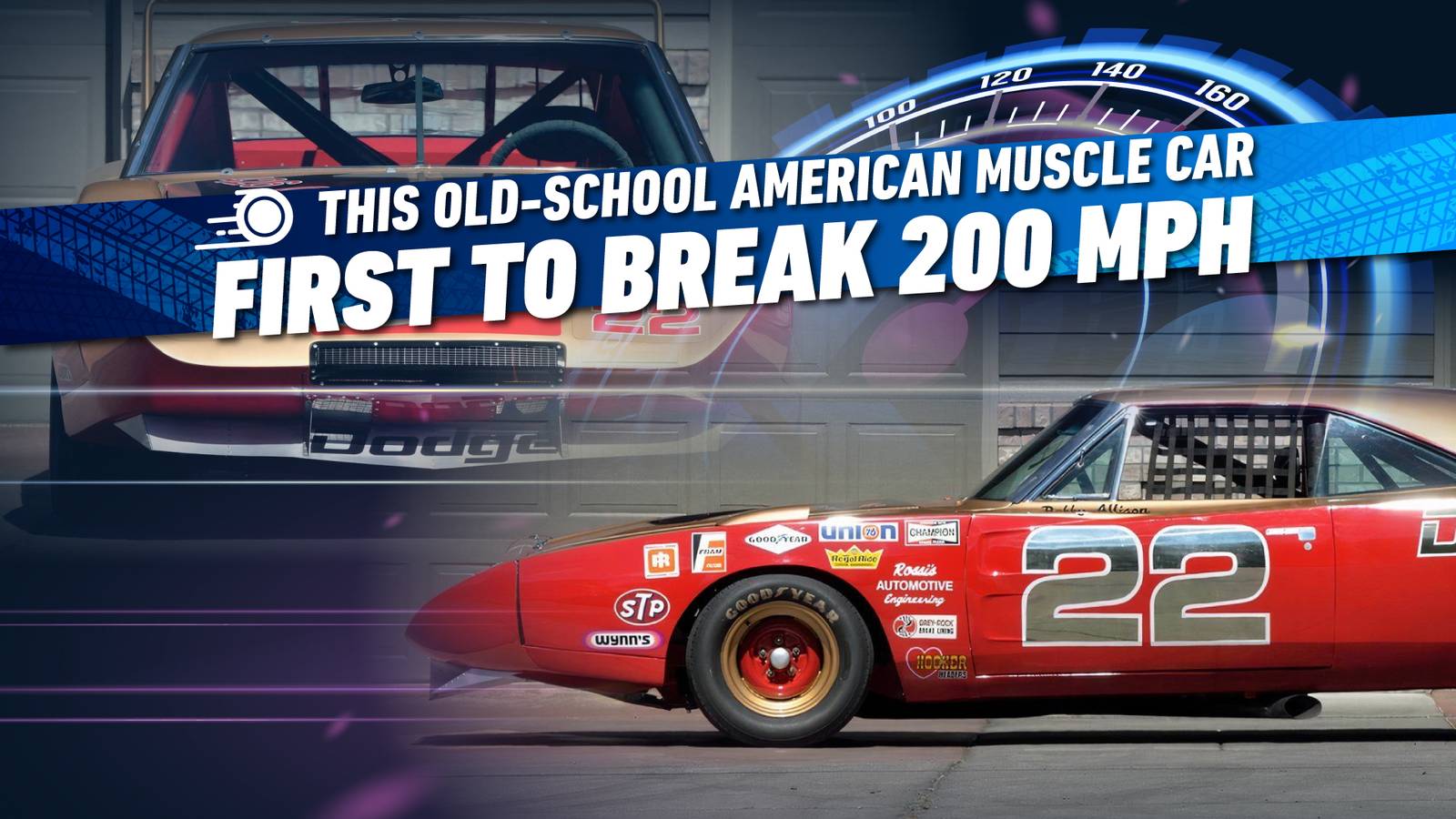
Beginning in 2007, NASCAR switched to a common body and chassis for all cars to put the focus on the driver’s skill versus the innovative design of the manufacturers. There are allegedly Chevrolet Camaros and Ford Mustangs on the circuit, but really they are “Next-Gen” vehicles and all look pretty much the same. Back in the day when NASCAR was true stock car racing, however, the cars on the track were the same ones in dealer showrooms. The “win on Sunday, sell on Monday” ethos drove automakers to create high-performance production models to set speed and sales records.
Modern NASCAR engines are also all basically the same in terms of displacement and power, but back in the day, there was an “anything goes” groove, as long as it was homologated. Both cars and engines had to be sold to the public to qualify for competition, which resulted in some of the most killer rides that anyone could drive on the street. The average top speed for a current NASCAR race car is 199.46 MPH, and 200 MPH laps are commonplace. Before 1969, nobody had hit that magical plateau until the super-funky-looking Dodge Daytona with a 426 Hemi V-8 broke the 200 MPH barrier on the track.

How The Dodge Charger Daytona Is Redefining The Future Of American Muscle
Carrying the torch to lead the American muscle legacy to a new future is no easy task, but here’s how Dodge is doing it.
1969 Dodge Charger Daytona

|
Engine |
Horsepower |
Torque |
Quarter-mile |
|---|---|---|---|
|
426ci Hemi V-8 |
425 HP |
490 LB-FT |
13.7 seconds |
1969 Charger Daytona (Homologated Version) Power and Performance
The second-generation Dodge Charger, introduced in 1968, is the baddest ride of the entire Golden Age of American muscle in terms of aggressive styling and ferocious performance. As killer as this car was on the streets, it was a garbage race car. Dodge raced the Charger R/T in NASCAR, where it was thoroughly trounced by Ford and Mercury cars. Drivers described piloting the R/T as kind of like driving on glass, and wind tunnel testing revealed that the Charger’s recessed windows created lift. Also, the wicked front end caused drag, preventing acceptable top speeds. The quick fix was the 1969 Charger 500, which used a Coronet front end and window caps, but it didn’t fare much better.

Dodge decided that since they needed to reduce drag and get their cars glued to the track, some radical steps should be taken. Starting with a 1969 Charger R/T, they added an 18-inch sheet metal nose cone to the front and a 23-inch rear wing that was bolted into the sub-frame. The result was the totally crazy-looking 1969 Charger Daytona, named after the Daytona 500, which was and still is the premier NASCAR race. Initial testing showed that the nose cone created 1,200 pounds of downforce and the wing another 600. The wing had the additional benefit of giving the car directional stability, so all that weirdness had real-world functionality.
Homologating The Charger Daytona

To qualify the Charger Daytona for NASCAR competition, Dodge had to homologate it, meaning they had to sell a certain number to the public, in this case at least 500. Dodge’s marketing department did a spit-take when presented with the wacky-looking car, but kicking ass on the track was paramount, so it went into production. The version sold through dealers had a fiberglass nose cone and the rear wing wasn’t as reinforced, but it was more or less the same car headed for NASCAR. Right off the hop, over 1,000 orders were taken, but Dodge only ended up producing 503 units, and that number may be less as rumors persist that regular R/T VINs were used in the homologation process.
426 Race Hemi

With the perfect race car design qualified for NASCAR, all the Charger Daytona needed was the perfect engine, and the obvious choice was the 426ci Hemi V-8. The Hemi had already been homologated in 1966 when a Ford complaint forced Chrysler to offer it in Dodge and Plymouth production models. The Charger Daytona sold to the public had a 426 Street Hemi option, but the NASCAR racer was equipped with the 426 Race Hemi. The Race Hemi has a hotter cam, higher compression, and high-performance headers, so chances are it generates a hell of a lot more power, but it is rated at 425 horsepower and 490 pound-feet of torque just the Street Hemi.

10 Things About The Original Dodge Charger Daytona That Will Blow Your Mind
The iconic 1969 Dodge Charger Daytona has some stories that are just as wild as its appearance
Talladega Days: The Legend Of Buddy Baker
Before 1969, the average speed for a qualifying lap in NASCAR was around 160 MPH, and the average top speed for a NASCAR race car was in the 170 MPH neighborhood. While that certainly is fast, that reality was about to be shattered and the doors of perception blown completely off. On July 20, 1969, at the Chrysler Proving Grounds in Chelsea, Michigan, road testing of the Charger Daytona got underway with drivers Charlie Glotzbach and Buddy Baker putting the “Winged Warrior” through its paces. With Baker behind the wheel, the Charger Daytona was clocked at 205 MPH, which still seems fairly bonkers today.
Fastest NASCAR Qualifying Laps
- 1987 Bill Elliott – 212.809 MPH
- 1987 Bill Elliott – 210.364 MPH
- 2014 Jeff Gordon – 206.558 MPH
- 2017 Kurt Busch – 200.915 MPH
- 2014 Kurt Busch – 198.771 MPH
(Lap speeds sourced from NASCAR)
Because it was achieved in a test and was simply a top speed, it wasn’t an official record, but Baker had already proven the Charger Daytona’s freakish powers. On March 24, 1970, Baker was testing out the transmission of the Charger Daytona at the International Motor Speedway in Talladega, Alabama, when he ripped off a 200.096 MPH lap. Then, he ran again at 200.447 MPH, becoming the first driver to hit 200 MPH on a closed course circuit. Baker would go on to have a very successful racing career, and he is one of NASCAR’s legendary drivers, but clearly, the radical innovation of the Charger Daytona helped him blow through the 200 MPH barrier.
1969 Talladega 500

The inaugural running of the Talladega 500 in 1969 is regarded as the worst race in history, and that is a reasonable assessment. Due to the course’s layout and high banked curves, insane speeds were possible and that, combined with the fact that the track literally ate tires, most major drivers dropped out, citing safety concerns. Even Buddy Baker was part of the boycott, so relatively unknown Richard Brickhouse was talked into driving the 1969 Dodge Charger Daytona. Brickhouse is credited as the winner, but only because of a score-keeping SNAFU, as Jim Vandiver actually took the checkered flag behind the wheel of a Dodge Charger 500.

10 Things You Need To Know About The Iconic Hemi Engine
The legendary Hemi engine is one of the most successful engines in the auto world.
NASCAR Bans The Charger Daytona

Automotive folklore would have us believe that the Charger Daytona was so dominant that NASCAR banned it from competition, but that’s not the entire story. The Dodge “Aerocar” entered the 1969 season late, but there were 12 more races that year, and a Charger Daytona only won one of them. Now here’s where things get weird: all published accounts say that the Charger Daytona only won four races in the 1970 NASCAR Cup Series season, but Hall of Fame driver Bobby Isaac took the championship that year behind the wheel of a ’69 Charger Daytona, with 11 wins.
1970 NASCAR Grand National Series Final Points Standings
|
Driver |
Make |
Starts |
Poles |
Wins |
Top 10s |
Points |
|---|---|---|---|---|---|---|
|
Bobby Isaac |
Dodge |
47 |
13 |
11 |
38 |
3911 |
|
Bobby Allison |
Dodge |
46 |
5 |
3 |
35 |
3860 |
|
James Hylton |
Ford |
47 |
1 |
1 |
39 |
3788 |
|
Richard Petty |
Plymouth |
40 |
9 |
18 |
31 |
3447 |
|
Neil Castles |
Dodge |
47 |
24 |
3158 |
Maybe Isaac was driving a different Dodge for some of those wins, as the info is a little shaky, but chances are he drove a Charger Daytona. Equally as puzzling are the reports that the 1970 Superbird, Plymouth’s Road Runner-based aerocar, only won eight races that year, when it was driven by The King, Richard Petty, who took 18 checkered flags for the season. Regardless of the actual number of Mopar Winged Warriors car victories, NASCAR viewed them as an unfair advantage, and while not outright banning them, limited them to 305 cubic inches of displacement. The 426 Hemi Charger Daytona and Superbird were clearly out of contention.
Legacy Of The Charger Daytona

The Dodge Charger Daytona may have had a limited run on the NASCAR circuit, never really getting the chance to prove its dominance, but it absolutely rules the collectible muscle car market of today. Only 503, and maybe fewer, of these amazing rides were ever built. A mere 70 of them were equipped with the 426 Street Hemi, making them the rarest and most sought-after rides from the classic era. A 440 Charger Daytona is a high six-figure car, but with the Hemi, it’s a guaranteed million-dollar ride.
Million-Dollar Mopar Club
- 1971 Plymouth Hemi ‘Cuda Convertible – $3.5 million
- 1969 Dodge Charger Daytona Hemi – $3 million
- 1970 Plymouth Hemi ‘Cuda Convertible – $2.3 million
- 1970 Plymouth Superbird – $1.65 million
- 1970 Dodge Challenger R/T Convertible – $1.45 million
- 1969 Dodge Charger Daytona Hemi – $1.43 million
In fact, Hemi Charger Daytonas are the most expensive regular production classic muscle cars ever made. There have been some auction-busting Dodge Challenger and Plymouth Hemi ‘Cuda convertibles, but their hardtop versions are worth considerably less. The Charger Daytona, on the whole, is the most valuable Golden Age ride, which will top the million-dollar mark every time it comes across the auction block. Much of that is due to the car’s character and rarity, but also, collectors want a piece of the historic car that first broke the 200 MPH barrier.