
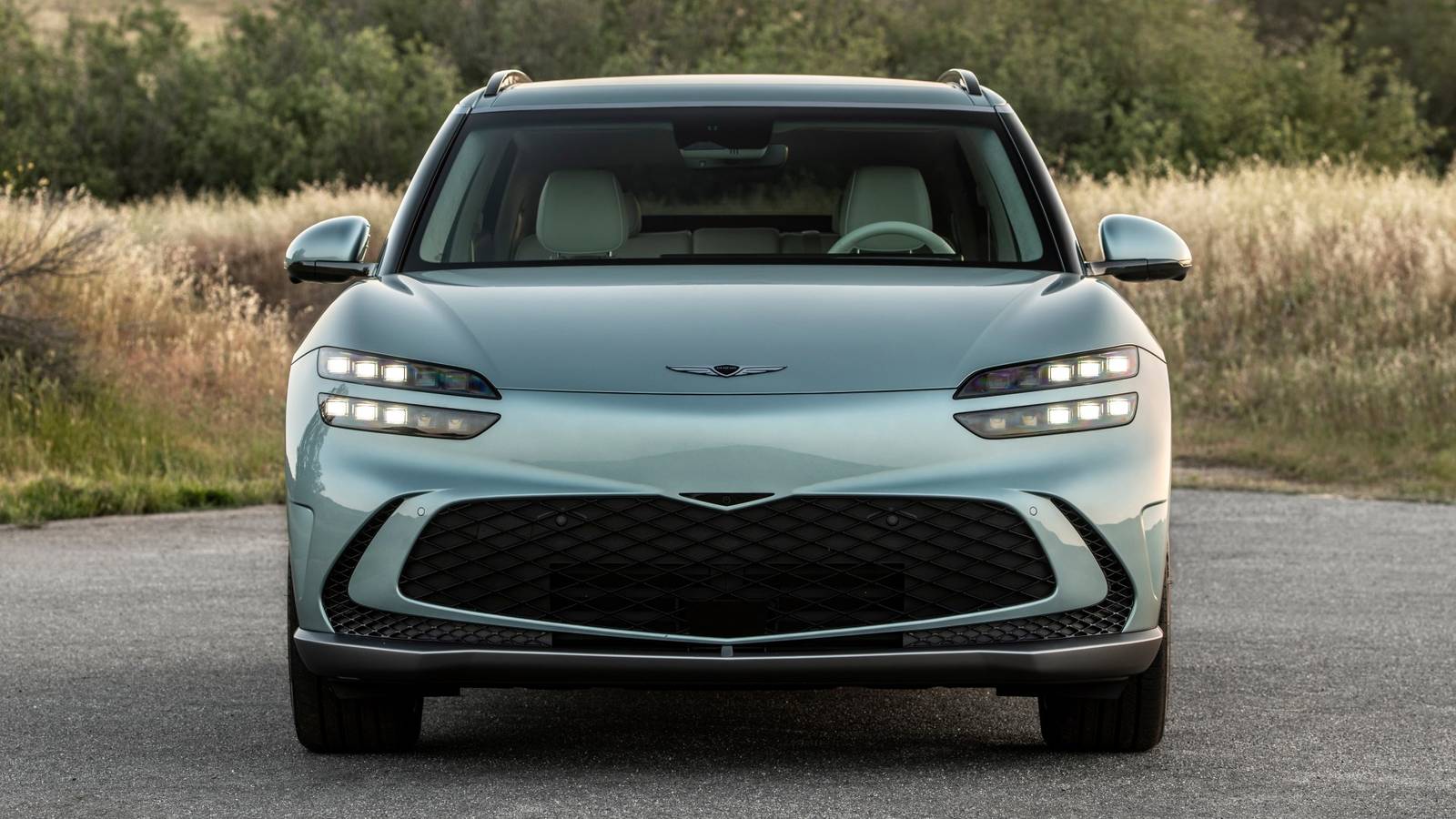
Most, though not all, luxury cars tend to depreciate faster than their mainstream counterparts. That’s because sometimes, these cars are more complicated due to how much tech and features they have, while with European brands in particular, their engines and drivetrains are more mechanically complex. Complexity, after all, always leads to a higher chance of failure.
But what about a mechanically simple luxury car? Shouldn’t it mean that they won’t suffer from rapid depreciation? Well, unfortunately, electric vehicles (EVs) are mechanically simple with fewer moving parts, but they depreciate faster than any vehicle. As a result, you can pretty much own a used Korean luxury SUV for less than a brand-new Hyundai Tucson, and it’s not even a bad EV at that.
Kicking Off Your Electric Genesis

Genesis means the origin or formation of something, so why not kick-start your EV life with this Genesis GV60? That’s because early GV60 models, particularly 2023 model year vehicles, retail for under $29,200—the base price of a brand-new Tucson.
When EV Depreciation Favors You

EV depreciation isn’t going to be your best friend if you are the owner of the vehicle, but if you’re in the used EV market, then it’s going to heavily favor you, the buyer. Though data on a used Genesis GV60 is still lacking, projections by CarEdge suggest that after five years, the GV60 will have an average resale value of $25,024. It is worth noting that the oldest models in used car lots today are going to be three years old, but you can already see a handful of units being sold for less than the $29,200 base price of a brand-new Tucson. There are a couple of used examples that are well-priced via Edmunds, while another one from iSeeCars is retailing for less than $29,200.
Why EVs Depreciate Fast

But why do EVs depreciate fast? Does it mean these are bad cars? Well, not exactly. For one, unlike in an internal combustion engine (ICE) car, wherein its core technologies are pretty much at their peak, EVs still have a lot of room for innovation. Charging speeds grow almost exponentially in just a few years, while battery chemistries allow for EVs with smaller but more energy-dense batteries just a few years apart. It is this speed of innovation that’s a major contributor to an EV’s faster depreciation.

Another reason why EVs tend to depreciate faster is somewhat anecdotal. Even if multiple studies have already shown that batteries last far longer than people think—often even longer and well beyond the time an ICE needs an overhaul—consumers are still wary of the life span of this new technology. Lastly, another factor contributing to this is that the demand for EVs tends to be lower than ICE cars or hybrids. Additionally, with so many new EV offerings being brought onto the market, EV supply is greater than demand, and as economics has taught us, greater supply and lower demand mean lower prices.

First-Gen Genesis GV60: Still A Solid Choice Despite Incoming Refreshed Model
The first-gen Genesis GV60 still checks all the right boxes — style, tech, and performance — even with the new model just around the corner.
Let’s Explore The GV60’s Design

If you’re considering the Genesis GV60 as your next vehicle purchase, then here’s what you need to know about this luxury EV in terms of its exterior and interior design, as well as what possible features you can get.
Striking Looks

Notice that I said striking, but not necessarily pretty? Well, to me, the GV60 isn’t good-looking, but of course, your preferences will vary. It’s your choice, so whether you like it or not is up to you, such as its signature Two-Line LED headlights and wide grille. But a part of me is finding the front end awkward due to the design of the grille and the side vents surrounding it. Thankfully, the side profile is more palatable, but for me, even this part of the vehicle seems like there’s too much happening. It isn’t helped by its hunchback-like rear, either. I don’t like this aesthetic in cars like the BMW X6, and I don’t like it in this format, either, since the trunk lid area, where the window ends, looks too tall.
Sumptuous Interior

But undeniably, where you’ll be getting your money’s worth, especially for less than the price of a brand-new Tucson, is its interior. Genesis makes some of the nicest interiors in the luxury space, and the GV60’s art deco-like aesthetic looks amazing. There’s hardly any gloss black materials, relying instead on tasteful matte metal textures and knurled switches, making the interior feel truly upmarket. Two 12.3-inch screens greet the occupants with a nice operating system to boot. It’s called the connected car Integrated Cockpit (ccIC), which is a derivative of Hyundai Motor Group’s (HMG) connected car Navigation Cockpit (ccNC) that’s used in the core Hyundai and Kia models.
The GV60 doesn’t just dress like a luxury EV — it fully commits, with materials and craftsmanship that feel genuinely high-end. Everything inside is thoughtfully designed and solidly built, from the soft-touch surfaces to the intricate detailing. It’s the kind of cabin that feels just as premium as it looks, if not more.

Of course, being a luxury EV, you’ve got a generous amount of features, but that will heavily depend on which trim you’ll end up with for less than the price of a brand-new Tucson. For the sake of sustainability, lower trims have leatherette upholstery, while leather or Nappa Leather is offered on higher trims. Expect features like power-adjustable front seats, a panoramic sunroof, a powered tailgate, and the full gamut of advanced driver-assistance systems, while higher trims even come with a Bang & Olufsen surround sound system.

Top 10 Used Compact Electric SUVs In 2025
If you are looking to go all-electric and need something that’s practical but won’t burn a hole in your pocket? These 10 options are your best bets.
Also, A Fundamentally Great EV

EVs may depreciate fast, but that shouldn’t put you off from owning a used one, especially since the Genesis GV60 has solid fundamentals. That’s because the Genesis GV60 is underpinned by HMG’s sophisticated Electric Global Modular Platform (E-GMP), which is what the award-winning Hyundai Ioniq 5 and Kia EV6 use.
Sophisticated Even In 2025

The efficient electric motors and skateboard architecture allow for competitive range figures and unparalleled interior space utilization. Also, with its 800-volt electrical architecture, the GV60 can support up to 350 kW of DC fast charging speeds, which allows for a 10 to 80 percent charge in just 18 minutes. Lastly, with vehicle-to-load (V2L), the GV60 can also be an external power source—useful for camping or when there’s a power outage. These capabilities were cutting-edge in 2023, and it’s only in 2025 that these features are starting to flourish in other EVs. And yet, not all EVs in 2025 or 2026, depending on when you’re reading this, have these capabilities.
Broad Powertrain Selection

Depending on your budget, you have four versions of the GV60, all of which have varying range and performance figures. At its most efficient single-motor Standard RWD configuration, the GV60 boasts 225 horsepower and an EPA-estimated range of 294 miles. Opt for dual-motor AWD versions, expect a power bump to 314 horsepower, but understandably, range drops to 264 miles (or 248 miles with the Advanced AWD’s 20-inch wheels). Craving even more speed? The Performance AWD offers a whopping 429 horsepower, but unsurprisingly, this is the least efficient version with just 235 miles of EPA-estimated range.
2023 Genesis GV60 Performance Specs
|
Standard RWD |
Standard AWD |
Advance AWD |
Performance AWD |
|
|
Drivetrain |
(Rear) Permanent magnet synchronous motor |
(Front and Rear) Permanent magnet synchronous motor |
||
|
Layout |
RWD |
AWD |
||
|
Transmission |
1-speed A/T |
|||
|
Horsepower |
225 hp |
314 hp |
429 hp (483 hp when boosting) |
|
|
Torque |
258 lb-ft |
446 lb-ft |
516 lb-ft |
|
|
EPA Range |
294 miles |
264 miles |
248 miles |
235 miles |
|
Battery Size |
77.4 kWh |
|||