
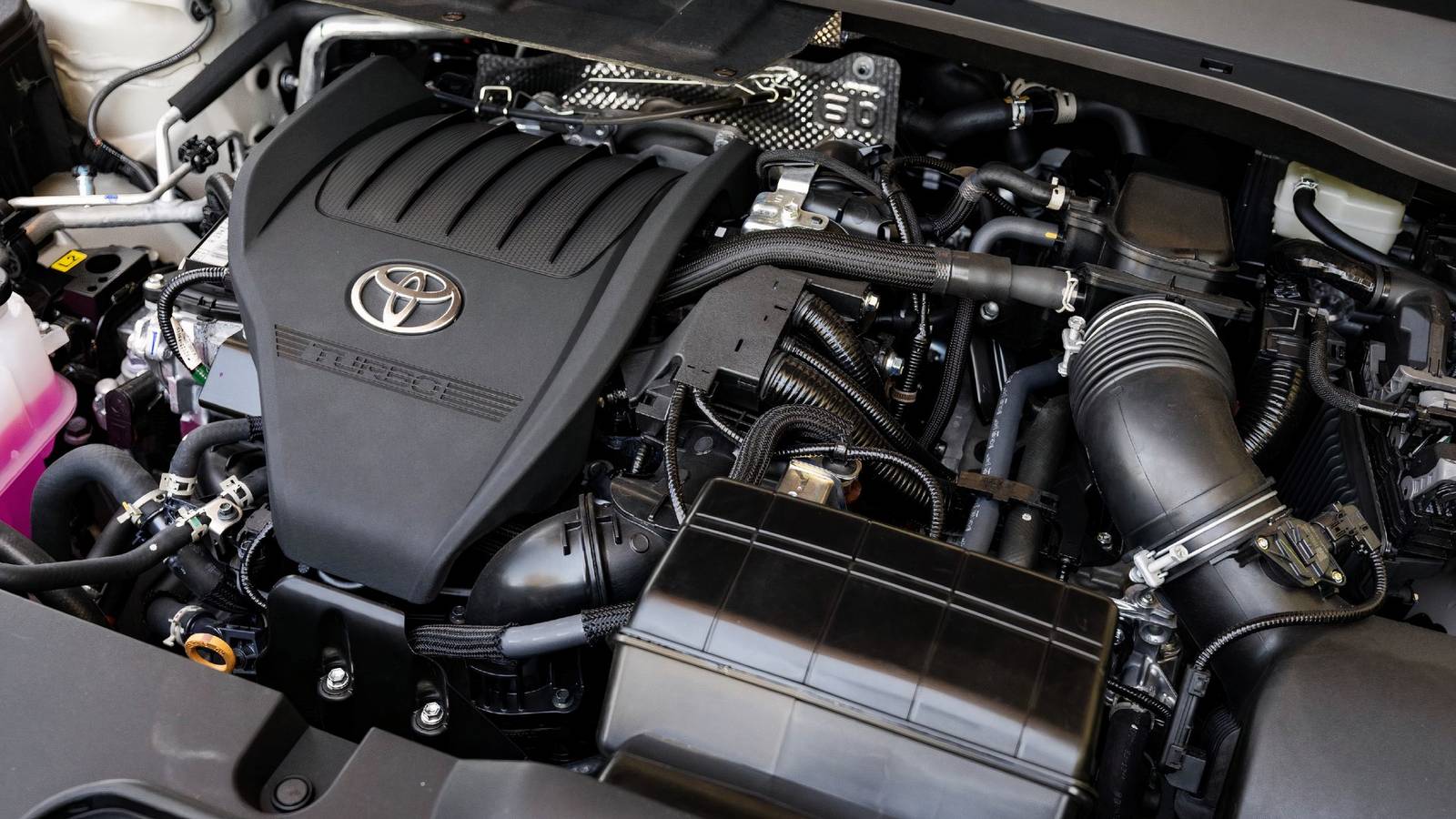
Toyota has managed incredible global success for decades because of one simple thing: the quality and efficiency of its engines. In 2017, Toyota, the largest automaker in the world, debuted its current-generation engine family, the Dynamic Force Series. This latest addition falls under the brand’s New Global Architecture, which is a modular platform meant to simplify the underpinnings of its vast vehicle line-up.
And simplify they did, as what was once a selection of about 800 engine variants has now been cut down to about 20 Dynamic Force engines. So far, there are only inline-three, inline-four, and V-6 Dynamic Force engines available. Yet, how does Toyota’s current slimmed-down engine line-up compare to its rivals? Let’s break down the key details.
Thermal Efficiency Is Everything

Nothing is more critical to an engine’s overall performance than thermal efficiency, whether your goal is power or fuel economy. An average modern combustion engine can typically achieve about 35 percent efficiency, and that is considered good. Toyota’s first Dynamic Force Family engine, the 2.5-liter A25A-FKS inline-four, achieved 40 percent, and its hybrid counterpart exceeded that at 41 percent. Those are not good figures, but rather, amazing ones.
The Growing Efficiency Of Engine Technology

To really put thermal efficiency in perspective, a Nissan study described how it took almost 30 years of development to go from 30 percent efficiency to 40 percent efficiency. Thermal efficiency of 50 percent has been achieved by modern combustion engines, but only functioning as a generator for an electric battery. This lean combustion method is achieved by restricting the engine’s operating range to a “fixed-point” and designing the entire engine to further optimize that exact RPM. Recent developments have continued to demonstrate that achieving greater than 60 percent is very much possible for a generator-style combustion engine as we adapt and optimize all the available avenues of efficiency.
The Efficiency Limits Of Pure Combustion Engines

As far as pure combustion platforms are concerned, Toyota’s Dynamic Force Family is still the benchmark at about 40 percent efficiency. Consider that this figure and technology were introduced back in 2018, and we have had seven years of development since. Recently, as of 2024, Chinese automakers Geely and BYD both announced hybrid combustion engines with thermal efficiency figures exceeding 45 percent. Although these figures are still unverified, and we won’t be receiving vehicles from either of these brands in the U.S., it goes to show that developments in this field are ongoing. While a figure of 50 percent thermal efficiency is still not guaranteed for a pure combustion engine, it is certainly possible in the future. In 2014, V-6 turbo-hybrid Formula 1 engines started at 40 percent thermal efficiency and became 10 percent more efficient in just six years. The same percentage increase will certainly take longer for consumer combustion engines, but we know it can be done.

Toyota Reportedly Lengthens Generational Cycles To Nearly A Decade: Is It A Good Idea?
Toyota is reportedly lengthening its product cycles, which would make sense since its vehicles have high demand for a very long time.
The Technology Implementation In Toyota’s Dynamic Force Series

Thus, if Toyota’s Dynamic Force engines still stand as the benchmark in efficiency, which technology is Toyota leveraging to achieve these exceptional numbers? Let’s discuss the key contributors.
D-4S Fuel Injection System

One of the most important systems at play in Toyota’s Dynamic Force engines is the D-4S Fuel Injection System. Toyota’s D-4S is a dual direct injection and port injection system that enhances both output and fuel economy by optimizing fueling according to engine load conditions. How it works is that during wide-open throttle and high load conditions, only direct injection is utilized, allowing for increased output and more efficient charging, along with increased compression ratios. However, under low to moderate engine loads, both port and direct injection are utilized, which improves the overall air-to-fuel ratio, leading to greater fuel saving. While dual port and direct injection systems are by no means a ground-breaking technology, no other automaker so far has utilized the technology for the sake of efficiency quite like Toyota.
The Overall Package Is More Important Than Individual Innovations

Of all the technologies implemented on Toyota’s Dynamic Force engines, only one of them was considered a “world’s first” or something that had never been utilized before on a consumer combustion engine. That detail was the specific finishing method of the piston skirt with a laser-applied crosshatch groove pattern that allows for a mirror finish that reduces overall friction and improves scuff resistance. As cool and complicated as that sounds, we’d be surprised if this novel innovation even contributed a percentage to the engine’s overall efficiency standards. Thus, this goes to show that Toyota’s leading efficiency is not achieved by one singular breakthrough or detail, but rather, the quality of the overall technology implemented. From the under-square design to the electric water pump, every feature of Toyota’s Dynamic Force engines has been designed and optimized for fuel efficiency. The impressive part is how well the entire orchestra plays together, rather than any standout solo performance by an individual instrument.

10 Used Hybrids That Hold Their Value Better Than Most SUVs
These models offer superb value over time compared to many of today’s ever-popular SUVs.
How Toyota Dynamic Force Stacks Up To The Competition

While Toyota may be the leader in engine efficiency, there is no shortage of viable alternatives available from rival brands, specifically their perennial rivals, Honda and Mazda, along with their competition across the pond, Kia and Hyundai. How do these alternatives compare to Toyota’s Dynamic Force engines? Let’s break it down.
Honda

Let’s start with Honda. Honda’s most compact and fuel-efficient engine, specifically developed for hybrid applications, is the 1.5-liter Atkinson cycle inline-four. According to Honda, this engine achieves a maximum thermal efficiency of over 40 percent. Compared to the brand’s emblematic 2.4-liter K24 inline-four, this hybrid engine offers more torque output despite a width reduction by more than 12 percent. Honda’s larger 2.0-liter hybrid direct injection inline-four also achieves an amazing 41 percent thermal efficiency, as well as 30 percent more torque when compared to its port-injected 2.0-liter inline-four predecessor.
Mazda

Considering electrification, hybrid adoption, and fuel efficiency, Mazda has been late to the party. Even now, we won’t get a real taste of Mazda’s true home-grown hybrid capabilities until the 2027 debut of the Mazda CX-5 Hybrid. The Japanese brand banked on their “Skyactiv-X” combustion technology to be their saving grace, but that proved to be a mistake. What was supposed to be Mazda’s revolutionary development never even made its way to the U.S. because it was expensive, lacked power output, and wasn’t as efficient as we’d hoped.
Mazda has also tried its hand at adding a rotary engine as an EV generator, as found in the Mazda MX-30 R-EV, but the fact that we don’t get it stateside means there are more questions than answers about this emerging technology.
Hyundai And Kia

Korean automakers Kia and Hyundai have been refining their powertrains’ capability and efficiency with great success within the last decade. Currently, the 2025 Kia Niro is the SUV with the best gas mileage in the industry at 53 MPG Combined, and it’s not even close. The current generation Kia Niro achieves this spectacular efficiency figure thanks to its “Smartstream” 1.6-liter hybrid inline-four. Yet, how does this small engine manage such incredible efficiency without sacrificing performance?
Well, that’s the thing, it does sacrifice performance, and we mean a lot of it. The 139 horsepower produced by this powertrain is just barely enough to be considered functional on U.S. highways, and the 10.8-second zero-to-60 time of the 2024 Kia Niro is slow enough to enrage even the most patient of drivers. As you can see, it isn’t that easy to have your cake and eat it too when it comes to automotive engineering.

Luckily, both Hyundai and Kia offer a turbocharged variant of the Smartstream 1.6-liter inline-four on slightly larger models than the Kia Niro, such as the Hyundai Tucson Hybrid. This turbocharged variant rectifies a lot of the performance issues of the engine at the cost of some efficiency. With 227 horsepower and 258 pound-feet of torque, the Smartstream 1.6-liter turbo still manages about 43 MPG Combined, which is good enough to place vehicles like the Kia Sportage Hybrid at the absolute top of fuel-efficient SUVs.

However, sedans still offer better MPGs than any SUV, and the 2025 Hyundai Sonata Hybrid offers an impressive 47 MPG Combined, thanks to its naturally-aspirated hybrid 2.0-liter inline-four. On the bigger end, the 2026 Hyundai Palisade Hybrid is the automaker’s largest three-row SUV and still manages 31 MPG Combined thanks to a turbocharged hybrid 2.5-liter inline-four, the largest and most powerful Smartstream hybrid available.
Sources: Fueleconomy.gov, Formula 1