
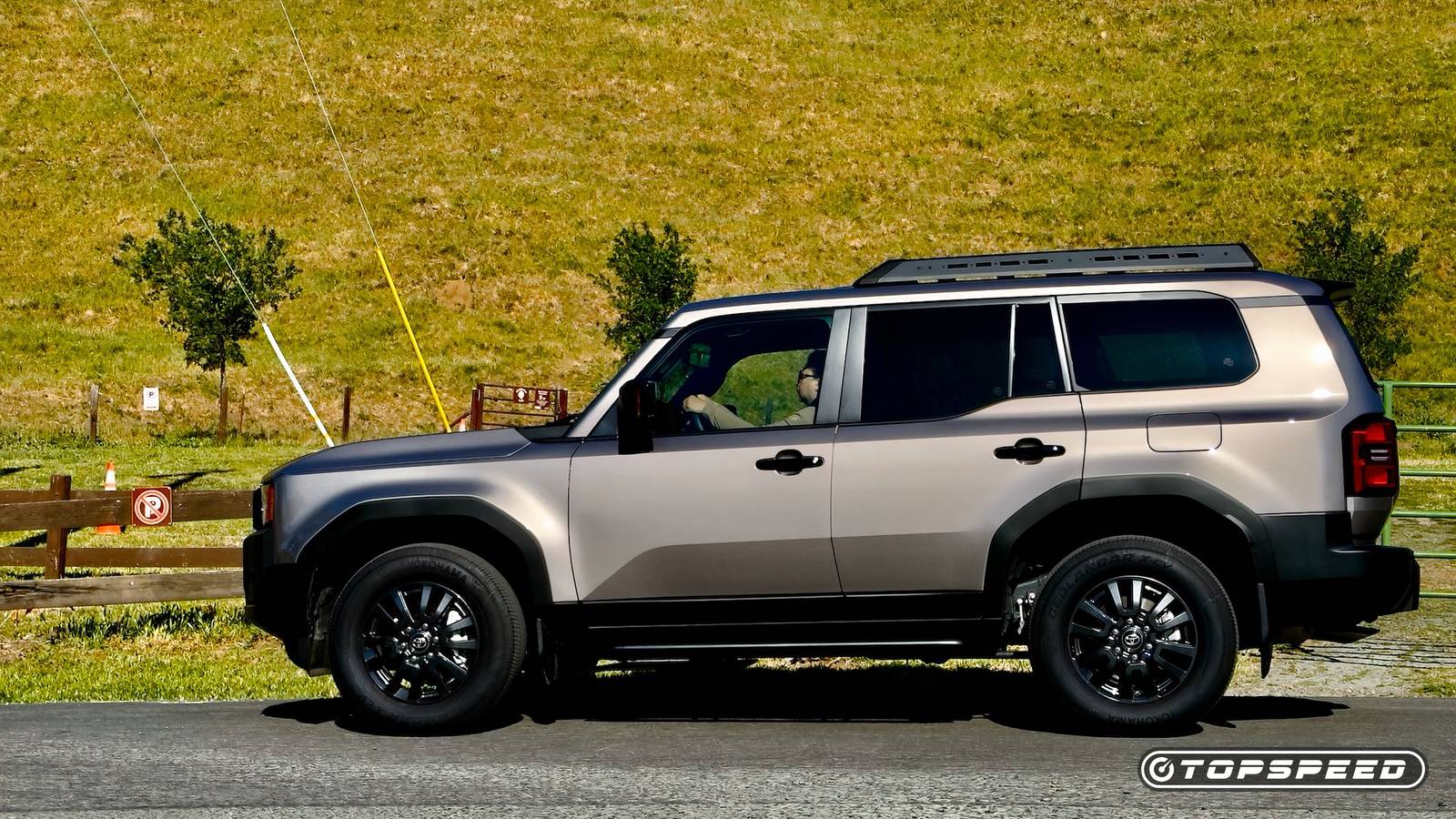
The Toyota Land Cruiser has been making a serious name for itself across the global markets, but in the U.S. in particular, it is proving to win a lot of hearts. As of October 2025, Toyota U.S. confirms that it has sold 37,798 copies of the off-roading-focused SUV, which isn’t a lot by the brand’s standards. Given that it is a relatively niche proposition in its line-up, this is a fairly respectable result, reflecting an 85.7 percent year-on-year sales increase.

- Base Trim Engine
-
2.4L Turbo Hybrid
- Base Trim Transmission
-
8-speed automatic
- Base Trim Drivetrain
-
Four-Wheel Drive
- Base Trim Fuel Economy (city/highway/combined)
-
22/25/23 MPG
- Base Trim Battery Type
-
Lead acid battery
- Make
-
Toyota
- Model
-
Land Cruiser
- Segment
-
Full-Size SUV
A big reason why this model is becoming more popular among the off-roading community in the U.S., is thanks to the gasoline-electric hybrid drivetrain that is proving to be impressively reliable and reasonably inexpensive to own. Toyota is no stranger when it comes to reliability and cost-effectiveness, so the Land Cruiser’s success in this department should come as no surprise whatsoever.
Toyota Builds The Land Cruiser To Last
8.8 For Reliability By iSeeCars

The 2026 Toyota Land Cruiser carries the flag of its predecessors with incredible reliability ratings from both publications and existing owners. iSeeCars issues the hybrid model with an 8.1/10 overall score, which includes 8.8/10 for reliability, 8.5/10 for retained value, and 7.0/10 for safety. On the reliability front, you can expect this model to hold an average lifespan of 14.8 years or 203,517 miles, with a 51.4 percent probability of reaching 200,000 miles without experiencing any noteworthy mechanical faults.
J.D. Power issues the same model with a 76/100 consumer-verified overall score, which includes 73/100 for quality and reliability, 71/100 for the driving experience, 87/100 for resale, and 76/100 for the dealership experience. The 32 existing owners of the model that have taken to Edmunds to submit their reviews award it an average of 4.4/5. Positives include good fuel efficiency, impressive reliability and manufacturing quality, and impressive handling and steering, but it loses some points for poor interior material quality, loud road noise, and bad braking abilities.
Equally Appealing Ownership Costs

On the depreciation side of things, iSeeCars suggests that this model will lose $22,652 or 40 percent of its purchase value within the first five years and 60,000 miles. CarEdge says that you are likely to spend $57,015 on a Land Cruiser over the same period, $21,634 of which accounts for depreciation, $10,045 for fuel, and $2,172 for maintenance and repairs.
According to Kelley Blue Book, the 2025 Toyota Land Cruiser costs $4,483 to maintain every year, after the two-year and 25,000 miles worth of complementary servicing runs out. All expenses, including fuel, insurance, financing, maintenance, repairs, and fees, are likely to square up at $38,635 over five years, excluding $31,375 worth of depreciation over five years.

Tuner Makes New Toyota Land Cruiser Into Even Better Off-Roader
The SUV comes with 37-inch tires, and openings in the fenders make adjusting the pressure a breeze.
Toyota’s Punchy HEV Drivetrain

The highlight of the Toyota Land Cruiser package is the i-Force MAX HEV drivetrain, which consists of a turbocharged 2.4-liter four-cylinder engine, a single permanent-magnet synchronous motor, and an eight-speed automatic transmission. The system sends a combined 326 horsepower and 465 pound-feet to the aforementioned four-wheel-drive system.
Toyota Land Cruiser Performance And Specifications
Efficiency Is Not Its Strongest Suit

On the efficiency front, the Land Cruiser doesn’t quite fare too well, but this is to be expected from a fully-fledged 4×4 SUV. The EPA estimates that this model consumes 22/25/23 MPG on the city/highway/combined cycle and achieves a 412-mile range, thanks to the 17.9-gallon tank and 1.67-kWh battery pack.
With this, the EPA indicates that you can expect to spend $5,000 on fuel costs over the course of five years, which, again, is hefty but not necessarily a surprise. You’ll also find yourself spending $2,600 on fuel every year and $4.33 to drive 25 miles. Expect to spend $71 to fill the tank up.
Toyota’s Complex But Thoughtful Engine Design

Toyota’s compact turbocharged hybrid setup integrates a trusted four-cylinder ICE unit benefitting from a permanent-magnet synchronous motor generator positioned alongside the automatic transmission, sourcing power from a compact lithium-ion battery pack. The Japanese brand’s engineering team prioritizes this design to deal with long-term usage under load and in the harshest of climates.
Toyota builds the engine using an aluminum block and head to cut weight while improving heat dissipation. This block houses a forged steel crankshaft with reinforced connecting rods designed to handle sustained load without deformation, which is critical for intense off-roading events. It also features a chain-driven dual overhead camshafts with variable valve timing to improve thermal management and reduce strain on internal parts.

Oil jets are a crucial part of the design that cool the pistons and strengthen durability during high cylinder pressures. The single turbocharger sits close to the exhaust ports to reduce plumbing complexity and increase reliability by lowering exposure to heat cycles. The hybrid motor’s positioning alongside the transmission housing also benefits the system by reducing wear points, thus allowing for smoother torque delivery that protects the combustion unit during hard acceleration or towing.
Toyota engineers also tune the cooling system with a high-flow water pump, a large surface area radiator, and dedicated heat exchangers for the hybrid components. In doing so, the system benefits from more stable temperatures during slow off-roading work or hot weather travel. The intake employs a high-mounted air path to reduce dust ingestion, and the engine control module uses conservative fuel mapping that prioritizes clean combustion and low stress.

The entire powertrain uses proven Toyota materials and engineering methods, and the combination of moderate boost pressure, thick cylinder walls, and hybrid assistance lowers mechanical load across the system. This design favors reliability because it reduces peak stress, spreads torque delivery across both power sources, and relies on simple heavy-duty components that resist wear, heat, and vibration over hundreds of thousands of kilometers.

The Toyota Land Cruiser Saved My Life—Here’s How
A tall-riding SUV at 70 MPH on the highway can quickly become a handful. Here’s how an evasive maneuver—and modern safety tech—saved my life
Competitive Pricing With Lots Of Features

Toyota only sells two iterations of the Land Cruiser, starting with the base 1958, priced at $57,200 MSRP. This features the heritage circular LED headlights, LED-integrated fog lights, and 18-inch dark gray alloy wheels. Within the cabin, you’ll find the following features as standard:
- A digital gauge cluster w/ seven-inch color multi-information display
- Triple-zone climate control
- Auto-dimming rearview mirror with HomeLink
- Black fabric seat upholstery
- Manually adjustable and heated front seats
- A 2,400-Watt AC inverter
You also only get access to the smaller eight-inch touchscreen infotainment system connected to a six-speaker audio system with wireless Android Auto and Apple CarPlay functionalities. Toyota only offers this model in Black, Meteor Shower, or Ice Cap white exterior paints. You can specify a rear bumper guard for $230 and a liftgate light for $195.

The standard Land Cruiser costs $63,275, but you benefit from standard features such as the more modern rectangular headlights, 18-inch matte-gray alloy wheels, an adjustable power liftgate with jam protection, illuminated entry, Rigid Industries LED color-selectable fog lights, roof rails, and running boards. You also get to enjoy the larger 12.3-inch touchscreen infotainment system with a 10-speaker audio system. Within the cabin, you’ll find:
- An electrically adjustable steering wheel.
- A 12.3-inch digital gauge cluster w/ selectable gauge display screens.
- All-weather floor liners.
- Multi-Terrain Monitor w/ selectable front, side, or rear views.
- Black or Java SofTex upholstery.
- An electronically-adjustable driver’s seat.
- Front seat heating and ventilation.
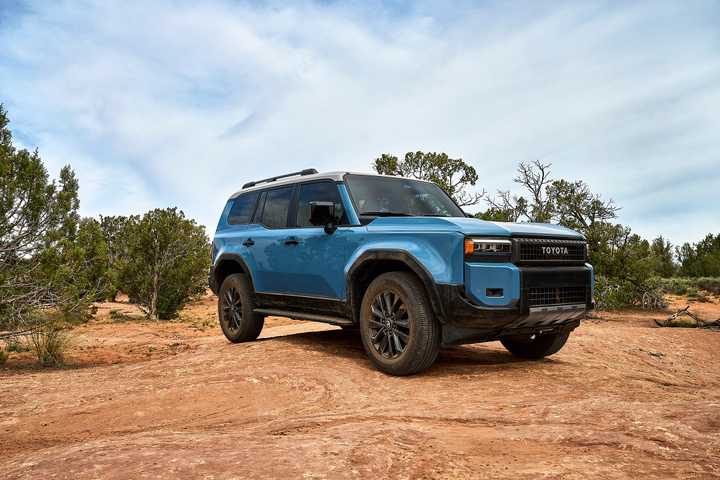
This iteration is a much more vibrant model, as you can also paint it in Underground gray or Heritage Blue exterior paints. If you want to add the two-tone Grayscape and Trail Dust or Heritage Blue paint, you’ll have to pay $350. Wind Chill Pearl costs $475.
The $4,600 Premium package adds the JLB 14-speaker audio system, illuminated entry with illuminated running boards, a Digital Key, sunroof, center console cool box, digital rearview mirror, Qi-compatible wireless charging, leather-trimmed memory driver’s seats, electronically adjustable front seats, and a heads-up display.
For a more pronounced stance, you can equip the 20-inch alloy wheels for $1,240, while a stabilizer disconnect mechanism increases the price by $1,230. Toyota also applies a $1,450 destination fee to all Land Cruiser orders.
Outstanding Safety Standards For An Off-Roader

The brand includes the Toyota Safety Sense 3.0 suite as standard across the entire Land Cruiser range. This convenient system includes:
- Pre-collision system with pedestrian detection
- Proactive driving assistant
- Dynamic cruise radar control
- Lane departure alert with steering assist
- Auto-high beams
- Lane tracing assist
- Road sign assist
The Land Cruiser range also benefits from a dynamic backup camera with dynamic grid lines and front and rear parking assist with autonomous braking. In the event of a collision, all inhabitants are protected by a collection of nine airbags located at the fronts, sides, and curtains, with front knee protection as well.
Thanks to this, the NHTSA awards the model with a 4/5 rating on the frontal crash test, 5/5 for the side crash test, and 3/5 for rollover, resulting in a 4/5 overall safety rating.
Sources: iSeeCars, NHTSA, EPA, Edmunds, CarEdge, J.D. Power.