
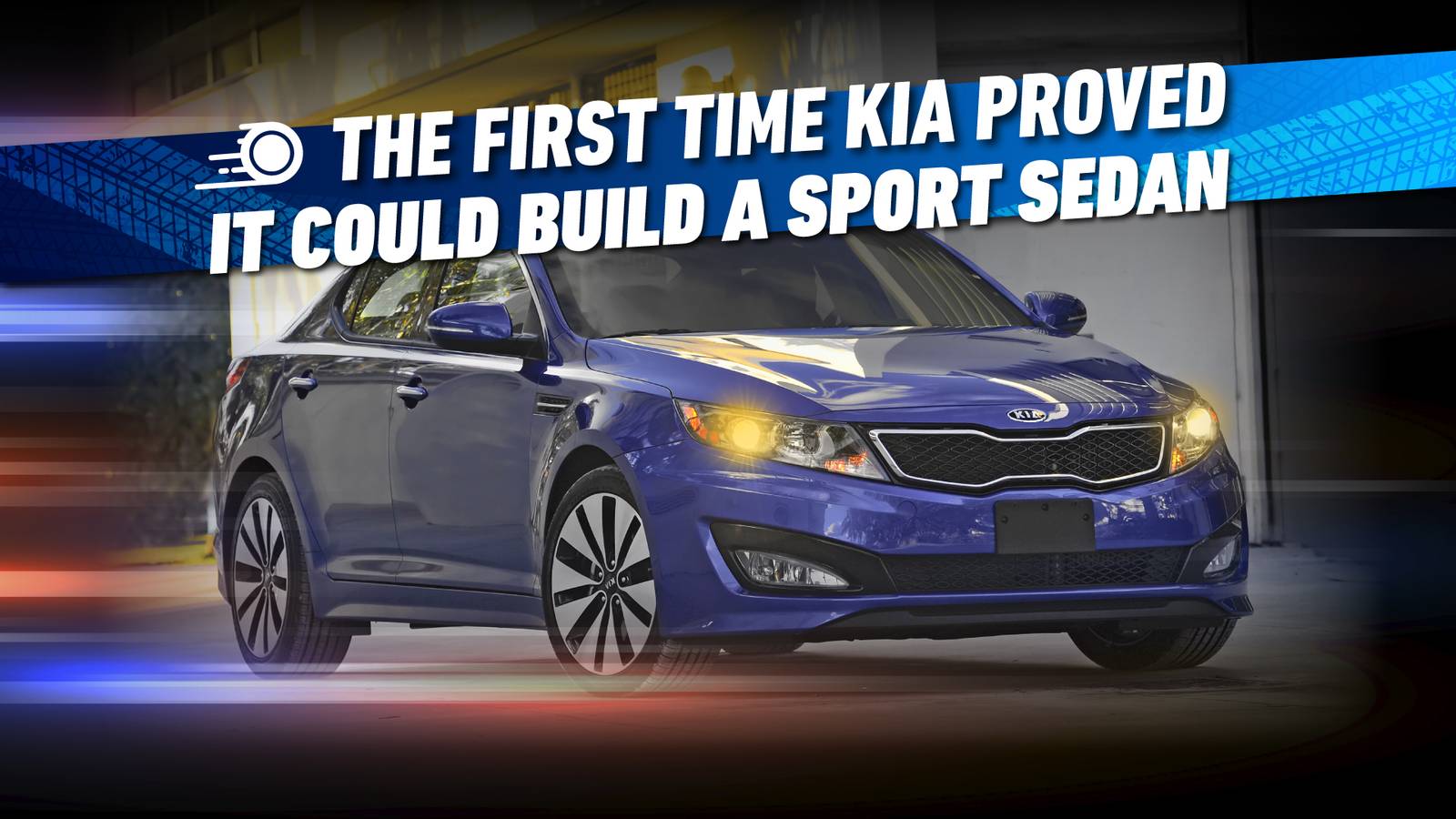
Kia’s youthful swagger didn’t spring fully formed with the Stinger. A little earlier, when shoppers were still figuring out whether Kia meant “cheap commuter” or “actually trying,” the Optima SX Turbo quietly did something important: it dressed a mainstream midsize sedan in performance clothes and then taught it to box above its weight class.
The Kia Optima SX Turbo wasn’t a halo car in the Lamborghini sense, but it was Kia’s first real wink to drivers who wanted punch, poise, and a little attitude without the luxury tax. Here’s why the SX Turbo deserves a spot on the shortlist of surprising sporty sedans from that era — and why it foreshadowed Kia’s later, bolder moves.
What The Optima SX Turbo Packed Under The Hood (And Why It Mattered)

The Kia Optima SX Turbo ran from MY 2011 – 2020. All things being equal, that’s a solid run. In many ways, the Optima Turbo’s success is foundational to the argument that it paved the way, or, at least, was a part of the warm-up for Kia’s spicy side. And more than any other aspect, the Optima Turbo’s engine was what made it special.

The headline numbers are what got people to look twice: a 2.0-liter, direct-injected turbocharged four-cylinder that produced 274 horsepower and 269 pound-feet of torque. This was a massive jump up from the regular Optima, making over 70 fewer horsepower and even less torque. This isn’t to say that the Optima SX Turbo is a race car, but that extra torque comes on very low in the rev range, making the Optima feel urgent around town and eager on the highway. Kia’s own specification sheet and contemporary road tests confirmed the engine’s outputs and its placement as the sporty heart of the SX line.
2011 Kia Optima SX Turbo Basic Specs
|
Engine |
2.0-liter turbo inline-4 |
|
Horsepower |
274 |
|
Torque |
269 lb.-ft. |
|
Transmission |
6-speed shiftable auto |
|
Driveline |
FWD |
Power Delivery And Performance Reality

Numbers are one thing; how the car actually behaves is another. Independent tests of the 2011/2013 SX Turbo showed 0–60 mph times in the mid-six-second range, which, for a front-wheel-drive midsize sedan at the time, was genuinely brisk. The turbo’s torque band — strong from roughly 1,750 rpm and sustained through the midrange — made the Optima feel quicker than its curb weight (3,553 pounds) implied and easy to hustle without constantly wringing the engine out. That immediate shove is part of why drivers who dismissed Kia as merely economical started paying attention.

This ’90s Coupe Came With A Twin-Turbo V-6, But Nobody Bought It
An exciting sports coupe from the 1990s had an excellent twin-turbocharged V6 engine under the hood, but nobody noticed it. Why is that?
The Kia Optima SX Turbo Was More Than Just A Fast Engine

If the SX Turbo had only been a fast Optima, it would still have been a headline. What made it feel purposeful on the road was the hardware Kia bolted on to match the power.
Sport-Tuned Suspension And Braking

The SX trim came with a noticeably firmer suspension setup compared with the base 2.4-liter models: firmer dampers and tuning that prioritized body control over cushy compliance. As Car & Driver mentioned when the car first came out, that tradeoff means a firmer ride over broken pavement, maybe even harsh, but it also produced flatter corners and a confidence-inspiring chassis when roads get twisty. Kia also fitted larger front discs and uniquely finished 18-inch wheels, and reviewers at the time noted black-painted calipers and stiffer damping that combined to sharpen the car’s responses.
Steering And Transmission: Paddle Shifts And The Perception Of Control

Kia equipped the SX with steering-wheel paddle shifters paired to a six-speed automatic that offered a Sportmatic manual mode. The paddles didn’t turn the Optima into a dual-clutch rocket, but they gave the driver something tactile to do — hold a downshift into a corner, or snick a gear on the exit. Combined with the sportier steering ratio, this made the SX feel more involving than the average family sedan of the day.

10 Practical Cars That Are Secret Sports Car Killers
Sports cars advertise their performance, but some cars are more covert about their unfettered power
The Kia Optima SX Turbo Wasn’t Overly Pretty, But It Was A Start

You can’t sell sporty without looking sporty. The Optima’s K-design lines were already a departure from closet-case sedans; the SX added HID headlights, LED taillights, a more “aggressive” body kit, and 18-inch alloys with low-profile tires. Inside, touches like metal pedals, unique leather-weave upholstery, and the Supervision instrument cluster gave the cabin a more performance-oriented personality than the trim level suggested. These visual cues mattered: they told buyers Kia wasn’t just offering value — it was offering just a touch of something other than plain.
Efficiency Plus Oomph: The Turbo Paradox

One of the most interesting things about the SX Turbo was how it balanced fun and fuel economy. Kia and reviewers of the time pointed out that despite the engine’s output, EPA city/highway figures were competitive, and real-world returns could be respectable if you kept your right foot in check. That duality (sport when you want it, commuter when you need it) made the SX a practical performance proposition for buyers who wanted a single car to do both jobs.

The Used 3-Year-Old Korean Hybrid SUV Worth Buying Today
The Korean auto industry is rapidly catching up to Japan in terms of quality, and this SUV shows why.
How The Optima SX Turbo Foreshadowed Kia’s Sport Future

The SX Turbo was not an endgame for Kia; it was a statement. By putting a high-output turbo in a mainstream sedan, fitting it with sports suspension, and dressing it to look the part, Kia signaled that it could build credible performance hardware and tune it to be usable in everyday life. Those lessons — about packaging, perceived value, and the emotional lift of sporty design — are the same moves the brand doubled down on with later models, culminating in cars like the Kia Stinger that aimed directly at performance-luxury buyers.
Points Of Friction: Why Some Critics Still Raised An Eyebrow

Of course, the SX Turbo wasn’t perfect. The firmer ride alienated buyers who prioritized the comfort of the regular Optima, and some testers found the steering heavy and a touch numb at times. Turbocharged front-wheel drive always risks torque steer and drivetrain drama, but reviewers generally agreed Kia did a neat job of controlling those tendencies. Also, while the paddles and Sportmatic mode added engagement, the six-speed still couldn’t match the crispness of truly sporty dual-clutch gearboxes. These flaws didn’t negate the Optima’s strengths; they just kept it honest.

Mazda’s Forgotten Masterpiece: A 2000s Icon Revisited
With big power in an affordable and practical package, the Mazdaspeed3 was a hot hatch ahead of its time, and here’s why it deserves a comeback.
Where The SX Turbo Sits Today: Value And Appeal For Buyers

As a used buy, early-2010s Optima SX Turbos represent an interesting value proposition: you can get near-luxury performance hardware at a non-luxury price. That makes them appealing to drivers who want a sporty character without the depreciation hit or sticker shock of a luxury sports sedan. Like any turbocharged used car, maintenance history and care matter — but properly kept examples deliver a lot of car for the money.
An Honest And Surprising Sport Sedan

Call the Optima SX Turbo an appetizer on the menu that eventually included the Stinger. It showed that Kia could engineer a car that combined real boogie, competent chassis dynamics, and styling that read sporty in the driveway. For drivers who remember the era when Kia was quietly climbing the credibility ladder, the SX Turbo is the model that said: we can do performance, too — and we’ll make it sensible. That willingness to surprise is what shifted Kia from a practical also-ran to a brand people started to take seriously. If you want a compact (well, midsize) reminder that sporty doesn’t always mean ostentatious, the Optima SX Turbo is worth a test drive.
Sources: The EPA