
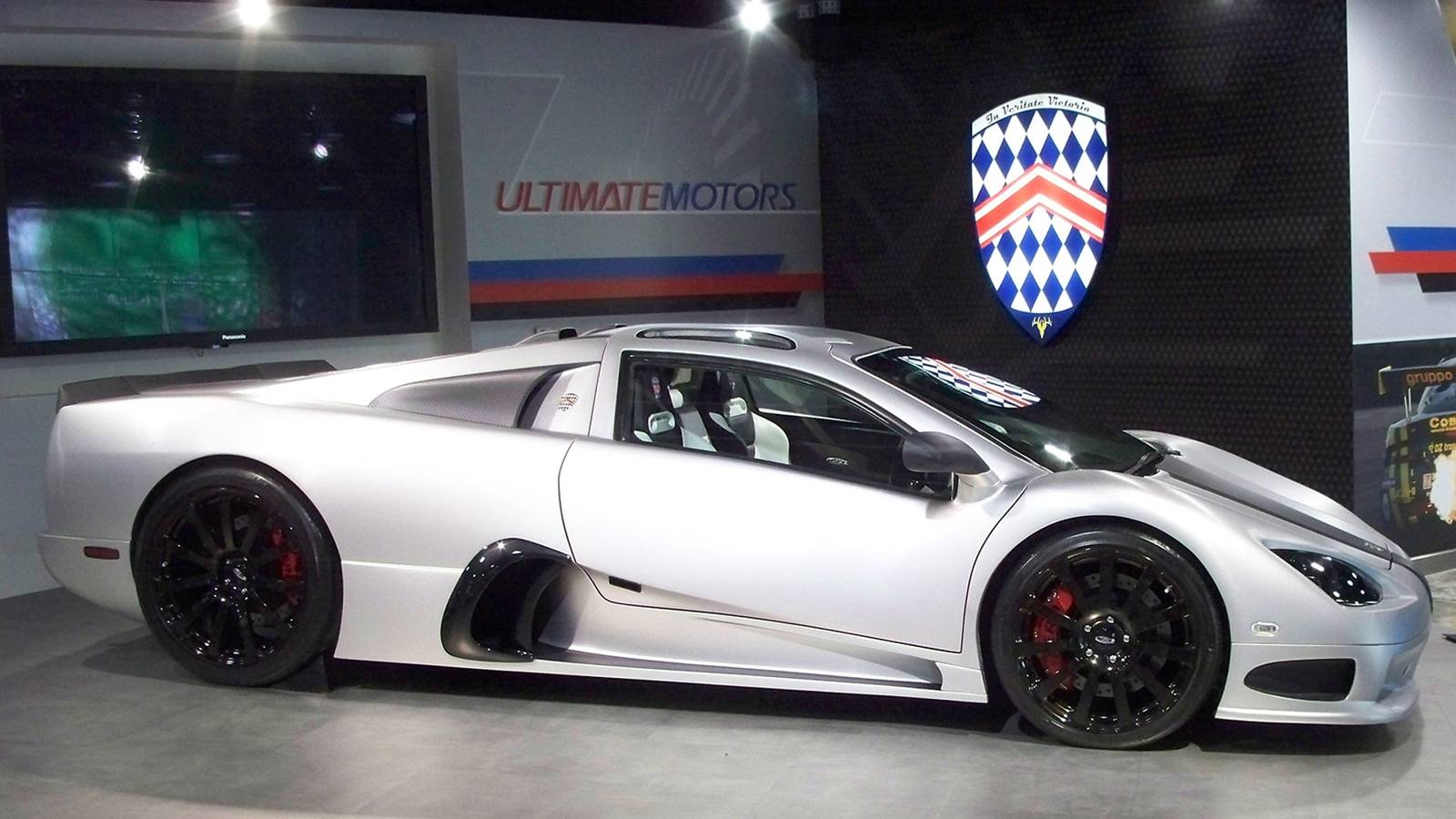
When we think of American supercars, we conjure images of the Hennessey Venom F5/GT, Ford Mustang GTD, and Chevy C8 Corvette, to name a few modern-day heavy hitters. However, there exists another model from a much smaller firm that had a major influence on future supercars coming out of the United States and abroad.
SSC North America, a Washington-based high-performance car manufacturer, has been developing record-breaking machines since the late 1990s, with one of their early models going head-to-head with the indomitable Bugatti Veyron. And while it didn’t hold on to the 0-60 MPH record for long before the Veyron’s quad-turbo W-16 engine launched the million-dollar supercar at blistering speeds, it did have an impact on American performance tuning and design that is still relevant to this day. Let’s check it out!

The Fastest Supercars In The World, Ranked
Packing some truly astounding performance numbers, these physics-defying supercars are capable of insane speeds and these are the fastest ones to date
The SSC Ultimate Aero Was The Fastest Car From 0-60 MPH For A Short Time

SSC North America is a company founded by Jerod Shelby (no relation to Carroll Shelby) in 1998, and was originally named Shelby Supercars Inc. Though the upstart American supercar manufacturer wasn’t keen on riding the iconic Carroll Shelby’s coattails, nor battling it out in court for the trademark, so the company’s name was changed to SSC North America in order to distinguish their products and company’s esteem from the high-performance muscle car tuner. SSC North America’s first production model to roll out was the Ultimate Aero, a sleek supercar with unheard-of ability.
2007 SSC Ultimate Aero Specs
|
Engine |
Supercharged 6.3-Liter V-8 |
|
Horsepower |
1,183 Hp |
|
Torque |
1,093 Lb.-Ft. |
|
Redline |
7,200 RPM |
|
Transmission |
6-Speed Manual |
|
Driveline |
RWD |
|
0-60 MPH |
2.78 Seconds |
|
0-100 MPH |
11.66 Seconds |
|
Top Speed |
260–273 MPH (mfr. est.) |
|
1/4 Mile |
9.90 Seconds @ 144 MPH |
|
Dry Weight |
2,750 Pounds |
|
Coefficient of Drag (Cd) |
0.357 |

The SSC Ultimate Aero featured a brawny supercharged LS-based V-8, which was capable of an impressive power – 1,183 horsepower at 6,950 RPM to be exact. The lightweight carbon body and incredible aerodynamics allowed the Ultimate Aero to reach speeds of 279 MPH, while wind tunnel test estimates hinted at more.
The production model became a springboard for SSC and American supercars in general, in that it delivered the United States’ first real answer to the foreign supercars that dominated the upper echelon of modern performance. This isn’t to discount the groundwork laid by models like the Ford GT that came around the same time as the Ultimate Aero, just that the Ultimate Aero aimed to dominate beyond the racetrack acclaim of the Blue Oval.
The SSC Ultimate Aero Changed The Face Of American Performance

While there were numerous models, including the Chevy Corvette and Dodge Viper, that dialed up the intensity in terms of performance, they all bore the quintessential American performance features, like a long hood with a large engine under it, conventional opening doors, and muscular contours.
When the SSC Ultimate Aero hit the scene, it looked like something flown straight from an Italian facility, with a short, slanted nose, butterfly doors, and a sleek, exotic attitude that would go on to challenge the global supercar supremacy, which hosted brands such as Ferrari, Porsche, Lamborghini, and Bugatti, the latter of which would duke it out with SCC for the better part of a decade.
The Ultimate Aero’s Brief, But Impactful 0-60 MPH Record Run

The SSC Ultimate Aero was able to sprint to 60 MPH from a standstill in 2.8 seconds, which, in 2005 when it ran this time, was enough to earn it the title as fastest car from 0-60 MPH in the world. Unfortunately for the Ultimate Aero, there was a European machine on the horizon that was poised to set the standard for speed, and would soon take the title from the American supercar. That model? The Bugatti Veyron, a ferocious vehicle that still strikes fear in the hearts of many supercar manufacturers.
The Bugatti Veyron, which ran from 0-60 MPH in 2.5 seconds later in 2005, would go on to become the pinnacle of performance for the next decade, and would quickly overshadow the SSC Ultimate Aero’s acclaim in less than one year. The Veyron packed a quad-turbo 8.0-liter W-16 engine in its bay, and sent power to all four wheels via a seven-speed dual-clutch auto transmission.

Plus, it had a specialized launch control feature, which, when paired with the aforementioned boons, afforded the Bugatti more power, control, traction, and torque delivery than the Ultimate Aero, which employed a supercharged 6.3-liter V-8, RWD, and a five-speed manual transmission at the time of its record-setting run.
While its star was short-lived, the Ultimate Aero showed the record-setting potential of modern American tuners, and opened the door for firms like Hennessey, and later on Czinger, to expand on their ideas and push their high-performance product into the mainstream. Also, models like the Saleen S7, which came before the Ultimate Aero, were able to gain some attention thanks to the growing global and domestic interest in American supercars.

The Ultimate Aero Evolves

While its 0-60 MPH record was set, and then promptly swiped, that didn’t stop SSC from chasing the peak of performance. In 2007, the Ultimate Aero would return with twin-turbocharged trim (TT) and snag a Guinness World Record, this time for top speed, for which clocked an average of 256.14 MPH. This was enough, even if marginally, to top its rival, the Bugatti Veyron, whose unofficial record sat at 253 MPH. This earned the SSC Ultimate Aero TT the title of the fastest production car in the world, knocking off the official Guinness World Record of 242 MPH set by the Koenigsegg CCR prior.

While an impressive figure, and enough for a world record plaque, SSC claimed the Ultimate Aero TT could go even faster! Through wind tunnel tests and some big-brained supercar maths, SSC engineers estimated the Ultimate Aero would be stable at speeds of up to 273 MPH.
SSC enjoyed the ‘fastest production car’ title for a solid three years, until Bugatti came knocking once again – this time with a juiced-up Veyron they called the Super Sport. The Bugatti Veyron Super Sport was able to top the Ultimate Aero TT’s top speed by more than 10 MPH, with a final speed of 267.9 MPH, taking the speed title from SSC once more.
Ultimate Aero TT Upgrades In All Departments

The Ultimate Aero TT’s record-setting ability was thanks to the upgrades it underwent in 2007, when SSC introduced the twin-turbocharged Ultimate Aero. Using SSC’s proprietary twin-turbo design allowed the Ultimate Aero TT to far surpass its original design specifications in all areas, producing a domineering 1,183 horsepower and 1,094 pound-feet of torque, and making it the most powerful production car at the time. While the heart of the Ultimate Aero TT is impressive, the lightweight carbon body and finely-tuned chassis are also key players in the vehicle’s overall ability, with a larger focus on precision handling and driving dynamics, as well as power, taking the TT over the limits.
‘What’s all that power if you’re not comfy?’ A thought that may have crossed the good folks at SCC North America’s minds when designing the cabin of the production version of their supercar prototype. Standard cabin features include supple leather and suede surfaces, custom Recaro seats, a premium sound system, GPS, a backup camera, and a cab-controlled suspension lift system.
The Ultimate Aero’s Last Hurrah!

After almost a decade of record-worthy performance, the final version of the Ultimate Aero, the XT, arrived with a new powerplant that, once again, upped the ante. The SSC Ultimate Aero XT featured a twin-turbo 6.9-liter V-8 that pumped out 1,300 horsepower and 1,004 pound-feet of torque.
Paired with a seven-speed SMG triple-clutch paddle-shift transmission, SSC theorized the Ultimate Aero XT could reach speeds of 273 MPH. The XT featured a few features that were set to appear on the upcoming Tuatara, which is a record-setting model in its own right, and it ran a very limited production of only five examples.

How An American Supercar Outperforms Pricey Rivals Against All Odds
This American supercar may cost less than some of its European counterparts, but that doesn’t mean it is any less of an adrenaline-inducing weapon.
Modern-Day Acclaim

The SSC Ultimate Aero will forever be a part of speed history, with its influence and innovation still making an impact in today’s top-speed community. That said, it never gained the full-on prestige its record-setting performance deserves. In fact, in 2018, there was an offer for a used SSC Ultimate Aero TT with less than 2,000 miles for more than 50 percent of its MSRP.
In 2021, the 2007 Ultimate Aero TT with chassis #001 was set to go for $400,000 at auction; it’s still listed as ‘Not Sold’, which is a shame, as it’s a literal piece of history. While its price doesn’t dictate its value, it shows a general disinterest in the model, with European rivals, including Ferrari, McLaren, Bugatti, and more all still pulling in a premium for their high-performance models. In other words, you won’t find a rare top-spec Ferrari for anything less than double its MSRP.