
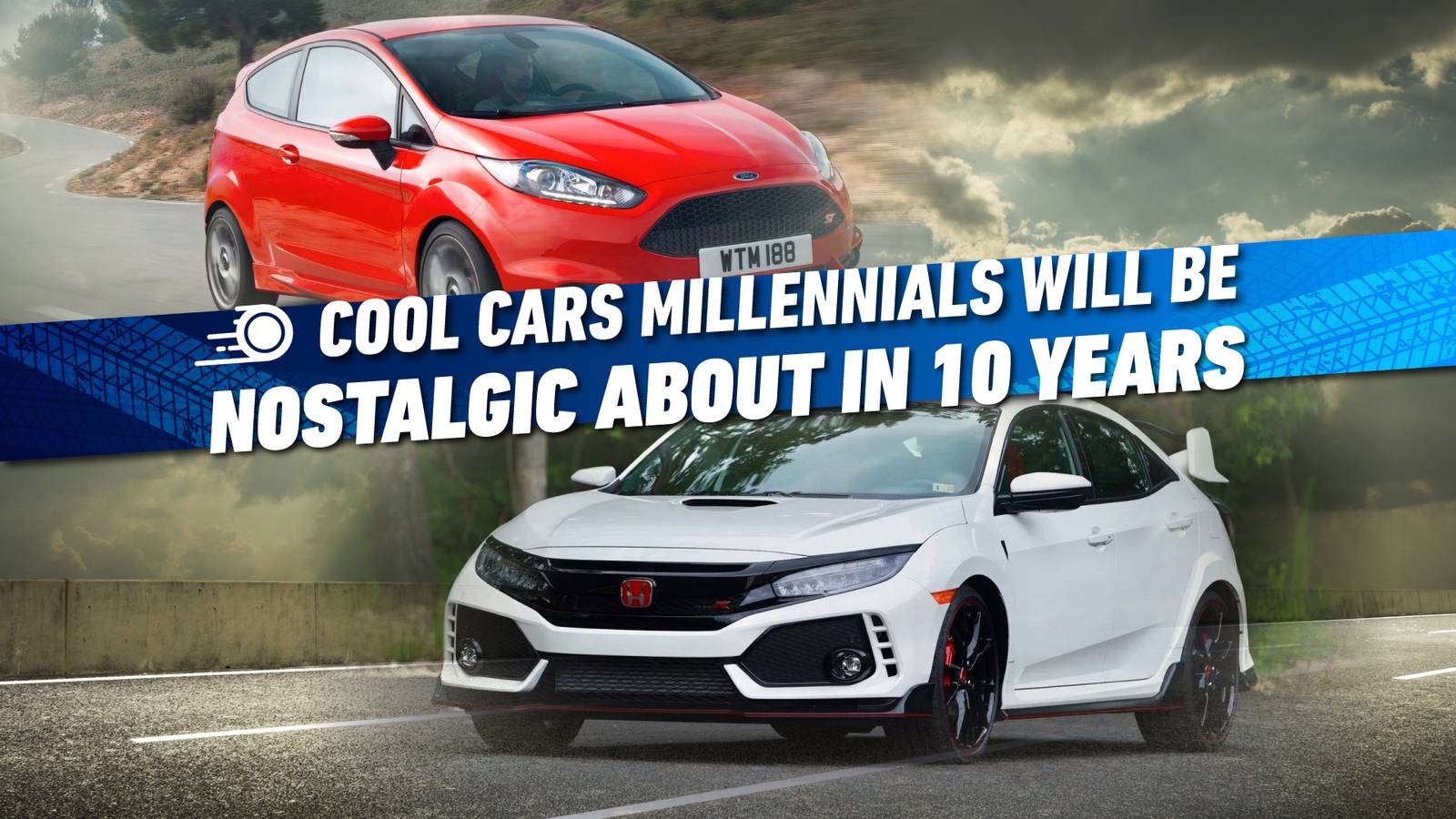
People love to reminisce about ‘the good old days’, when times were always simpler and more vibrant. This is especially relevant in car culture. Despite amazing current technology and performance, we currently spend a lot of time romanticizing the style of the 80s, 90s, and even the early 2000s.
Scarily, in a decade’s time, millennials will be middle-aged, and they too will be explaining how the SUVs, hatchbacks, and sports cars of their day were better. These 10 cars will be sure to evoke this inevitable feeling.
Ford Fiesta ST (2012)
Average Used Price: $10,000

Ford decided to pull the plug on the Fiesta in July 2023, leaving this iconic hatchback destined to become a memory. But what a memory this car will be. The 2012 iteration of the Fiesta ST, introduced initially in the UK, completely set the benchmark for hot hatches, surpassing rivals such as the Peugeot 208 GTi, Volkswagen Polo GTI, and the Vauxhall Corsa VXR.

It was powered by a 1.6-liter turbocharged engine with 180 horsepower and produced a deeply exciting driving experience. The power was combined with sporty suspension, upgraded brakes, and a 15-second ‘overboost’ function that briefly increased power. And yet, it had all the same sensible practicality as a standard Fiesta, achieving over 30 mpg. Although the ride was firm and the interior a little plain, the Fiesta ST was the hot hatch to have. It went on sale in the U.S. in 2014. This car is the millennials’ equivalent to the fast Fords of previous generations and will stir up just the same nostalgia and excitement.
|
Strengths |
Weaknesses |
|
|
Mazda MX-5 (NC)
Average Used Price: $14,000

Speaking of an analogue driver experience, this is completely synonymous with the Mazda MX-5 — the biggest-selling two-seat sports car of all time. As cars become ever bigger and accumulate more screens, this happy little roadster will always represent freedom in its simplest form. The NC, released in 2006, will also be remembered fondly by millennials as the ultimate, attainable sports car.

This car had an option of a 125-horsepower 1.8-liter or a 158-horsepower 2.0-liter in-line four. It brought more refinement and comfort than its predecessors, and for the first time, you also had the choice of a soft-top roadster or a Coupé Cabriolet. Wind-swept hair was now at the push of a button. The NC cost $20,995 when it was new, but the low price did not mean anything was missing. It darted into corners with precision, sang with its high-revving engine, and generated a joyful driving experience. There are fewer happier cars than the MX-5. The styling even makes it look like the car is smiling, just as people will be remembering it.
|
Strengths |
Weaknesses |
|
|
Tesla Model S
Average Used Price: $14,000

This was the first fully independent car that Tesla made — not just an electrified Lotus Elise. It was the car that caught the big brands off guard and forced them to quickly catch up, being a vital turning point for EVs. The concept wasn’t revolutionary. It had a 100-kW battery pack powering two electric motors that would drive all four wheels. The drivetrain, however, was very practical, allowing for a low center of gravity and abundant boot space.

But most importantly, the game changer was the Model S‘ performance. The base model has 661 horsepower and could do 0–60 mph in 3.1 seconds, easily beating Ferraris and Porsches off the line. They even made a Plaid Track Package, which has 1,020 horsepower and does 0–60 mph in 2.1 seconds. This addictive, instant acceleration is even more impressive for a quiet, four-door saloon. With an average range of 300 miles (depending on the self-control of your right foot), the Tesla Model S still holds its own as a practical daily car 12 years later. As time passes and EVs evolve, the Model S will be remembered for being the pivotal point that proved electrification is a viable and even desirable option for motorists.
|
Strengths |
Weaknesses |
|
|
Jeep Wrangler (JK)
Average Used Price: $18,000

This is the ultimate all-American heavy-duty off-roader, and a car that any millennial will remember as synonymous with their younger freedom. It had solid front and rear axles (being one of the last SUVs to do so) and an old-school body-on-frame design, along with a switchable low-range transmission and great general ground clearance.

It never had the all-around appeal of a Range Rover or a Toyota Land Cruiser; upon release, its 3.8-liter V6 was underpowered and thirsty, and the ride was too firm to traverse regularly onto tarmac. The Wrangler JK, however, was never meant to. Instead, it unashamedly maintained its rugged, World War Two Willy’s Jeep appeal. It embraced the ability to be fantastic on rough terrain and to be the car to hang out of with the wind in your hair while driving along a beach. The era of the Wrangler JK coincided with the boom of Instagram, and millennials were taught that this was the machine for any adventure.
|
Strengths |
Weaknesses |
|
|
Toyota GT86
Average Used Price: $20,000

The GT86 is not the quickest of cars. It has a modest 2.0-liter four-cylinder Boxer engine and has underwhelming low-end torque. It also isn’t the most practical; the interior is noisy, and there is very little room in the back seats. It was designed, however, to be one of the very best driver’s cars, utilizing a very basic formula of fun rear-wheel drive, a manual gearbox, and high-end torque to pack just enough of a punch. It worked.

The handling is well-balanced and precise with plenty of feedback through the steering wheel, and moreover, the driver-focused aspect is truly felt with its low-slung seats and all the dials that are angled directly towards you. Still holding a standout aspect over a decade later, the Toyota GT86 will be remembered for perfectly defining the golden age of analogue driver involvement.
|
Strengths |
Weaknesses |
|
|
Dodge Challenger SRT Hellcat
Average Used Price: $30,000

This car was refreshing — in an era where hybrid and turbocharged engines were becoming the norm, the Challenger Hellcat unapologetically had a 707-horsepower supercharged V8 and was the most powerful muscle car you could buy, being even more powerful than a Lamborghini Aventador.

It was also less than one-sixth of the price, offered comfort on the road, four seats, and was a refined enough car to live with. But what truly makes this car such a staple among millennials is the internet culture it created. The Dodge Challenger Hellcat has such a sense of lovable ‘hooniganism’ that is still so often captured. The blend of monstrous power and (relative) attainability led to countless viral moments involving a whining supercharger and a lot of tire smoke.
|
Strengths |
Weaknesses |
|
|
Honda Civic Type–R (FK8)
Average Used Price: $35,000

The bold styling from every angle of the FK8 Civic Type-R divides opinion but is very memorable. It doesn’t look like a conventional hot hatch due to being low down and lengthy like a saloon. Nor does it drive like one, because the 316-horsepower FK8 does 0–60 mph in 5.7 seconds. Its 2.0-liter turbocharged four-cylinder engine is the same as the FK2, but the 295 pound-feet of torque is spread more throughout the rev range. All of this created the quickest front-wheel-drive car that the world had ever seen, and its abundance of grip made the concept of FWD desirable again, as it was sparse throughout the 2010s.
On the track, we found the Type R to only exhibit very mild and predictable understeer at the limit. Otherwise, the car tracks straight and true, offering a fun-filled and safe driving experience. Adding to that is the lightweight clutch and silky smooth six-speed shifter.
– Mark McNabb, TopSpeed Journalist

Just like its early ancestors from the 1990s, the fifth-generation Civic Type-R will generate nostalgia in years to come, and now on a bigger scale, as the FK8 was also the first Type-R to be sold in the US. It truly is one of the best hot hatches of the century, continuing the legacy of attainable fun, outright speed, and punching well above its weight.
|
Strengths |
Weaknesses |
|
|
BMW M2 (F87)
Average Used Price: $38,000

The BMW M2 was a new name, but at a time when its big brother, the BMW M3, was getting more expensive and complicated, it became very deserving of its M badge. The early N55-powered cars, released in 2014, were somewhat underwhelming. But in 2018, this all changed with the release of the Competition, which had a much punchier 404-horsepower S55 engine and revised suspension.

This car kept the classic formula alive: a straight-six sending power to the rear, and the option of a proper manual gearbox. It shares much of its DNA with the E30 BMW M3 but also carries over the lovable lunacy found in the BMW M1. The first M2 will be remembered for being a compact performance car that felt raw, playful, and mechanical when everything else was getting bigger and quieter. It truly resembles the small M cars of the 90s and early 2000s. Only this time, the millennials were old enough to have one.
|
Strengths |
Weaknesses |
|
|
Jaguar F-Type
Average Used Price: $40,000

This car is a modern interpretation of one of the most beautiful, iconic cars ever made — the Jaguar E-Type. However, the F-Type will certainly have its own nostalgia aspect in years to come. Functionally, there are better coupes (and convertibles for that version), especially considering that the price when new was in Porsche 911 territory at around $80,000.

But any inadequacies are quickly made redundant by the F-type’s aggressive, yet sleek styling and intoxicating engine note. There were two engine options for this car: a 2.0-liter four-cylinder turbocharged engine or a 5.0-liter supercharged V8. Its V8 makes the sound of a literal Jaguar when it’s displeased. These distinctive characteristics are what will make the F-type memorable, especially in years to come after Jaguar’s recent rebranding. From what we currently know, future Jaguars will have a completely different ethos, making the F-type one of the last charming characters of an old brand.
|
Strengths |
Weaknesses |
|
|
Lexus LFA
Average Used Price: $700,000

Released in the US in December 2010, it had taken Lexus 10 years to complete the LFA. By this time, its Formula 1-inspired V10 was completely out of date. But what they did was create (from scratch) one of the most memorable cars of this century, the ultimate Japanese supercar, and an all-time great. The wait was worth it, especially considering it was down to an immense attention to detail. The body, for example, is 65 percent carbon fiber, which Lexus had woven themselves.

Its 4.8-liter V10 was lighter than the average V6 engine and could rev from 0–9000 RPM in 0.6 seconds. An analogue rev counter couldn’t keep up, so Lexus made their own digital one. Acoustics experts from Yamaha were even hired to produce the best possible sound. It worked. The Lexus LFA had an animalistic scream; many regard it as one of the greatest-sounding cars ever made. Lexus lost money on each of the 500 units sold, even with the new price tag being $375,000.
The LFA will now sell second-hand for $700,000, marking just how much of a classic it will be. With a spiritual successor expected to be unveiled in December 2025, this car, which didn’t even have a cupholder, will be reminisced about for being an enigma – a truly bonkers creation from a mundane brand that had never attempted a supercar. The result was a masterpiece.
|
Strengths |
Weaknesses |
|
|
Sources: Bring a Trailer, Classic.com, The EPA