
Luxury cars are typically niche and low-volume sellers, with margins decreasing with each year that passes. Cars that operate in this segment always make for poor investments, with depreciation rates being one of the worst across the entire car market. A big reason for these models suffering from such poor depreciation rates is attributed to their long-term reliability, which often requires large sums of investment to keep them on the road after the warranty has expired, ultimately making them undesirable products.

- Base Trim Engine
-
2.5L Dynamic Force I4 Hybrid
- Base Trim Transmission
-
CVT
- Base Trim Drivetrain
-
Front-Wheel Drive
- Base Trim Horsepower
-
184 HP @6000 RPM
- Base Trim Torque
-
163 lb.-ft. @ 5200 RPM
- Fuel Economy
-
53/50/51 mpg (best: LE FWD)
- Base Trim Fuel Economy (city/highway/combined)
-
53/50/51 MPG
- Make
-
Toyota
- Model
-
Camry
This is one of the most noteworthy reasons why many steer clear of these products. However, demand for more premium features across the new car market has exponentially increased in recent years, resulting in formerly budget offerings evolving into somewhat more luxurious cars. The 2026 Toyota Camry is a prime example of how you can get Lexus levels of quality, if you specify the top-of-the-range XLE and XSE derivatives.
The Camry’s Flagships Hit The Mark On Modern Luxury

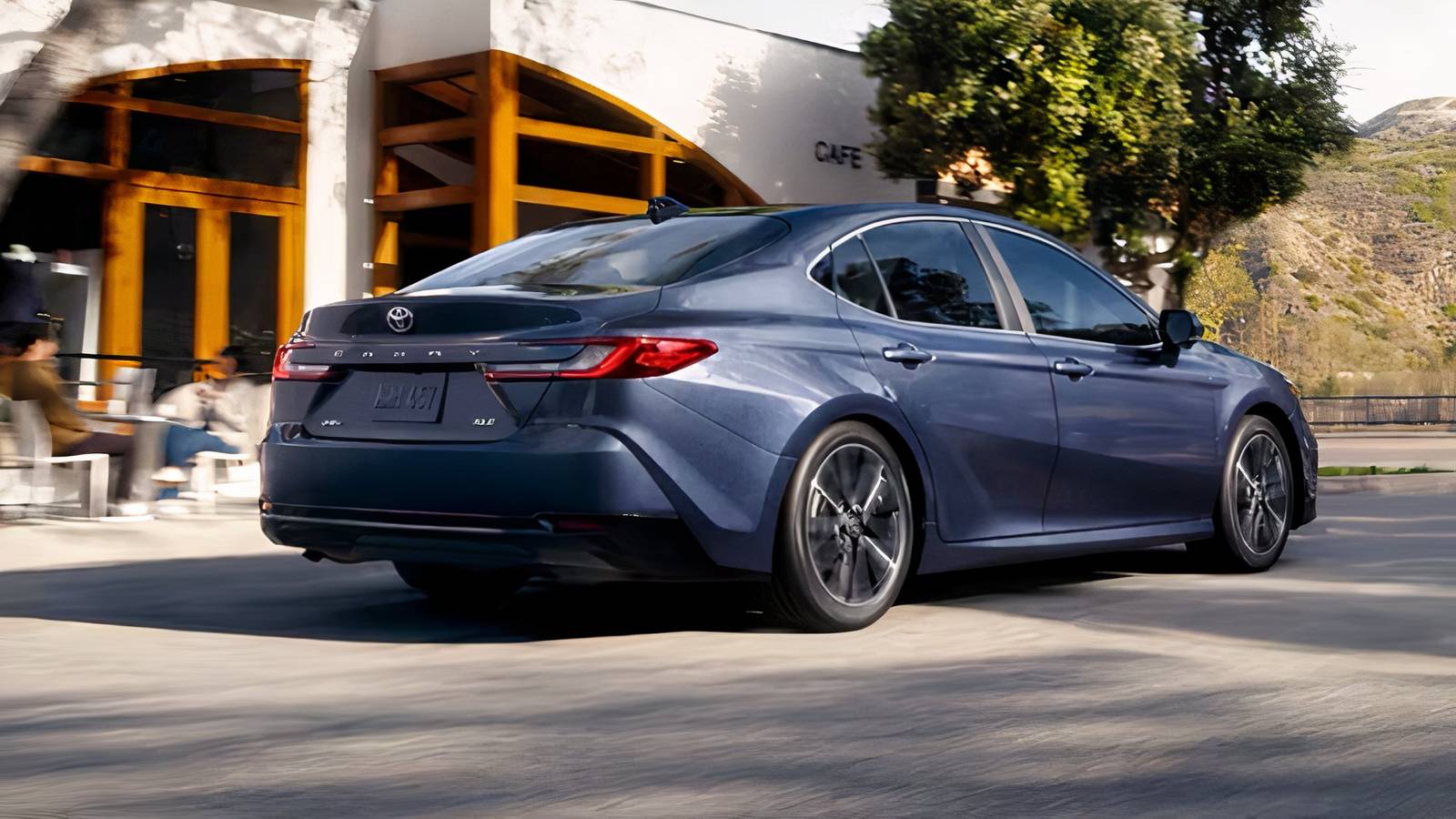
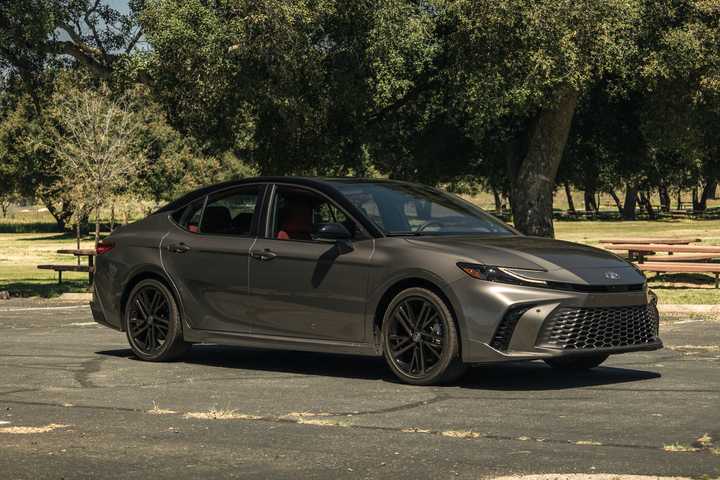
The most expensive Camry options are the XLE and XSE, priced at $35,525 and $36,725, respectively. For reference, the base Lexus ES Hybrid equivalent costs $44,835. On the exterior front, the XLE comes standard with heated electrically adjustable door mirrors, LED exterior lighting, blacked-out exterior trimmings, and a dark metallic gray horizontal bar front grille. The standard wheel of choice is the 18-inch two-tone multi-spoke alloy set. The XSE falls in line with the same design, but with a more athletic approach. This includes dual chrome exhausts, racing-inspired gloss-black air curtains, and color-keyed front side canards, a color-keyed sport mesh front grille and rear lower diffuser, and 19-inch smoked gray and black-finished alloy wheels.

The interior is where these two trims start to feel a bit more special. Here you’ll find white ambient interior lighting, an auto-dimming rearview mirror with HomeLink, a wireless smartphone charger, and a collection of five USB ports located across the front and rear for charging and data transfers. Additional comfort features include dual-zone climate control, leather- and microfiber-trimmed seats, front electrically adjustable seats with heating, and Toyota’s 12.3-inch digital instrument cluster. At the center of the dash, you get a 12.3-inch touchscreen infotainment system, including wireless Android Auto and Apple CarPlay. Appearance-wise, the XSE takes the same cabin and adds a layer of sportiness.
If you want a truly more luxurious setting, you can specify the $3,810 Premium Package, which includes the following features:
- Panoramic glass roof with front power tilt and slide sunroof
- Nine-speaker JBL Premium Audio system
- Ventilated front seats
- 10-inch Head-Up Display
- Digital Key capability
- Rain-sensing windshield wipers
- Driver’s seat and outer-mirror memory
Equally Appealing Ownership Costs

The Camry’s impressively low maintenance and long-term running costs are a major reason why so many American consumers continue to back it as their daily driver. According to Edmunds‘ True Cost To Own calculator, you can expect a new front-wheel-drive 2025 Toyota Camry XLE to cost you $45,724 over the course of five years and 60,000 miles. This includes $14,343 worth of depreciation. You’ll also find yourself spending $3,802 on maintenance, and just $773 on repairs. Fuel is also only likely to cost you around $7,858.

According to CarEdge, you can expect to spend $36,433 on your Camry over the same period, which includes $14,274 on depreciation, $4,530 on fuel, and $1,512 on maintenance.
iSeeCars issues the Camry range with an 8.2/10 overall score, including 8.1/10 for reliability, 8.6/10 for retained value, and 8.0/10 for safety. The publication indicates that the model will run for 13.1 years or 171,785 miles without encountering any noteworthy mechanical issues, together with a 31.7 percent probability of hitting 200,000 miles.

The Real Cost Of Owning A Toyota Camry Hybrid Over Five Years
The Toyota Camry Hybrid benefits from impressively low running costs, and here’s how it fares in the long run.
Modest Performance Outputs

The current-generation Camry range carries over the previous-generation model’s trusty naturally aspirated 2.5-liter four-cylinder Atkinson-cycle engine, which produces 184 horsepower and 163 pound-feet of torque in isolation.
The front-wheel-drive model features a pair of electric motors that generate a combined 134 horsepower and 153 pound-feet. Toyota doesn’t give us a combined torque figure, but it confirms that it limits peak power to 225 horsepower. The all-wheel drive model adds a third electric motor to the rear axle, producing 40 horsepower, 62 pound-feet, which increases the peak output to 232 horsepower.
Toyota doesn’t declare any of this car’s performance specifications, so we can’t tell you how fast it is, but Edmunds reveals that the front-wheel drive model sprints from 0 to 60 MPH in around 7.8 seconds, making it slightly faster than its rivals, while MotorTrend confirms a 6.8-second 0 to 60 MPH sprint result for the all-wheel drive model.
Outstanding Fuel Consumption Returns

The main reason why you’d even be considering a new Toyota Camry Based on the EPA’s testing of the model, the new-generation midsize sedan excels at optimizing both range and fuel consumption. The front-wheel-drive XLE and XSE is the most preferable of the lot, boasting a 46 MPG combined fuel consumption estimate is to save fuel. and a 498-mile range claim. The all-wheel drive XSE sits at the opposite end of the spectrum, with its 43 MPG combined fuel consumption estimate and 559-mile range figure.

The Hybrid Sedan That’s Perfect For First-Time Buyers
If you’re buying a hybrid for the first time, or for that matter, even a car for the first time, this option is the one you should strongly consider.
A True Pro At Holding Its Value And Satisfying Owners

In terms of depreciation, iSeeCars indicates that the model will lose $10,829 or 37.7 percent of its sale value after five years or 60,000 miles, which is a bit less than the average competitor in the midsize hybrid sedan segment.
J.D. Power issues the 2026 Toyota Camry model year with an 82/100 consumer-verified overall score, including 80/100 for quality and reliability, 82/100 for the driving experience, 92/100 for resale, and 76/100 for the dealership experience.
This generation of the Toyota Camry currently holds a 4.2/5 owner review score on Edmunds, with key strengths being its reliability and manufacturing quality, driving experience, and fuel efficiency. It does lose some respect for offering uncomfortable seating and a poor standard sound system.

These Are The First 10 Production Cars In History With Factory Turbochargers
We may love a good turbo today, but they had to start somewhere – here are the first 10 production cars to boast a turbocharged engine under the hood.
How The Lexus ES Compares To The Camry

The Lexus ES 300h is one of the best HEV cars you can buy for less than what you would spend on the average new car in 2025. The premium American-based Japanese brand kicks pricing off at $43,835 for the entry-level trim. Despite being a base model, it comes equipped with all the comfort and convenience features you’ll need, including dual-zone climate control, electrically adjustable front seats with heating, and perforated NuLuxe interior upholstery. You also get the eight-inch touchscreen infotainment system connected to the brand’s in-house-developed 10-speaker premium audio system. It also features wireless Android Auto and Apple CarPlay.
The $50,005 Luxury gets the added benefit of additional adjustments for the driver’s seat, quilted and perforated semi-aniline leather upholstery, front seat heating and ventilation, wood trimmings, ambient lighting, an electronically adjustable rear sunshade, a wireless smartphone charger, and a heated multifunction steering wheel with wood and leather trimmings.

The Ultra Luxury is the most expensive model in the range, with a $53,725 starting price, but this includes every available feature as standard, such as rear door sun shades, a 10.2-inch heads-up display, and the larger 12.3-inch touchscreen infotainment system.
The F-Sport Design costs $49,220 and mimics the Luxury trim, apart from a couple of bespoke visual exterior and interior cues. For $51,130, you can upgrade this to the F Sport Handling package, which adds performance dampers, adaptive variable suspension with bespoke F Sport tuning, and additional driving modes. Lexus’s $2,790 Premium package is available for the base and luxury trims, and adds the following options:
- Heated and ventilated front seats with Lexus Memory System
- Rain-sensing windshield wipers
- Heated leather-trimmed steering wheel
- Fast-response interior heater
- Power-folding outside mirrors
- Wood trim
There’s also the $1,630 technology package, which includes a larger infotainment system and head-up display. Destination costs $1,295.
The Lexus ES Hybrid’s Identical Drivetrain Configuration

The Lexus ES 300h features an identical powertrain to the Toyota Camry, which is why we are using this as a means of comparison, as opposed to the ICE 250 and 350 models. Its drivetrain consists of a naturally aspirated 2.5-liter four-cylinder Atkinson-cycle engine connected to a pair of permanent-magnet synchronous motors. Unlike the Camry, you can only have the ES 300h with the front-wheel-drive system, producing a combined 215 horsepower. In true Toyota fashion, there’s no idea of how much torque the system produces.

While you sacrifice power when driving a Lexus ES 300h, you do get to benefit from some of the most impressive fuel consumption returns that you can enjoy from the segment. According to the EPA’s estimates, you can expect this model to return a 43/44/44 MPG consumption on the city/highway/combined cycle and cover 581 miles on a single 13.2-gallon tank of gas, with some help from a 1.6-kWh lithium-ion battery pack. Based on these same estimates, you can also expect to save $3,250 in fuel costs over the course of five years. A year’s worth of gas will cost you $1,050, while you’ll find yourself spending $1.79 to drive 25 miles. You’ll also be spending about $42 to fill up the tank.
Sources: Edmunds, iSeeCars, J.D. Power, MotorTrend, and the EPA