
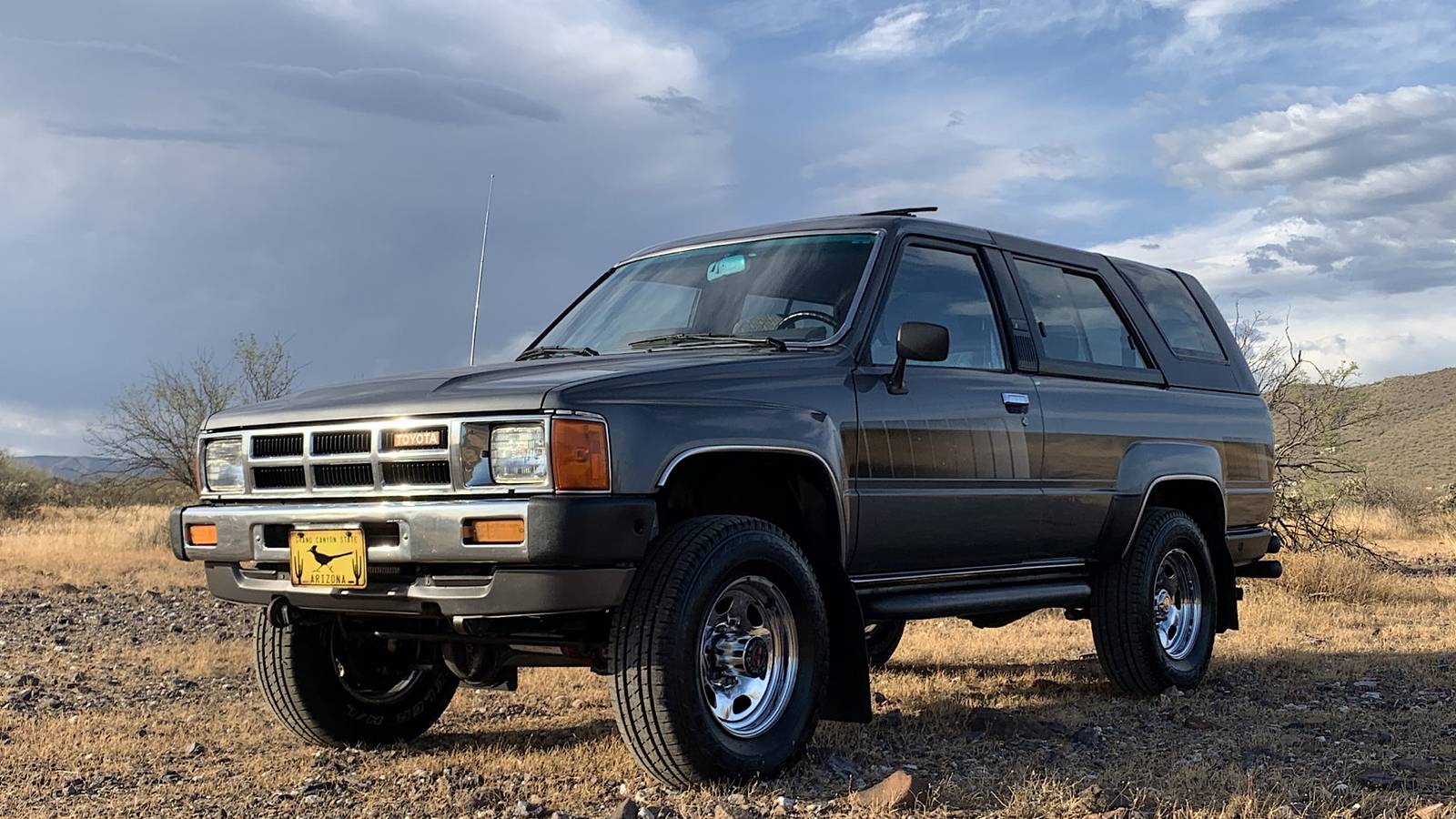
Launched onto the market in 1984 with a beautifully simple design that incorporates hardy off-road prowess, solid Toyota-esque dependability, a rock-solid body build, and just enough interior detail to peak the interests of everyone from those of us who need an SUV for hard work to those of us who like a comfortable commute, the Toyota 4Runner has gone from strength to strength over the last four decades and six generations.
2025 marks the start of the sixth generation of the 4Runner, and though it has moved with the times, there is one thing that remains characteristically endearing about this iconic SUV: its ability to revel in simplicity. We have taken a deeper look into this and how the Toyota 4Runner has endured through an ever-changing SUV market while staying true to its tough roots, how its design has been adapted to fit with the modern SUV market, how its simplistic design has become one of its keys to success, and why it remains such a popular model in the U.S.A.

2025 Toyota 4Runner: The Comeback Of The Classic Gas-Powered SUV
The all-new SUV is modern and relevant but still emphatically a Toyota 4Runner.
The Toyota 4Runner: A Timeless Adventure Icon

Toyota is one of the most legendary users of the Kaizen Method (continuous improvement), and thanks to the tried, tested, improved, tried, tested, and ten-fold improved components that feature in a lot of models and generations of the 4Runner, durability rules.
Built to Last: The Legacy Of The 4Runner’s Durability
The 4Runner outsells some of Toyota’s most popular and hardy models for many reasons, but one of the most resonating reasons for so many loyal owners is because of its rugged design, with multiple generations boasting high dependability scores.
|
Model |
1999 Toyota 4Runner |
2002 Toyota 4Runner |
2017 Toyota 4Runner |
2019 Toyota 4Runner |
2020 Toyota 4Runner |
|
Reliability Rating |
4.9/5 |
4.9/5 |
4.9/5 |
4.8/5 |
4.8/5 |
|
Total Recalls |
2 |
2 |
2 |
2 |
The third-generation 4Runner is a severely undervalued and reliable SUV, one of the most reliable generations in fact, but thanks to the 4Runner’s simple yet incredibly hardy build over the last 40 or so years, it has endured everything we can throw at it, even the “less-reliable” model years, and has become a beloved adventure companion, family ferry, hauler, and general tough-as-nails go-to SUV for a huge amount of us.
Staying True To Its Roots In An Over-Engineered World

Originally taking almost all of its inspiration from the equally bulletproof Toyota model, the Hilux, which is always a good place to start for reliability, the 4Runner was originally built on the same body-on-frame chassis but with an added removable fiberglass roof and some extra creature comforts.
In ’96, the 4Runner received its own version of the body-on-frame chassis for improved comfort on the road, moving it away from its trucking roots, but in recent generations, it has returned to its beefier origins, while the 2025 4Runner boasts a new platform, the TNGA-F body-on-frame chassis that is shared with the Tacoma. Why? Because it keeps working as a solid base for a rugged SUV that can churn up the trails while still offering us some comfort and usability.
Slowly but surely, the 4Runner has become more comfortable over the generations, with the addition of a double-wishbone front suspension in the third generation, coil springs later on, and more luxury features in subsequent generations, but what remains is its off-roading and working prowess – just as it was intended when it was released, a no-nonsense SUV with a lot to offer.

10 Worthy Alternatives To The Toyota 4Runner
From rugged off-roaders to luxurious family haulers, these SUVs give the 4Runner a run for its money.
Why “Less Is More” Defines the 4Runner’s Appeal

In an SUV market with tons of intuitive techy features, electrical aids, and things that could possibly go wrong, “no-frills SUVs” could make for a good buy, especially if you are looking to just take your SUV off-road and lug things around. Again, this is where the 4Runner takes center stage. Though it has moved with the times with certain aspects of its design and build, in other ways it has kept things nice and simple.
The Power Of Mechanical Simplicity
According to the 2024 Initial Quality Report, emerging technology was the biggest bugbear for car owners, with integrated systems, warnings, and technology failing the most and presenting the biggest challenge for auto brands in keeping up vehicle quality.
Though the 4Runner started life with an inline-four powertrain, in 1988, the first V-6 engine was offered. Each subsequent generation boasts a choice between an inline-four and the most popular engine choice, the 4.0-liter V-6. Known for its durability (with some owners putting way over 300,000 miles on the clock with simple maintenance), it has mostly avoided the added complexity of a turbocharger, except for a couple of years in the late ”80s with the 22R-TE before being dropped for simplicity again.

The new 4Runner boasts a turbocharged inline-four i-Force Max, but thanks to the evolution of the turbo and gains in turbocharged reliability, we should see the combination of better fuel economy and decent power.
Another key feature that has kept a majority of 4Runner V-6s running for so long with minimal interference is the fact that all V-6s equipped in models from 2003 to 2020 are chain-driven instead of belt-driven. This means that longer can be left before having to change it, a more durable build for higher power, and more resistance to hot temperatures – ideal for towing or low-speed crawling over rough ground.
Loyal Following Built On Trust

One of the best ways of telling how reliable a vehicle has been over the generations is by how the drivers of it respond to it. There have been 310 reviews of the Toyota 4Runner on Car Survey.org, with model years ranging from 1986 to 2019. Out of the 310 reviews, 74% of owners (229 owners) said they’d buy another Toyota model based on the 4Runner. Across most of the board, the 4Runner scores highly, and most importantly, highly for reliability.
- Toyota 4Runner Average Reliability Score. 8.3 out of 10.
- Toyota 4Runner Average Performance Score. 7.4 out of 10.
- Toyota 4Runner Average Comfort Score. 7.6 out of 10.
- Toyota 4Runner Average Running Cost Score. 6.6 out of 10.
There are loyal fans of the 4Runner all over the world, and on platforms such as IH8MUD and 4Runners.com, owners of all generations come together to share stories, pictures, and videos to show how hard they can push this loyalty-inducing beast by showing off how they got a scratch here, bump there, and most endearingly, how much they have come to respect this boxy, rugged, and simple SUV.

Overall, a great combination of dependability, performance, economy, and general usability. Nimble enough to easily drive through big cities, rugged enough to take off-road, seating for 5 + cargo makes it a great road tripper (it’s even quiet on the highway); top-notch creature comforts at the price point (sunroof, heated seats, leather); the rear window sliding into the back hatch is brilliant for lake trips or tailgating. Plus, mid-20s MPG and oh the towing. 5000 lbs towing makes it great for boats, motorcycles, small campers, moving or pulling your brother-in-law’s truck out of the mud and back to his house.
– Owner review of their 2001 Toyota 4Runner on Car Survey.org
Each of the six generations of the 4Runner has garnered a loyalist following. There are arguments about what generation is the best. Though a lot of people say it is the third generation thanks to its added comfort compared to the second generation and high dependability, but ultimately, they are all fans of the 4Runner, giving it one of the most cult-like followings out of any vehicle ever made – some would say rivaling that of the Jeep Wrangler following and its fans quirky ways of showing their love for it.

Old-School DNA: Why The 2025 Toyota 4Runner’s Solid Axle Is Its Best-Kept Secret
The 2025 4Runner may boast all the modern bells and whistles you’d need, but it also holds on to its old-school solid axles – it is the best of both.
Off-Road Ready: The 4Runner’s Simple Design Dominates Trails

The 4Runner has become an off-road icon by focusing on simplicity rather than unnecessary luxury appointments or overly complex systems. Current models still boast a solid rear axle and the ever-sturdy body-on-frame construction, both of which are ideal for durability and stability over rough ground. Essential off-road features like Crawl Control and factory-installed skid plates protect the underside, allowing you to crawl over rocks without the fear of dinging up something important, while its overall straightforward design makes it shine on challenging paths, from Moab’s Hell’s Revenge to remote mountain trails.
Proven Off-Road Systems Without The Complexity
Some of the equipped off-road systems are built for ease of use and dependability, giving it an edge over overly complicated and fancy SUVs that rely on lots of extra electronic actuators. Its part-time 4WD system is operated by a manual lever on models up to the mid-cycle refresh of the fifth generation, while the locking rear differential, standard on the TRD Off-Road and TRD Pro models, maximizes traction in mud, snow, or on uneven rock trails. Crawl Control helps you to handle steep inclines, while Multi-Terrain Select optimizes traction with a dial, avoiding a touchscreen that can be more prone to failure.
Additionally, unlike SUVs that are equipped with more “fragile” air suspension, the 4Runner’s TRD Pro features robust Fox shocks and coil springs for durability in harsh conditions, skid plates protect vital components like the transfer case and fuel tank, and all the while, the simple, naturally aspirated V-6 (available up until this year’s new addition to the lineup) is reliable in remote areas.
Why Simplicity Wins In The Wild

The last thing you want is to be in the middle of nowhere, and your truck fails you because of a complex gadget that has got wet or full of mud, but thanks to most aspects of the 4Runner, even the newer ones, featuring simple systems, there is less to go wrong.
One of the coolest features of the new 4Runner is a stellar example of simplicity done right. It boasts an available Stabilizer with a Disconnecting Mechanism (SDM) that doesn’t rely on fluid to operate, meaning that you can take it into freezing temperatures without worrying that it is going to go AWOL on you when you need it most.
Additionally, the 4Runner comes equipped as standard with roof rails, making it easy to carry tents and kayaks without having to buy extras from Toyota, while the interior boasts a simple design layout with durable materials like weather-resistant SofTex upholstery.

Running Deep: The 4Runner, The Ranger, And Going River-To-Rim
How great gear, including a legendary Toyota off-roader, can convince you to plan the next adventure.
Simplicity Meets Modern Expectations: Striking a Balance

Toyota follows five key principles when they design, create, and produce their vehicles:
- Always be faithful to your duties, thereby contributing to the company and to the overall good.
- Always be studious and creative, striving to stay ahead of the times.
- Always strive to build a homelike atmosphere at work that is warm and friendly.
- Always have respect for spiritual matters, and remember to be grateful at all times.
- Always be practical and avoid frivolousness.
This is exactly what Toyota has done with the latest Toyota 4Runner; they have not made it frivolous, and they have kept it practical.
There are two hybrid engine options available; it can still tow a reasonable amount (the most a 4Runner has ever been able to tow), it is still made for the off-road life, it boasts a bunch of retro throwbacks that conjure up a load of nostalgic feelings for the older generations, and it is still simple to use.
|
Engine |
2.4-Liter i-FORCE Turbocharged Inline-Four |
2.4-Liter i-FORCE MAX Turbocharged Inline-Four Hybrid |
|
Transmission |
Eight-Speed Automatic |
Eight-Speed Automatic |
|
Horsepower |
278 Horsepower |
326 Horsepower |
|
Torque |
317 LB-FT |
465 LB-FT |
|
Driveline |
Rear-Wheel Drive or Four-Wheel Drive |
Rear-Wheel Drive or Four-Wheel Drive |
|
0-60 MPH |
6–7 Seconds (Estimated) |
6–7 Seconds (Estimated) |
|
Towing Capacity |
6,000 LBS |
5,800 LBS |
|
Payload Capacity |
Timeless Features That Stand The Test of Time

The 4Runner’s rugged legacy continues to this day with the sixth-gen models while moving with the modern market and providing us with a lot of SUV chops and better fuel economy (an estimated 22 to 23 combined MPG). The Trailhunter edition, as part of the TRD trim, stands out with 33-inch Toyo Open Country all-terrain tires, rock rails, and high-strength skid plates, while all trims come equipped with a 14-inch touchscreen, and most nostalgic-inducing, it retains its signature roll-down rear window (which can be opened from the outside with a button), providing easy cargo access and ventilation options.
By blending what we all love about the 4Runner with modern tech (but not too much) and retaining its rock-solid, hard-hitting-looking appearance, it is poised to continue to be the simple SUV that has stood the test of time.